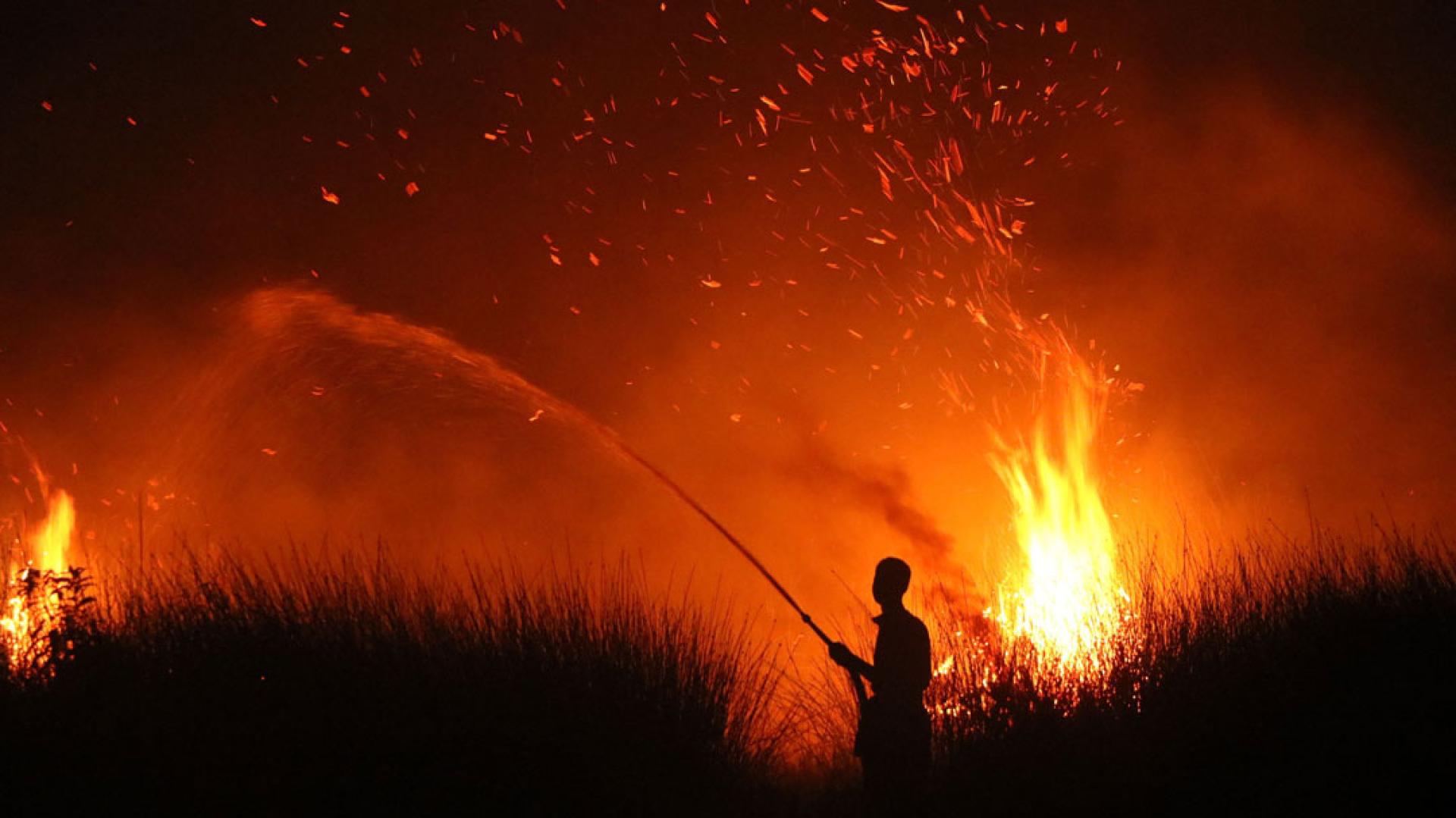
Recently, forest and land fires have broken out on Indonesia's Sumatra, Kalimantan, and Java islands. According to official Indonesian statistics, as of the 11th, the burned area of the famous tourist attraction Mount Bromo has reached 899.35 hectares.
Due to the impact of the fire, Bromo Tengger Semeru National Park announced that all entrances and exits to Mount Bromo would be temporarily closed from the 8th, suspending tourist visits, with reopening dates to be announced separately. The wildfire, which started on August 3rd, still has multiple active hotspots.
A joint task force composed of local government departments, military, and police is working to control the fire through ground firefighting and aerial water bombing. However, affected by thick fog, pilot visibility has decreased, and the number of helicopters used for aerial water bombing has been reduced from three to two.
In addition, dry vegetation, wind, and the dry season weather have also increased the difficulty of firefighting.
The Mount Bromo wildfire is part of the recent spate of forest and land fires in many regions of Indonesia. Data from Indonesia's National Disaster Mitigation Agency show that as of the 10th, nearly 48,900 hectares of land had been burned in six key fire-prone provinces nationwide, with the largest burned area in West Kalimantan Province. Data from Indonesia's forestry department indicate that more than 107,000 hectares of land nationwide were affected by fires from January to June this year, about double the amount of the same period in 2023.
Affected by smoke haze from the wildfires, the capital of West Kalimantan, Pontianak, recently moved student classes online.
The Indonesian meteorological department has stated that this year's dry season may be unusually long and intense, and the El Niño phenomenon further increases the risk of drought and wildfires. The Indonesian government has deployed helicopters, fixed-wing aircraft, and other aviation assets for firefighting, but as there are currently no suitable rain clouds, artificial rainfall is not yet possible.
Smoke haze from Indonesian forest fires has crossed the border into Sarawak, East Malaysia, worsening air quality on Tuesday. According to Malaysia's Department of Environment, as of 4 PM that day, 11 regions in East Malaysia, all in Sarawak, reported air pollution index levels in the unhealthy range.
Of these, Sri Aman recorded an air quality index of 190, Samarahan 169, Kuching 166, Bintulu 159, with Sibu, Mukah, Sarikei, and others all above 154, and the lowest at 119.