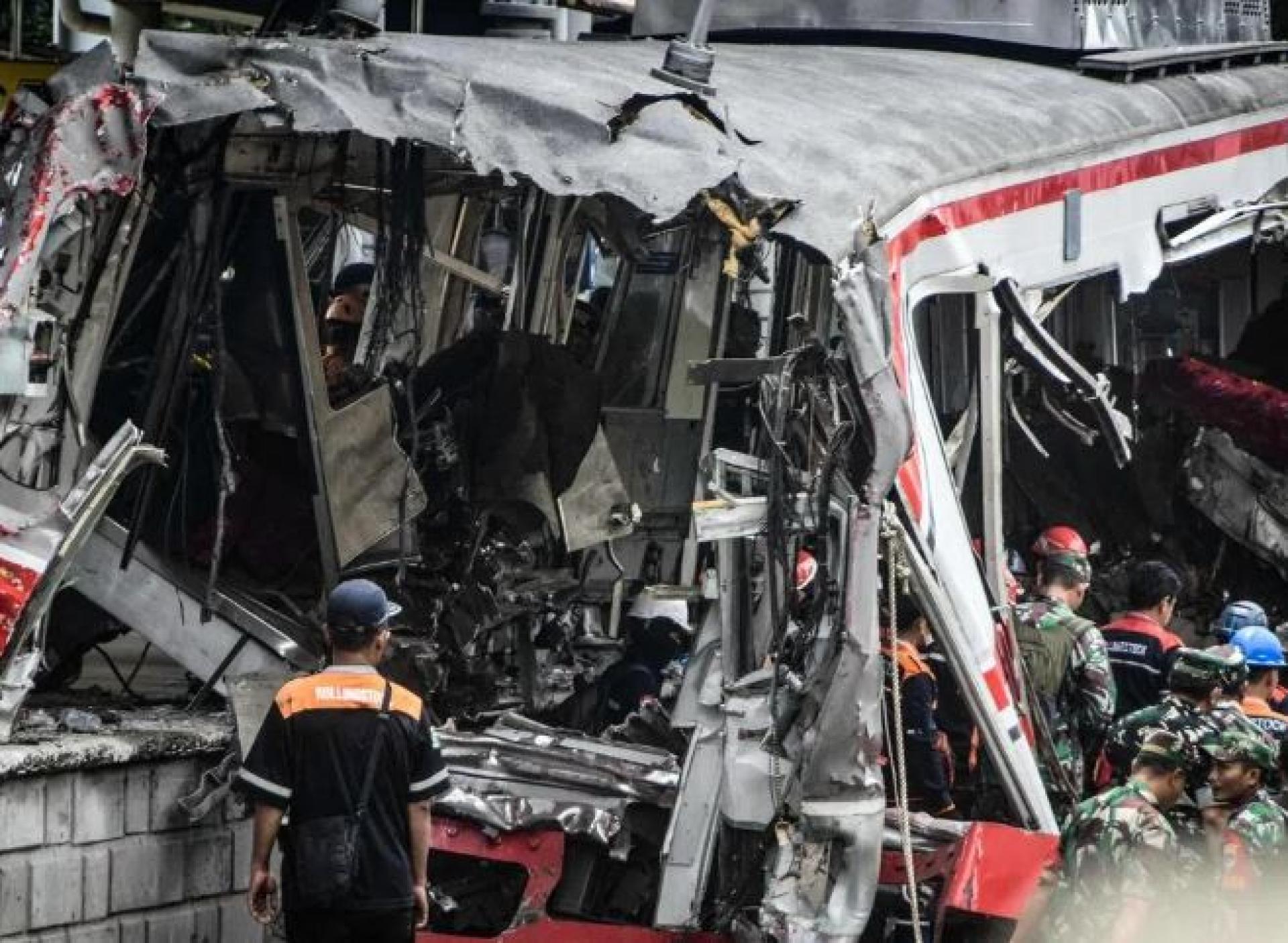
On April 27, a train collision occurred near East Bekasi Station in the Jakarta suburb, resulting in 16 deaths and at least 90 injuries. Although a complete account of the incident is still pending investigation by authorities, the event has already triggered widespread domestic questioning of the railway safety system and calls for the government to comprehensively review related mechanisms.
According to the initial clarification by Indonesian officials, a taxi collided with a commuter train at a level crossing. Afterward, controllers instructed another commuter train to stop at the platform, but it was subsequently rear-ended by a long-distance train from behind, causing a chain accident with severe casualties.
The investigation has identified two major safety hazards. First, the involved level crossing had no barrier and was unattended, increasing the risk of vehicles crossing the tracks; the taxi involved was stranded on the tracks due to a breakdown, triggering the chain incident.
Second, the railway signaling system should have issued a warning when another train was ahead, but the long-distance train still rear-ended, indicating potential system malfunction or driver reaction failure.
Safety experts pointed out that long-distance and commuter trains sharing tracks increases the impact of sudden accidents. They recommend gradually segregating tracks, eliminating risky level crossings, modernizing the signaling system, establishing a national real-time dispatch center, and carrying out independent safety audits.
Of note, the carriage struck in the accident was a women-only car, and all the casualties were female, drawing significant social attention. Indonesia’s Minister of Women’s Empowerment and Child Protection later suggested adjusting the placement of women-only carriages, though this proposal has drawn online criticism for not addressing the core problem.
Indonesian President Prabowo visited injured victims in the hospital after the accident and announced a comprehensive review of railway level crossing safety, approval of an elevated bridge construction plan, and allocation of nearly 4 trillion rupiah (about 296 million Singapore dollars) to improve railway infrastructure and public transportation safety.
However, public opinion questions these reforms as mostly “post-incident remedies” that fail to prevent future accidents.
Statistics show that from 2020 to 2025, Indonesia has investigated 27 train accidents, with 10 already occurring in 2025, a marked increase over 2024. Several train and vehicle collisions have also occurred this year, presenting a grave safety situation.
Currently, Indonesia has 4,046 level crossings nationwide, of which 1,903 are unattended, representing major safety risks. Transportation experts note that while widespread construction of overpasses can improve the problem, it is costly; more crucial is strengthening traffic discipline and safety awareness.
Analysts believe the Bekasi accident again highlights systemic gaps in Indonesia’s railway safety management, infrastructure, and risk response, and underscores the urgent need to establish a long-term safety culture.
The investigation has identified two major safety hazards. First, the involved level crossing had no barrier and was unattended, increasing the risk of vehicles crossing the tracks; the taxi involved was stranded on the tracks due to a breakdown, triggering the chain incident.
Second, the railway signaling system should have issued a warning when another train was ahead, but the long-distance train still rear-ended, indicating potential system malfunction or driver reaction failure.
Safety experts pointed out that long-distance and commuter trains sharing tracks increases the impact of sudden accidents. They recommend gradually segregating tracks, eliminating risky level crossings, modernizing the signaling system, establishing a national real-time dispatch center, and carrying out independent safety audits.
Of note, the carriage struck in the accident was a women-only car, and all the casualties were female, drawing significant social attention. Indonesia’s Minister of Women’s Empowerment and Child Protection later suggested adjusting the placement of women-only carriages, though this proposal has drawn online criticism for not addressing the core problem.
Indonesian President Prabowo visited injured victims in the hospital after the accident and announced a comprehensive review of railway level crossing safety, approval of an elevated bridge construction plan, and allocation of nearly 4 trillion rupiah (about 296 million Singapore dollars) to improve railway infrastructure and public transportation safety.
However, public opinion questions these reforms as mostly “post-incident remedies” that fail to prevent future accidents.
Statistics show that from 2020 to 2025, Indonesia has investigated 27 train accidents, with 10 already occurring in 2025, a marked increase over 2024. Several train and vehicle collisions have also occurred this year, presenting a grave safety situation.
Currently, Indonesia has 4,046 level crossings nationwide, of which 1,903 are unattended, representing major safety risks. Transportation experts note that while widespread construction of overpasses can improve the problem, it is costly; more crucial is strengthening traffic discipline and safety awareness.
Analysts believe the Bekasi accident again highlights systemic gaps in Indonesia’s railway safety management, infrastructure, and risk response, and underscores the urgent need to establish a long-term safety culture.