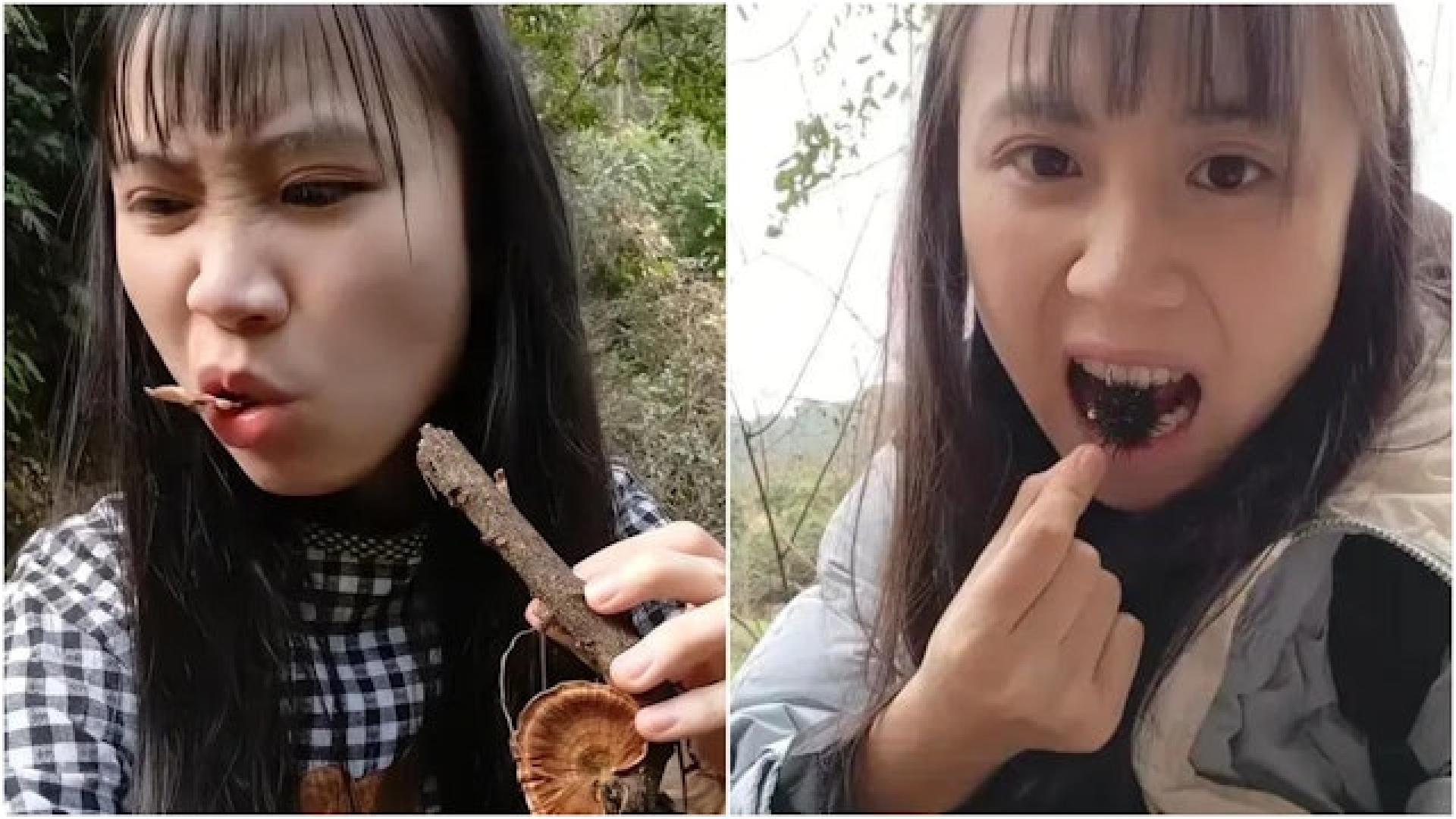
Recently, a Douyin creator “Xiao Hua Zi” quickly went viral with her “Traditional Chinese Medicine Student Foraging in the Mountains” short video series. Her account has accumulated over 1.1 million likes and more than 120,000 followers, with one video—where she tastes wild herbal plants—gaining a whopping 629,000 likes. On March 3rd, this young content creator shared her story with Chinese media.
According to “Jimu News”, “Xiao Hua Zi”—whose surname is Wu—is a fourth-year student majoring in Traditional Chinese Medicine, and comes from Tongdao Dong Autonomous County in Huaihua, Hunan. From a young age, she followed her grandfather into the mountains to gather herbs and is extremely familiar with the local terrain. When she returned home last December after her internship, she came across some foraging videos online and decided to give it a try herself. She explained that having spent her childhood in the mountains with her grandfather, she feels at home there. As for why she films her videos, she has two main motivations: first, to hopefully ease some financial pressure on her family using internet traffic, and second, to show the authentic appearance of medicinal herbs through her lens so that more people can understand the essence of traditional Chinese medicine culture.
Wu shared that each trip into the mountains to look for herbs takes about half a day—she usually sets off at noon and returns home around five or six in the evening. Since last December, she’s discovered over 20 to 30 types of medicinal herbs in the wild near her home; some herbs that didn't look good on camera haven’t made it into her videos. Most of the herbs in her videos are wild and local, requiring patient searching and careful identification.
In response to netizens' concerns about potential poisoning, she emphasized that she is a student of Traditional Chinese Medicine and relies mainly on textbooks and professional knowledge for plant identification—for example, checking characteristics of Codonopsis (“lion’s head,” “Jinjing Yulan,” “chrysanthemum heart,” etc.) as described in documentation. She also draws on folk knowledge passed down from her grandfather and has gradually developed a keen eye. When encountering very similar or hard-to-distinguish species, she takes photos and consults her teachers after coming down the mountain, returning to film only after confirmation. When tasting, she only lightly samples and spits the plant out—never swallowing; she never touches unknown plants, ensuring safety.
Netizens have also expressed concerns about her safety when venturing into the mountains alone. Wu replied that having roamed the local forests since childhood, she never gets lost. If heading to unfamiliar areas, she invites friends or family along, and sometimes takes her dog for company. All her videos are self-shot during her hikes, with no professional team—family occasionally helps.
Regarding criticism accusing her of “staging” or “showing off,” she admitted that at first, negative comments made her uncomfortable, but she’s since learned to take them in stride. She added, “You can’t please everyone—some will like it, some won’t. The most important thing is to be yourself.”
As she’s about to graduate, Wu hopes to work in a medical or healthcare-related field to help more people in the future. However, regardless of her career, she plans to keep posting videos. “I study theory at school, but my grandfather teaches me practical skills—filming is a learning process too.”
She especially reminds the public that her herb tasting is built on a solid professional foundation, allowing her to accurately judge toxicity. She adds: all medicine is toxic to some extent, and many wild herbs contain toxins until properly processed—so people should never imitate her just because of the videos. Never touch unknown plants, and never put them in your mouth.
Wu shared that each trip into the mountains to look for herbs takes about half a day—she usually sets off at noon and returns home around five or six in the evening. Since last December, she’s discovered over 20 to 30 types of medicinal herbs in the wild near her home; some herbs that didn't look good on camera haven’t made it into her videos. Most of the herbs in her videos are wild and local, requiring patient searching and careful identification.
In response to netizens' concerns about potential poisoning, she emphasized that she is a student of Traditional Chinese Medicine and relies mainly on textbooks and professional knowledge for plant identification—for example, checking characteristics of Codonopsis (“lion’s head,” “Jinjing Yulan,” “chrysanthemum heart,” etc.) as described in documentation. She also draws on folk knowledge passed down from her grandfather and has gradually developed a keen eye. When encountering very similar or hard-to-distinguish species, she takes photos and consults her teachers after coming down the mountain, returning to film only after confirmation. When tasting, she only lightly samples and spits the plant out—never swallowing; she never touches unknown plants, ensuring safety.
Netizens have also expressed concerns about her safety when venturing into the mountains alone. Wu replied that having roamed the local forests since childhood, she never gets lost. If heading to unfamiliar areas, she invites friends or family along, and sometimes takes her dog for company. All her videos are self-shot during her hikes, with no professional team—family occasionally helps.
Regarding criticism accusing her of “staging” or “showing off,” she admitted that at first, negative comments made her uncomfortable, but she’s since learned to take them in stride. She added, “You can’t please everyone—some will like it, some won’t. The most important thing is to be yourself.”
As she’s about to graduate, Wu hopes to work in a medical or healthcare-related field to help more people in the future. However, regardless of her career, she plans to keep posting videos. “I study theory at school, but my grandfather teaches me practical skills—filming is a learning process too.”
She especially reminds the public that her herb tasting is built on a solid professional foundation, allowing her to accurately judge toxicity. She adds: all medicine is toxic to some extent, and many wild herbs contain toxins until properly processed—so people should never imitate her just because of the videos. Never touch unknown plants, and never put them in your mouth.