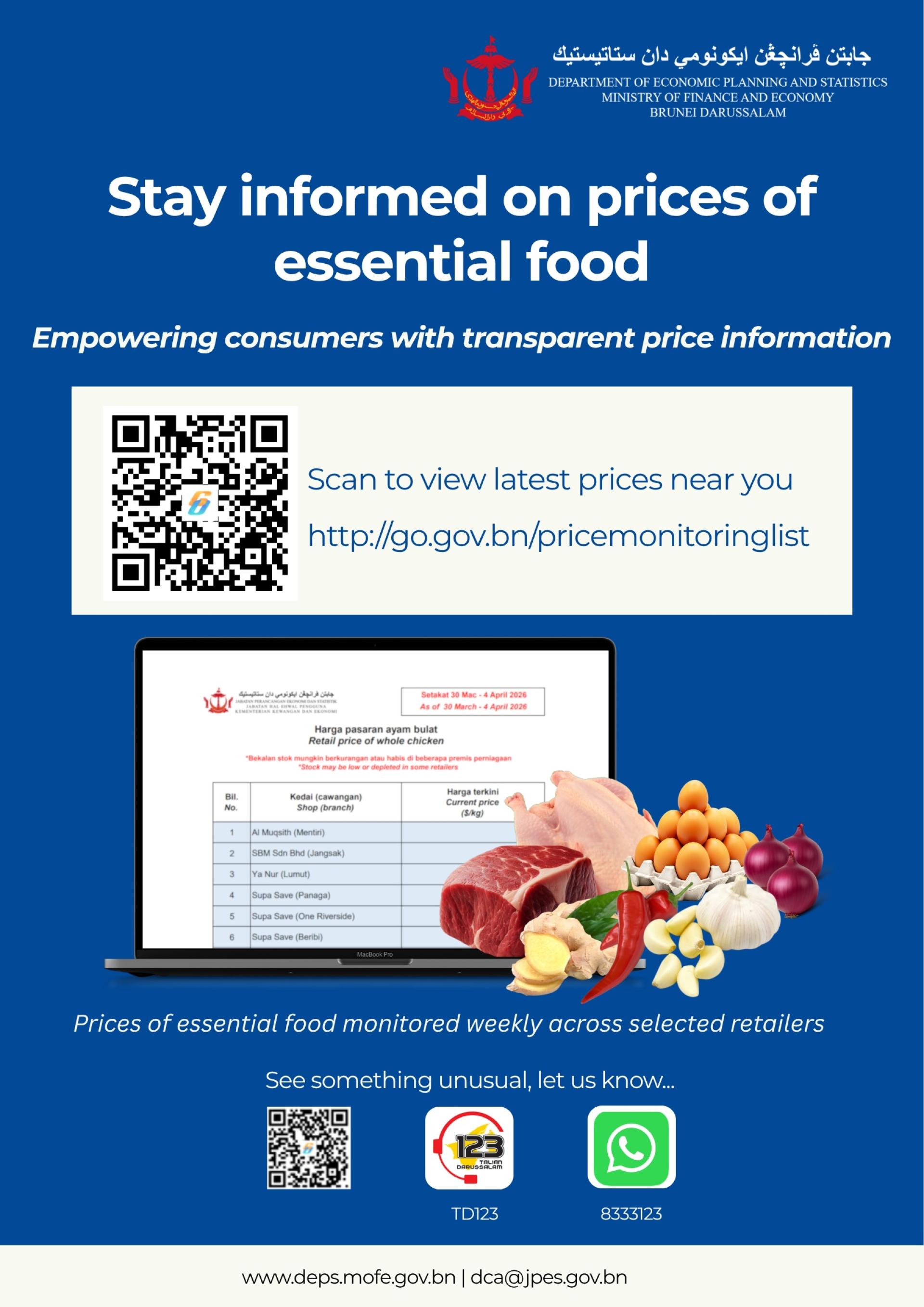
(Bandar Seri Begawan, 8th) The Department of Economic Planning and Statistics (JPES) under the Ministry of Finance and Economy has issued a statement that, in response to global economic uncertainties and increased consumer spending during festive periods, the department continues to strengthen price monitoring initiatives. This is to encourage consumers to make informed purchasing decisions and promote fair and transparent market practices.
Every week, the department monitors the prices of selected food items, aiming to improve price transparency and strengthen consumer confidence in the market. This initiative also aims to promote healthy competition among traders, thereby contributing to the formation of more competitive market prices. The food items being monitored include whole chicken, grade B eggs, red shallots, garlic, ginger, chili, and meat.
The retail price list for selected food items is available on the JPES official website at https://go.gov.bn/pricemonitoringlist.
At the same time, the department’s price monitoring of certain supermarkets and retail outlets nationwide enables a comprehensive reflection of price trends.
Overall, the price trend for selected food at the beginning of 2026 has been stable, with minimal fluctuations. However, between late February and March, there was a shortage of chicken supplies and a slight increase in the price of chilies, which is in line with changes in costs and supply from exporting countries as well as pressures in global supply chains.
According to industry feedback, there are now signs of rising logistics costs, but the impact on domestic prices has not been immediately evident.
If this trend continues, it may affect a variety of agricultural inputs, such as fertilizers that are closely linked to the producing country’s production costs. To reduce reliance on imported inputs, the industry is also exploring the use of local alternatives, including compost, to strengthen the resilience of the agricultural sector.
However, compared to other countries that are more susceptible to increases in energy costs, Brunei is expected to be less affected. Even so, ongoing monitoring and preparedness are needed, including exploring alternative sources to ensure the stability of national food supply.
The authorities urge businesses to continue to operate responsibly and ethically. In the face of potential cost impacts amid global economic uncertainty, any price adjustments should be reasonable, transparent, and correspond to actual cost changes, and should not be excessive or disproportionate.
Authorities encourage traders and consumers to play a role in creating a transparent, fair, and well-informed market. Given global economic uncertainties, it is important to raise awareness that external factors may impact the domestic market, but this should not be used as a reason for disproportionate or unethical actions.
Authorities also remind merchants to maintain business ethics and ensure that price tags are clear, accurate, and not misleading. At the same time, consumers are encouraged to pay close attention to the latest developments, use the provided price information to make comparisons, and make careful, informed purchase decisions.
For any inquiries, the public may call the hotline at 123 or send an email to aduanpengguna@jpes.gov.bn to contact the Consumer Affairs Division.
Every week, the department monitors the prices of selected food items, aiming to improve price transparency and strengthen consumer confidence in the market. This initiative also aims to promote healthy competition among traders, thereby contributing to the formation of more competitive market prices. The food items being monitored include whole chicken, grade B eggs, red shallots, garlic, ginger, chili, and meat.
The retail price list for selected food items is available on the JPES official website at https://go.gov.bn/pricemonitoringlist.
At the same time, the department’s price monitoring of certain supermarkets and retail outlets nationwide enables a comprehensive reflection of price trends.
Overall, the price trend for selected food at the beginning of 2026 has been stable, with minimal fluctuations. However, between late February and March, there was a shortage of chicken supplies and a slight increase in the price of chilies, which is in line with changes in costs and supply from exporting countries as well as pressures in global supply chains.
According to industry feedback, there are now signs of rising logistics costs, but the impact on domestic prices has not been immediately evident.
If this trend continues, it may affect a variety of agricultural inputs, such as fertilizers that are closely linked to the producing country’s production costs. To reduce reliance on imported inputs, the industry is also exploring the use of local alternatives, including compost, to strengthen the resilience of the agricultural sector.
However, compared to other countries that are more susceptible to increases in energy costs, Brunei is expected to be less affected. Even so, ongoing monitoring and preparedness are needed, including exploring alternative sources to ensure the stability of national food supply.
The authorities urge businesses to continue to operate responsibly and ethically. In the face of potential cost impacts amid global economic uncertainty, any price adjustments should be reasonable, transparent, and correspond to actual cost changes, and should not be excessive or disproportionate.
Authorities encourage traders and consumers to play a role in creating a transparent, fair, and well-informed market. Given global economic uncertainties, it is important to raise awareness that external factors may impact the domestic market, but this should not be used as a reason for disproportionate or unethical actions.
Authorities also remind merchants to maintain business ethics and ensure that price tags are clear, accurate, and not misleading. At the same time, consumers are encouraged to pay close attention to the latest developments, use the provided price information to make comparisons, and make careful, informed purchase decisions.
For any inquiries, the public may call the hotline at 123 or send an email to aduanpengguna@jpes.gov.bn to contact the Consumer Affairs Division.