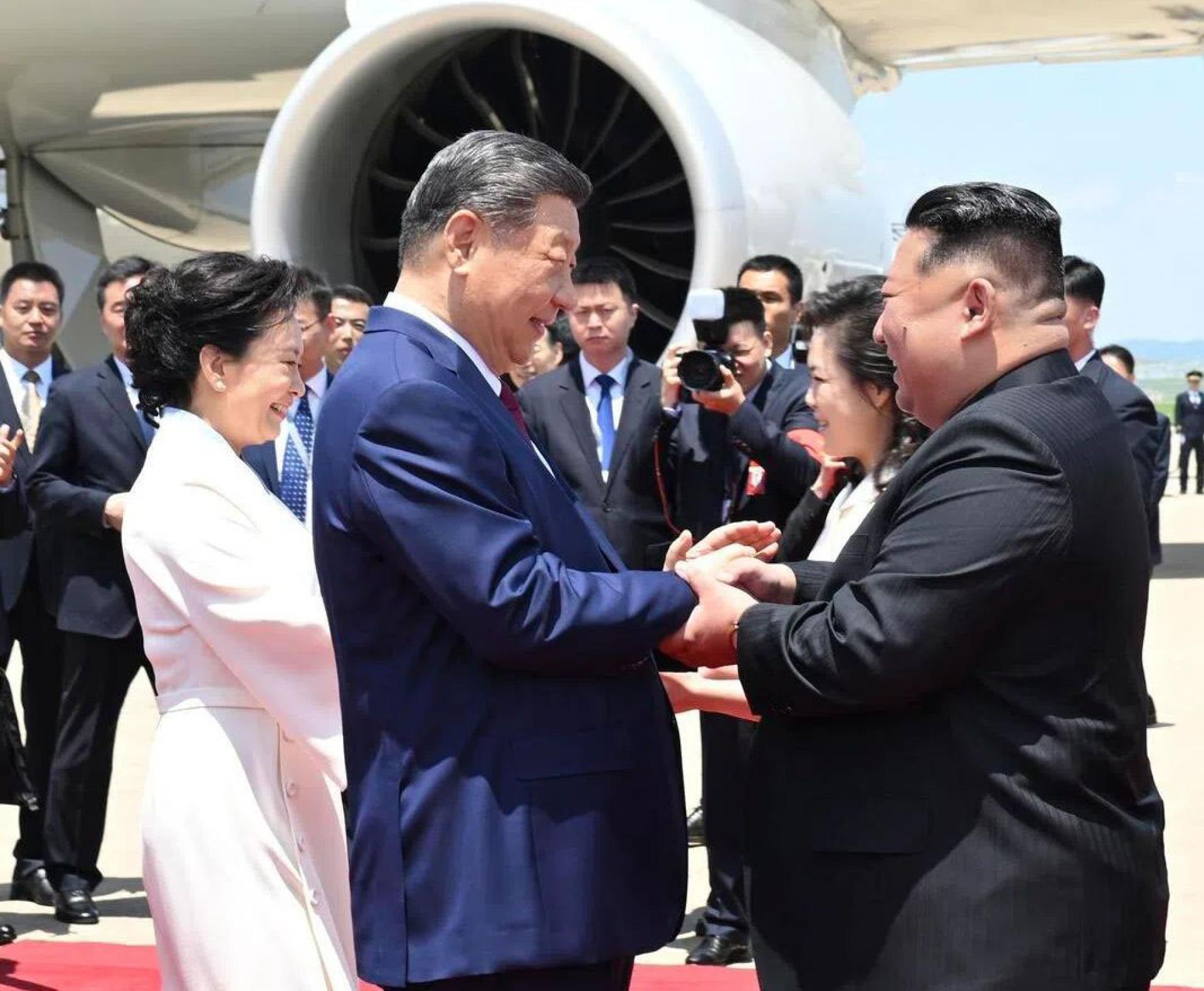
During his visit to North Korea, Chinese President Xi Jinping held talks on Monday with North Korean Supreme Leader Kim Jong Un, focusing on strengthening bilateral cooperation and strategic coordination, with no mention whatsoever of denuclearization of the Korean Peninsula—highlighting that the focus of China-North Korea relations is shifting.
Interviewed scholars analyzed that this change reflects an increased need for Beijing to use North Korea as a strategic foothold amid the deepening of Russia–North Korea relations, more frequent Japan–Taiwan interactions, and intensified China–US strategic competition, while North Korea relies on China’s economic and trade support. As a result, the focus of China–North Korea relations is shifting from the peninsula issue to bilateral strategic coordination and protection of shared interests.
Xi Jinping began his two-day state visit to North Korea on Monday, marking his first return visit to the country in seven years and also his first overseas visit this year. Xi and Kim last met in September last year, when Kim visited Beijing to attend the “September 3rd Victory Parade.”
As with Xi Jinping’s 2019 visit to North Korea, Pyongyang gave Xi a high-level reception. According to Xinhua News Agency, when Xi and his wife arrived at noon in Pyongyang, Kim Jong Un and his wife personally welcomed them at the airport. Accompanied by Kim, Xi Jinping reviewed the three armed forces honor guard of the Korean People’s Army, with honor guards greeting in Korean: “Wishing Comrade Xi Jinping good health.” People from all walks of life and children in Pyongyang, dressed in festive attire, waved flags, flowers, and balloons, and chanted slogans of China–North Korea friendship.
Afterwards, the two leaders held talks at Kumsusan State Guesthouse. That evening, Xi Jinping and his wife attended a welcome banquet at Pyongyang’s Mokran Hall, and later, accompanied by Kim Jong Un and his wife, attended a cultural performance at Pyongyang Indoor Stadium.
In his talks with Kim Jong Un, Xi Jinping emphasized the “Three Unchanging Commitments” and the “Four Principles.” He said, regardless of how the international situation changes, China’s firm position of valuing the traditional China–North Korea friendship will not change, its steadfast support for Kim Jong Un’s leadership of North Korea’s socialist cause will not change, and its firm determination to safeguard the common interests and good strategic environment of both countries will not change.
Xi Jinping put forward four suggestions for the development of China–North Korea relations. First, persist in leading with high-level exchanges to solidify the foundation of political mutual trust. Second, persist in aiming to benefit the people by upgrading pragmatic cooperation, expanding cooperation in economy and trade, agriculture, healthcare, etc.; taking the comprehensive reopening of border ports and the resumption of civil aviation flights and passenger trains as opportunities to achieve two-way exchanges. Third, persist in using the inheritance of friendship as a driving force, tightening people-to-people bonds. Fourth, persist in the concepts of fairness and justice to enrich the connotation of strategic coordination. China and North Korea should strengthen strategic coordination, resolutely safeguard respective sovereignty and security, and jointly maintain peace and development in the region.
According to Xinhua, Kim Jong Un thanked Xi Jinping for his suggestions on developing China–North Korea relations and stated that North Korea would do its utmost to promote new developments in exchanges and cooperation in extensive areas such as economy and trade, infrastructure, science and technology, education, and cultural exchange; strengthen party-to-party channels for experience sharing, and help the North Korean people join the Chinese people on the road to modernization.
Kim Jong Un also stated that consolidating and developing China–North Korea friendship is North Korea’s unchanging strategic choice and unwavering strategic will, and that North Korea would, as always, regard developing China–North Korea relations as its most significant top strategic undertaking; jointly contributing to regional and world peace and prosperity.
This year marks the 65th anniversary of the signing of the “China–North Korea Treaty of Friendship, Cooperation and Mutual Assistance.” Before visiting North Korea, Xi Jinping held talks in Beijing with US President Donald Trump and Russian President Vladimir Putin. Meanwhile, North Korea has continued to signal a tough stance, reiterating that its status as a nuclear-armed nation is irreversible.
Kang Jun-young, Director of the Center for International Area Studies and Professor at the Graduate School of International Area Studies, Hankuk University of Foreign Studies, analyzed for Lianhe Zaobao that North Korea is a strategic asset for Beijing, and China does not want Russia–North Korea relations to deepen. China needs to maintain influence over North Korea to ensure it retains strategic space on the Korean Peninsula, so it can play a balancing role in the face of US-Japan-South Korea cooperation, Japan–Taiwan engagement, and what Beijing refers to as the trend of Japanese “new militarism.” North Korea’s core concerns are twofold: consolidating its nuclear status and securing economic and trade support. Thus, the focus of China–North Korea relations has shifted from the peninsula’s denuclearization to bilateral cooperation and strategic coordination.
Wang Dong, tenured full professor at the School of International Studies at Peking University and Executive Director at the Institute for Global Cooperation and Understanding at Peking University, believes that the uniqueness and irreplaceability of China–North Korea relations are rooted in their geographical proximity, cultural affinity, and back-to-back strategic mutual trust. Strengthening China–North Korea relations is more about proactively shaping a favorable environment in the Northeast Asian security game than about what outsiders interpret as “deliberate wooing” or “mutual wariness.”
According to China’s Ministry of Foreign Affairs website, those accompanying Xi Jinping on this visit include Politburo Standing Committee member and Director of the Central Office Cai Qi and Politburo member and Foreign Minister Wang Yi, among others.