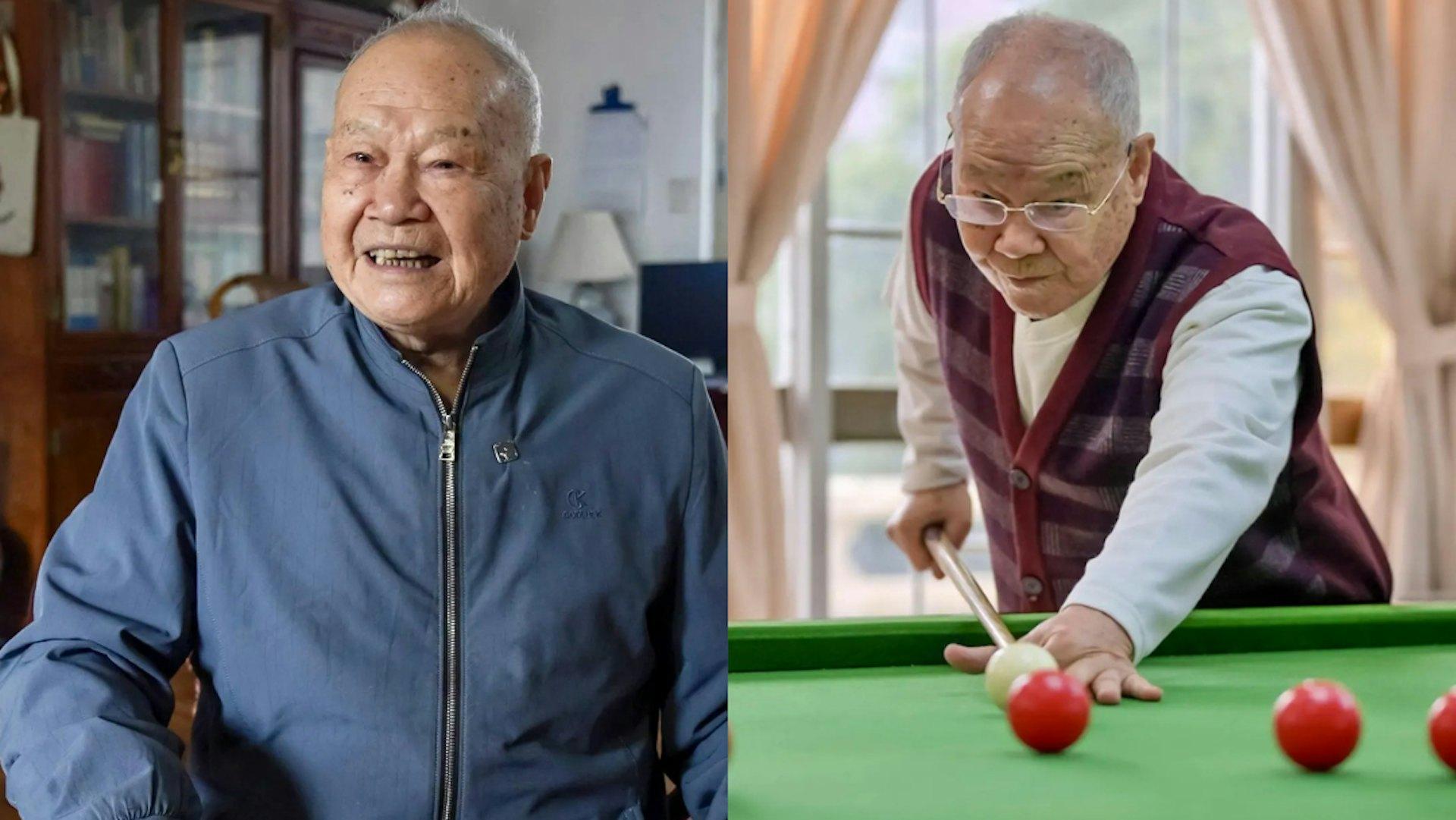
Mr. Yan, who lives in Dashadi, Huangpu, Guangzhou, is already 90 years old this year, but looks like he’s only 80 and is as fit as someone in their 70s. Born during the years of the War of Resistance, it can be said that learning has been his secret to overcoming fate and enjoying a healthy, long life.
He is from Meixian, Guangdong, and went to Central China Normal College in the 1950s. Back then, for a not-so-tall Guangdong native to develop his own special skills wasn’t easy. Inspired by world champions like Chen Jingkai and other Guangdong athletes at the time, he began to train in weightlifting and developed a strong physique, becoming a national second-level athlete during college. After graduation, he was assigned to work for decades in the mountainous areas of Hubei. The ups and downs of that experience were sustained by his robust body and further enriched by his learning in local language, table tennis, organ, and other skills. By the 1980s, he finally returned to his hometown and started teaching in Huangpu, Guangzhou.
After retiring in 1996, aside from traveling around the country with his wife, Mr. Yan kept up with the times and learned to type on the computer. His four manuscripts—including memoirs and poetry collections—were all typed by himself using pinyin input. Sending emails, surfing the internet, using WeChat—eventually he mastered them all.
In 2009, while performing with a senior citizens’ orchestra, Mr. Yan, who had dabbled in the erhu as a youth, felt he couldn’t just muddle through and enrolled at the Seniors University on Xiatang West Road. Although it was quite a long journey from Huangpu once a week, he still attended more than forty or fifty classes over a year and a half. Now, the erhu has genuinely become an instrument he uses to entertain himself and others.
Speaking of learning, he regrets that when he wanted to learn to drive, his children discouraged him; although he learned to ride an e-bike, he gave it up as it wasn’t legal yet. He excels at table tennis, playing aggressively, but as he got older and younger people balked at playing against him, he switched to learning snooker.
He was deeply saddened by the loss of his eldest son in 2016 and his wife in 2022, but once again relied on knowledge and learning as support. This has become his daily routine: in the mornings, he usually reads journals on literature, history, and philosophy such as the ‘Xinhua Digest’, and occasionally practices calligraphy; in the afternoon, he must play over two hours of snooker. His snooker buddy is an 89-year-old retired colleague—they call themselves the ‘post-90s’ duo.
Mr. Yan says that “use it or lose it”: not only should seniors keep learning, they should also stay productive. Since retirement, he’s never allowed himself to be idle. In 2007, he received the Advanced Worker for Caring for the Next Generation Award in Guangdong’s education system. In 2018, he continued to teach ancient poetry to citizens at the Huangpu Subdistrict Culture Station; in 2020, he won second prize in the “Best of Guangzhou” new lyrics contest.
Lifelong learning is not only for his own benefit, but inspires young people around him. Mr. Yan often gives away his books or books he buys to family and friends. Interestingly, his current housekeeper is a rural woman who had little education and, after years of labor, had almost forgotten how to read and write. In addition to doing chores, one of the main tasks Mr. Yan gives her is to read. She isn’t allowed to watch TV at his house—only to read classics like ‘Robinson Crusoe’, sometimes even writing reflections on what she’s read. He enjoys teaching, and now the housekeeper has become his student. In just one year, with his tutelage, she’s even able to recite the ‘Thousand Character Classic’.
He is the epitome of a New China intellectual who strived for progress all his life. Before the country’s liberation, while many fellow townspeople went abroad to Southeast Asia to make a living, he, as a child who firmly believed there would be a new China, chose not to leave. He participated in Korean War propaganda efforts, supported rural development, and eventually threw himself into the forefront of reform and opening up. His motivation for learning comes from his patriotism: he studied humanities to explore the true path of traditional culture and national strength, and pursued scientific knowledge to understand the rapid development of China’s science and technology.
When talking about lifelong learning, Mr. Yan admits age eventually catches up and says his greatest wish is for more accessible learning opportunities—such as small classes close to home, senior-friendly online courses, and more engaging micro-courses.
This Year of the Horse Spring Festival, this “post-90s” wrote Spring Festival couplets for friends and neighbors as always, but this year he has also begun learning to use AI to generate couplets—a new project for him.
After retiring in 1996, aside from traveling around the country with his wife, Mr. Yan kept up with the times and learned to type on the computer. His four manuscripts—including memoirs and poetry collections—were all typed by himself using pinyin input. Sending emails, surfing the internet, using WeChat—eventually he mastered them all.
In 2009, while performing with a senior citizens’ orchestra, Mr. Yan, who had dabbled in the erhu as a youth, felt he couldn’t just muddle through and enrolled at the Seniors University on Xiatang West Road. Although it was quite a long journey from Huangpu once a week, he still attended more than forty or fifty classes over a year and a half. Now, the erhu has genuinely become an instrument he uses to entertain himself and others.
Speaking of learning, he regrets that when he wanted to learn to drive, his children discouraged him; although he learned to ride an e-bike, he gave it up as it wasn’t legal yet. He excels at table tennis, playing aggressively, but as he got older and younger people balked at playing against him, he switched to learning snooker.
He was deeply saddened by the loss of his eldest son in 2016 and his wife in 2022, but once again relied on knowledge and learning as support. This has become his daily routine: in the mornings, he usually reads journals on literature, history, and philosophy such as the ‘Xinhua Digest’, and occasionally practices calligraphy; in the afternoon, he must play over two hours of snooker. His snooker buddy is an 89-year-old retired colleague—they call themselves the ‘post-90s’ duo.
Mr. Yan says that “use it or lose it”: not only should seniors keep learning, they should also stay productive. Since retirement, he’s never allowed himself to be idle. In 2007, he received the Advanced Worker for Caring for the Next Generation Award in Guangdong’s education system. In 2018, he continued to teach ancient poetry to citizens at the Huangpu Subdistrict Culture Station; in 2020, he won second prize in the “Best of Guangzhou” new lyrics contest.
Lifelong learning is not only for his own benefit, but inspires young people around him. Mr. Yan often gives away his books or books he buys to family and friends. Interestingly, his current housekeeper is a rural woman who had little education and, after years of labor, had almost forgotten how to read and write. In addition to doing chores, one of the main tasks Mr. Yan gives her is to read. She isn’t allowed to watch TV at his house—only to read classics like ‘Robinson Crusoe’, sometimes even writing reflections on what she’s read. He enjoys teaching, and now the housekeeper has become his student. In just one year, with his tutelage, she’s even able to recite the ‘Thousand Character Classic’.
He is the epitome of a New China intellectual who strived for progress all his life. Before the country’s liberation, while many fellow townspeople went abroad to Southeast Asia to make a living, he, as a child who firmly believed there would be a new China, chose not to leave. He participated in Korean War propaganda efforts, supported rural development, and eventually threw himself into the forefront of reform and opening up. His motivation for learning comes from his patriotism: he studied humanities to explore the true path of traditional culture and national strength, and pursued scientific knowledge to understand the rapid development of China’s science and technology.
When talking about lifelong learning, Mr. Yan admits age eventually catches up and says his greatest wish is for more accessible learning opportunities—such as small classes close to home, senior-friendly online courses, and more engaging micro-courses.
This Year of the Horse Spring Festival, this “post-90s” wrote Spring Festival couplets for friends and neighbors as always, but this year he has also begun learning to use AI to generate couplets—a new project for him.