Large Influx of Migrants into Spain’s North African Enclave Condemned by EU Leaders
Published atAug 01, 2026 03:37 pm
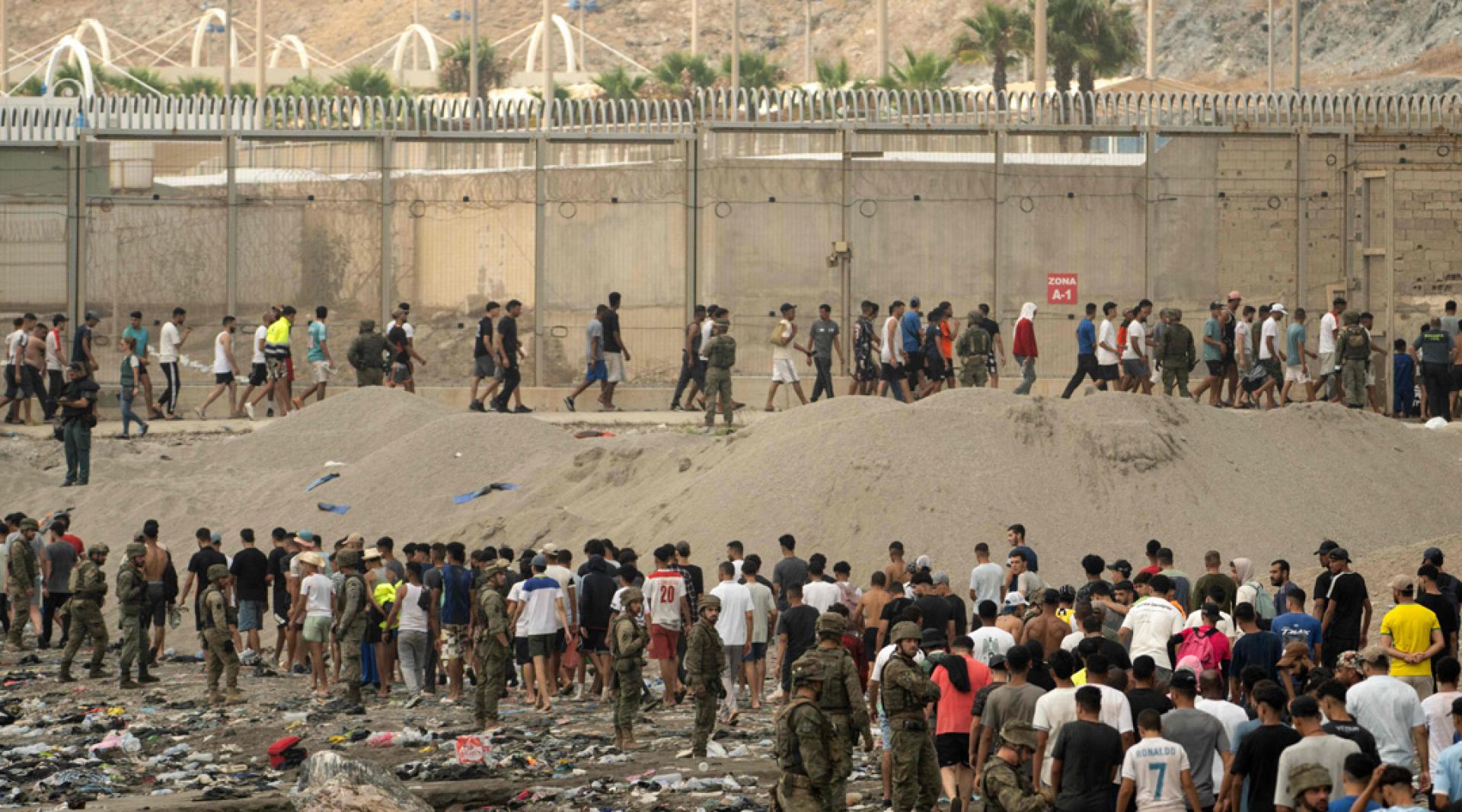
On the 31st, a large number of migrants surged into Spain’s North African enclave Ceuta from Morocco, shocking the international community. European Commission President Ursula von der Leyen emphasized that such actions will never be tolerated and that repatriation processes must be accelerated.
That evening, von der Leyen issued a strongly worded statement on social media, saying that the scenes from Ceuta are unacceptable and that no one should be allowed to enter the EU without following the rules.
She stated that, within the framework of EU rules, repatriation work must proceed rapidly. Two commissioners have been appointed to maintain contact and cooperation with Spain and Morocco respectively, to help control the situation. At least 60 migrants died while attempting to swim across the border.Located in Africa, belongs to Spanish territory
An enclave refers to a region or territory of a country that is surrounded by another country or region, and is not connected to its main territory.
Ceuta is a Spanish enclave located in North Africa, on the southern shore of the Strait of Gibraltar. It is surrounded by sea on three sides and shares its land border with Morocco. It covers an area of about 18.5 square kilometers and has a population of about 85,000. Although it is entirely located on the African continent geographically, it is politically part of Spanish territory and thus part of the European Union. For many migrants, Ceuta has long been an important gateway into Europe and a crucial stepping stone to pursue a better life. Ceuta is politically part of Spanish territory, and also part of the European Union.60 migrants died while attempting to swim across the border
In recent days, about 50,000 to 60,000 migrants have surged toward this enclave of just a few square miles in size from Morocco; at least 60 migrants died while attempting to swim across. However, Spanish authorities estimate that as of the afternoon of July 31, at least 48,300 people have already returned to Morocco. Many people, unable to obtain food and shelter in Ceuta, eventually returned to Morocco through border checkpoints or gaps in the fence.
Spanish officials pointed out that some migrants drowned, while others were trampled to death while trying to climb the border fence on the breakwater.
Analysts believe that this wave of migration is caused by a combination of factors, including prolonged economic hardship, misleading information on social media, calm summer sea conditions, and border control measures.
This large-scale border-crossing incident immediately triggered strong backlash from European far-right politicians, and related controversies are expected to continue to ferment.
This article has been translated using our AI technology. While we strive for accuracy,
AI translations
may contain errors. For the most precise information, please refer to the original article.