Looking east from the 'Moon Gate' on the second floor of Shenzhen International Art Museum, the Shenzhen Science and Technology Museum resembles a silvery-grey 'spaceship' docked in Guangming Science City. The former uses art to connect souls, while the latter illuminates the future with science. The two cultural facilities face each other across the street, together forming a new urban landscape as Shenzhen opens itself to the world.
As the 2026 APEC meeting approaches, what will Shenzhen showcase to the Asia-Pacific and the world? On August 6th, the “Meet in Shenzhen, Witness Miracles”—100-day Countdown to the APEC Summit Media Tour was officially launched, with its first stop inside these two venues to seek answers: to see how a city brings premium cultural resources to citizens' doorsteps, and how, through art as language and innovation as identity, Shenzhen enables visitors from home and abroad to understand Shenzhen and China.

Upon entering the Shenzhen International Art Museum, visitors are first greeted by a space open to the city. The main structure is elevated to the second floor, naturally connecting the gallery on the first floor with public spaces, so citizens can stroll, view exhibitions, and rest, all while unexpectedly encountering art.
Ascending the steps, the “Window of Art” is suspended in the atrium. Metal wires, acrylic panels, and lighting interweave to create a constantly changing 'moon', echoing the Eastern connotation of “A bright moon rises over the Bay Area.” Inside and outside the gate, Chinese character art meets algorithmic images; Zodiac animal heads from the Old Summer Palace are displayed alongside European masterpieces. Tradition and the contemporary, East and West, engage in dialogue here.

“Internationalization is a very important direction for us,” said Yao Wentan, Deputy Director of the Shenzhen International Art Museum. Focusing on East-West cultural exchange, dialogue between tradition and contemporary, and the integration of technology and art, the museum has already attracted many overseas visitors, especially young people from the Greater Bay Area and Hong Kong. Guided tours are available in Mandarin, Cantonese, and English, allowing audiences from different cultural backgrounds to get close to art and understand Chinese culture.
A 'Hello World' Enables Two-Way Encounters Between Innovation and the Public
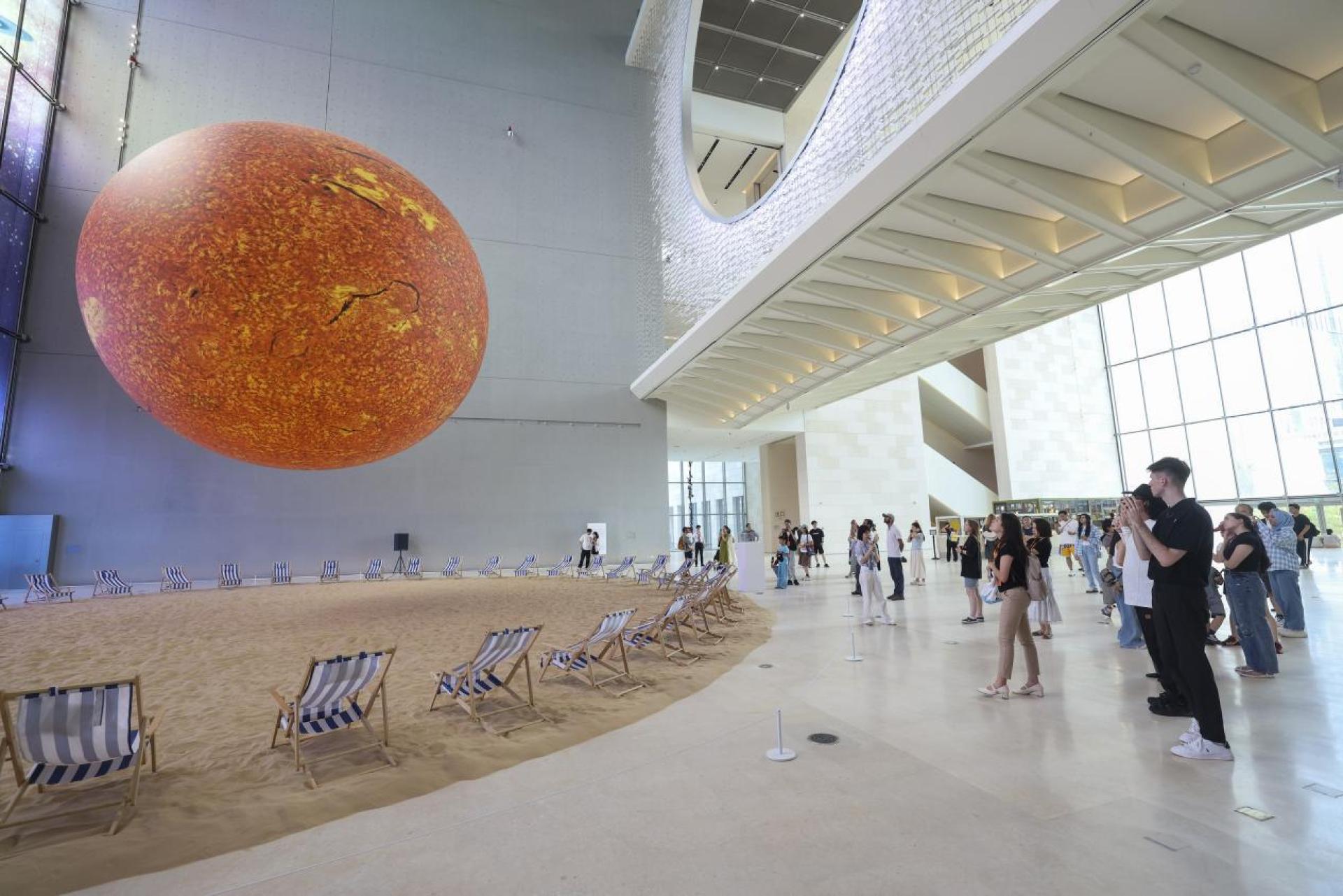
Entering the Shenzhen Science and Technology Museum, the 'Big Eye' installation lights up with “Hello World!”—a greeting familiar to programmers, now serving as Shenzhen’s invitation to the world. Children wave their arms to control virtual scenes, visitors interact with humanoid robots; from cloud computing and the Internet of Everything to brain science and genetic codes, abstract cutting-edge technology is transformed into tangible, hands-on life experiences.
This “sci-fi spaceship” centers around the theme of “Digital Civilization, Innovation for the Future”, featuring four permanent galleries and 950 innovative exhibits, 80% of which offer deeply immersive experiences, and 80% closely aligned with Shenzhen’s “20+8” industrial clusters. From AI entering transportation, communities and homes, to new materials and smart logistics drawing out industrial landscapes, and even from cells and genes reaching for the stars and seas, Shenzhen's innovation becomes tangible and perceptible.

An outstanding science and technology museum is not just about displaying exhibits—it should let people encounter innovation. The Shenzhen Science and Technology Museum positions itself as a 'large classroom' for youth to learn about science technology, a 'grand living room' for scientists and the public to interact, and a 'broad stage' for releasing new technological achievements. Since opening, the venue has welcomed more than 4 million domestic and overseas visitors, including over 74,000 from Hong Kong, Macao, Taiwan, and abroad; science popularization activities are ongoing, turning “Science Is So Much Fun” into an accessible public cultural service.