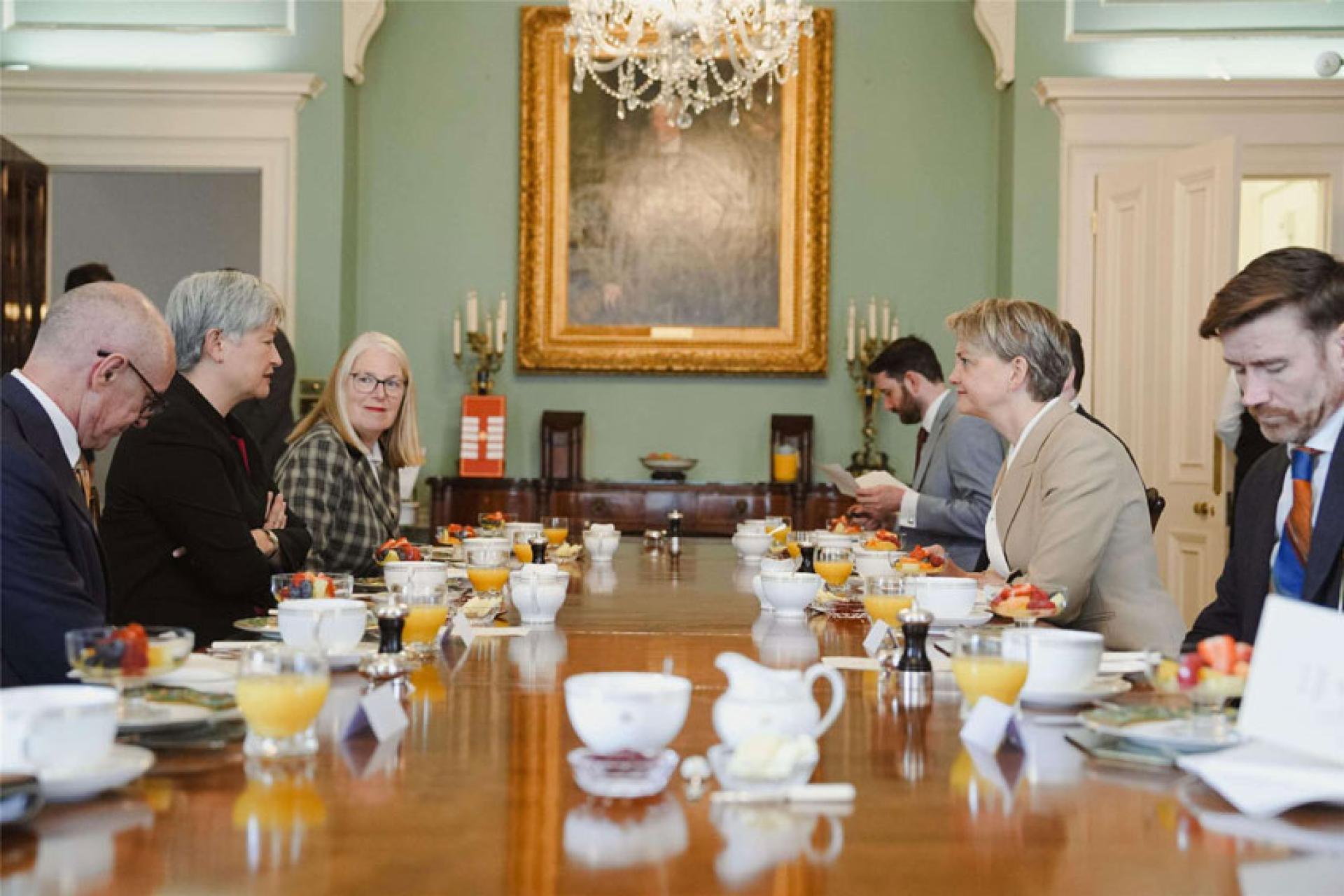
The UK and Australian foreign and defense ministers held talks in London on Wednesday and issued a joint statement afterwards, reiterating that peace and stability in the Taiwan Strait are of vital importance. The statement expressed concern over China's destabilizing military exercises around Taiwan and opposed any attempts to unilaterally change the status quo in the Taiwan Strait.
The statement encouraged resolving differences through dialogue, rather than resorting to coercion or force.
The statement also acknowledged that the international community benefits from Taiwan’s expertise and technology. As a result, the UK and Australia will continue to support Taiwan’s meaningful participation in international organizations that do not require statehood as a prerequisite, or participation as an observer or guest.
The statement reaffirmed that the UK and Australia will strive to deepen relations with Taiwan in the fields of economy, trade, science, technology, and culture.
On June 10th, UK Foreign Secretary David Lammy and Defence Secretary John Healey held the annual UK-Australia Ministerial 2+2 meeting (AUKMIN) in London with Australian Foreign Minister Penny Wong and Defence Minister Richard Marles. The joint statement covered issues such as the Middle East, Ukraine, the Indo-Pacific regional situation, security and defense cooperation, hybrid threats, and economic resilience.
The UK-Australia statement strongly opposed activities in the South China Sea that could increase tensions, raise the risk of miscalculation, and lead to escalation. The UK and Australia will continue to cooperate to uphold freedom of navigation and rights within the region. The statement also expressed concern regarding the situations in the East China Sea and Yellow Sea.
The UK and Australia expressed serious concern about human rights violations inside China, mentioning the persecution and arbitrary detention of Uyghurs and Tibetans, as well as infringements on freedom related to religion, culture, education, and language use.
The UK and Australia also raised concern over the growing trend of transnational repression, pointing out that such repression undermines national security, sovereignty, human rights, and the safety of the public in various countries. This includes actions taken by authorities in Hong Kong and Beijing against pro-democracy advocates in exile living in the UK, Australia, and other nations.
The statement further expressed deep concern about the continued systemic infringement of Hong Kong’s autonomy, democratic processes, and individual rights and freedoms, including the authorities’ imposition of the National Security Law and the persecution of British citizen Jimmy Lai and Australian citizen Owen Wu (Ng Chak-hang).
Regarding North Korea, the UK-Australia joint statement strongly condemned Pyongyang's nuclear and ballistic missile programs, calling for the complete and irreversible denuclearization of North Korea. The statement also expressed deep concern over North Korea’s malicious cyber activities.
The UK and Australia expressed concern about China’s economic support for Russia and called on the Chinese government to take measures to prevent companies from supplying dual-use components to Russia’s military-industrial complex.
The UK and Australia further urged China to leverage its “significant influence” over Moscow authorities to help bring the war to an end.
In addition, the statement noted that military cooperation between Moscow and North Korea is deepening, which is having serious consequences for the security of both the Indo-Pacific and Euro-Atlantic regions.
It pointed out that North Korea is gaining practical experience from its involvement in the Russia-Ukraine war, which it may later apply on its own initiative, undoubtedly further impacting the security and stability of the Indo-Pacific region.