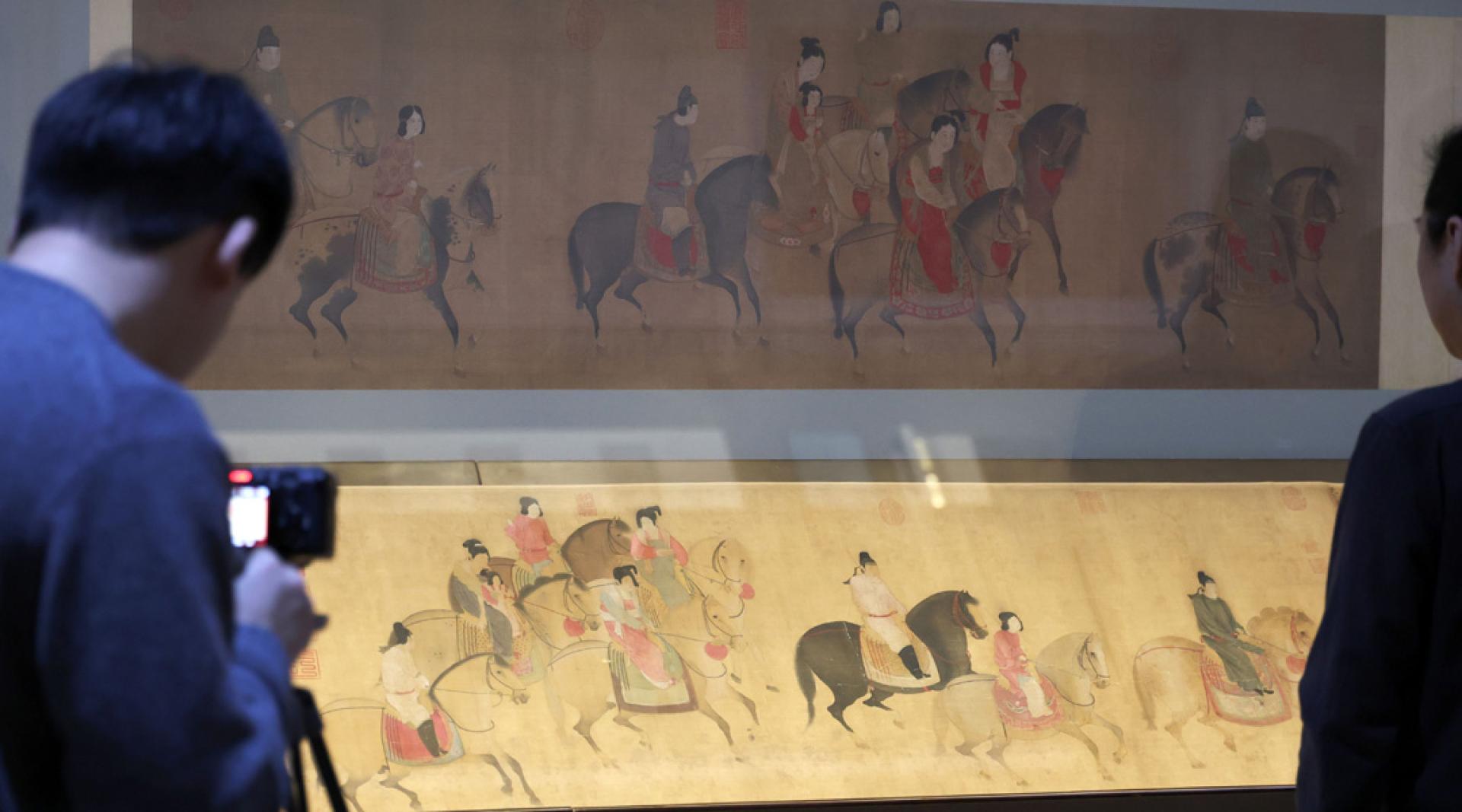
Chinese media report that government departments in Shaanxi have been subjected to days of persistent harassment by 'pseudo-history theorists' demanding the demolition of Tang Dynasty-related historical sites in Shaanxi province, on the grounds that 'the Tang Dynasty never existed.' Claims such as 'the Ming Dynasty ruled the world' are circulating on Chinese social media platforms such as Xiaohongshu and Douyin, with some parents saying that this has caused serious confusion about historical understanding among children.
The official rumor-busting WeChat account of Nanjing Municipal Cyberspace Administration, 'Nanjing Online Rumor Debunking,' on Wednesday reprinted a commentary article from the Chinese Communist Party Nanjing Municipal Committee's official newspaper, Nanjing Daily, titled “'Tang Dynasty Never Existed'? This Evil Pseudo-History Trend Must Be Stopped!”
The article states that Shaanxi's culture and tourism departments have recently been harassed by internet users claiming to be 'pseudo-history theorists' for several days. Their core demand is to tear down Tang Dynasty-related historic sites in Shaanxi province, with the justification that 'the Tang Dynasty never existed.'
According to the article, claims that 'the Tang Dynasty did not exist' generally appear in several forms on the Chinese internet: Some claim that the 300-year history of the Tang was fabricated later to 'unite the nation,' that Tang-era documents and artifacts are all forgeries; some believe the Li Tang royal family had Xianbei ancestry and thus equate it to a 'barbarian regime;' another group denies the Tang Dynasty's existence to make room in history for '800 years of the Song Dynasty' or to prop up the narrative of a 'global Ming Empire.'
The article notes that those spreading 'the Tang Dynasty never existed' are often also adherents of other interrelated pseudo-historical narratives, such as 'the Song Dynasty lasted 800 years' and 'the Yuan and Qing were not part of China.' 'The view that the Yuan and Qing were not Chinese regimes can be traced to the period of Japanese invasion of China; it was used to provide ideological justification for splitting China and establishing the puppet Manchukuo. The lessons of history are clear: The blood-colored background of this rhetoric is enough for us to remain highly alert to today’s pseudo-history theories. They are not exploring history, but instead deconstructing national identity and undermining cultural roots.'
According to the 'Statistical Bulletin of the First National Census of Movable Cultural Relics' published by the National Cultural Heritage Administration, there are over 3.42 million movable relics from the Tang Dynasty, accounting for 6.25% of the national total. The article therefore states: 'Nihilists ignore all archaeological evidence and documentary records, and recklessly promote their ideas based on nothing but subjective imagination, attempting to strip our nation of its complete historical foundation and solid cultural roots. This perverse trend really must not be allowed to continue!'
The article also raises the question: How could a dynasty explicitly recorded in middle school textbooks and supported by abundant archaeological artifacts and documents be declared 'nonexistent' by some online? 'Behind this is a type of historical nihilism that warrants the highest vigilance. Pseudo-history theories are by no means academic exploration or debate, but a closed, interconnected web of false narratives whose depth of harm and widespread influence far surpass those of ordinary online rumors.'
The article considers that the spread of pseudo-history theories on the internet is inseparable from the indulgence of some platforms and the amplification effects of algorithmic mechanisms.
The article concludes: 'History cannot be distorted, and civilization cannot be nihilized. In the face of this perverse trend of pseudo-history theories, we must wield facts as our shield, law as our sword, and education as our foundation—respond decisively and resolutely curb it. This is not just respect for history, but responsibility for the future.'