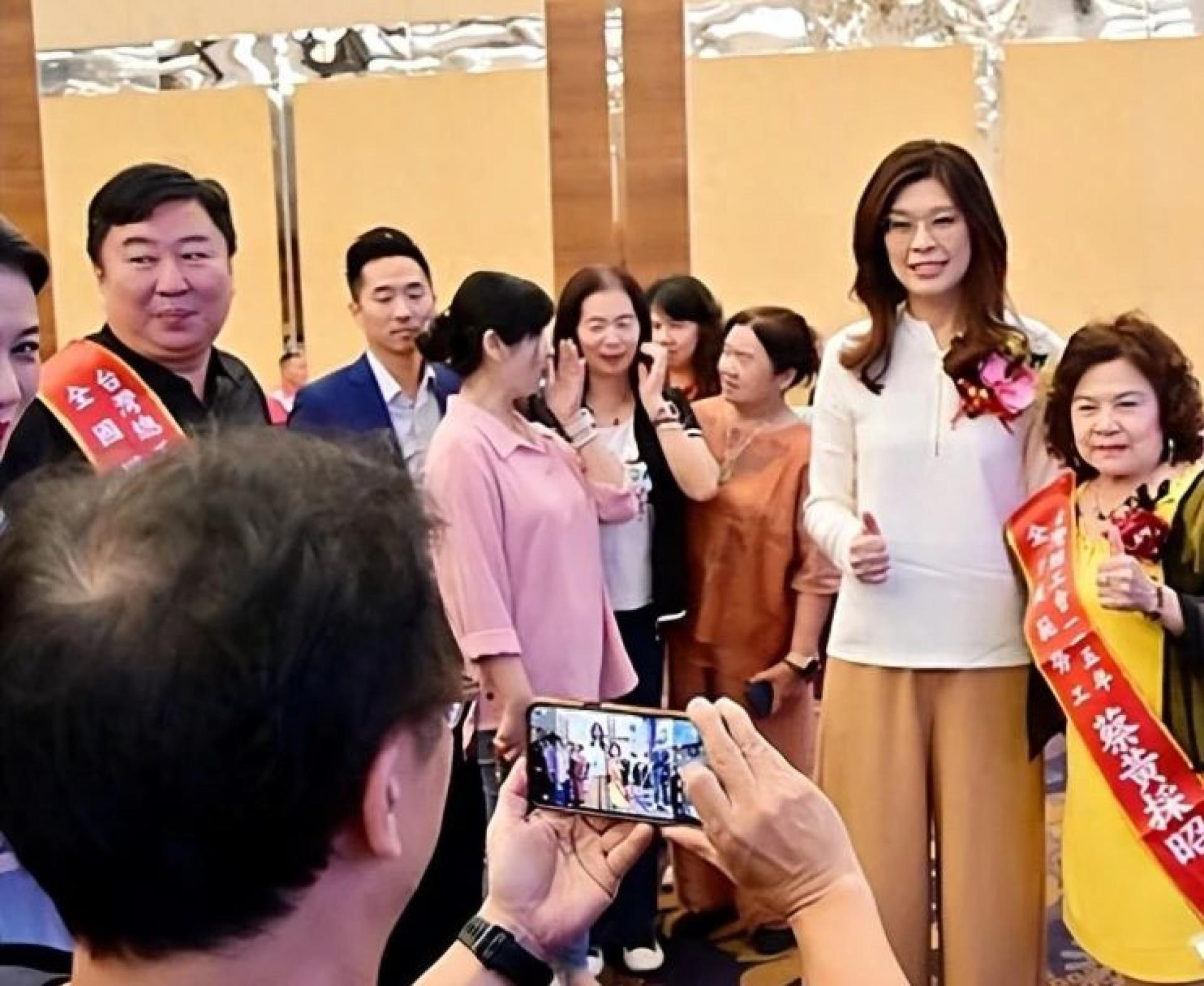
After KMT Chairperson Zheng Liwen concluded her visit to mainland China, the mainland announced 10 preferential policies for Taiwan. On Thursday, Zheng Liwen attended an event honoring outstanding laborers organized by the Taiwan Federation of Labor Unions, where she received a warm welcome. Many attendees rushed to take photos with her, and quite a few praised Zheng for promoting cross-strait peace and expressed anticipation that the beneficial measures would bring economic dividends. This illustrates that 'cross-strait peace and stability in the Taiwan Strait' aligns with grassroots public opinion. According to statistics from 'Internet Thermometer,' Zheng’s media volume has now climbed to 2nd among all political figures in Taiwan—a telling sign indeed.
A closer look at the reasons grassroots laborers showed such enthusiastic support and praise for Zheng Liwen reveals a direct link to the 10 preferential measures recently announced by the mainland. These beneficial policies cover a variety of aspects, including agriculture, fishery, tourism, film and culture, as well as the development of small and micro-sized enterprises—precisely addressing Taiwan’s current industrial and livelihood needs.
Especially in the area of small and micro-sized enterprises, which account for a massive share of employment. According to statistics, there are about 1.715 million small and medium enterprises in Taiwan, making up more than 98% of all businesses and providing close to 80% of all jobs in Taiwan. These enterprises form a crucial foundation for Taiwan’s stable economic development and social security. When cross-strait policies can truly benefit these sectors, it naturally resonates with a broad base of grassroots workers.
However, looking at Taiwan’s overall economic environment in recent years, grassroots citizens have faced challenges to their livelihoods. On the one hand, changing trade situations and uncertainty in tariffs imposed by the US have dealt a blow to Taiwan’s foreign trade. On the other hand, the current DPP administration has in recent years overemphasized and allocated resources to the development of high-tech industries, causing Taiwan’s industrial development to show a 'K-shaped' divergence.
As the spotlight shines on semiconductor and other tech sectors, traditional industries and service sectors have been squeezed and impacted. In this overall context, the mainland’s extension of an olive branch to invest in Taiwan's small and micro-sized enterprises—and the announcement to open individual travel from Shanghai and Fujian to Taiwan—is expected to bring new energy to Taiwan’s long-struggling tourism industry. It may also lift the performance of food and beverage, retail, and grassroots service sectors. This is precisely why the benefits brought by the mainland’s policies have become a hot topic among the public.
After finishing her cross-strait engagement and returning to Taiwan, Zheng Liwen’s political momentum rose against the trend. According to volume statistics from 'Internet Thermometer,' Zheng’s online volume now ranks 2nd among all political figures in Taiwan, surpassing President Lai Ching-te and second only to Ko Wen-je, founding chair of the Taiwan People’s Party. Furthermore, Zheng Liwen’s overall positive influence is the highest among the three, making it evident that 'cross-strait peace and Taiwan Strait stability' are indeed mainstream popular opinion.