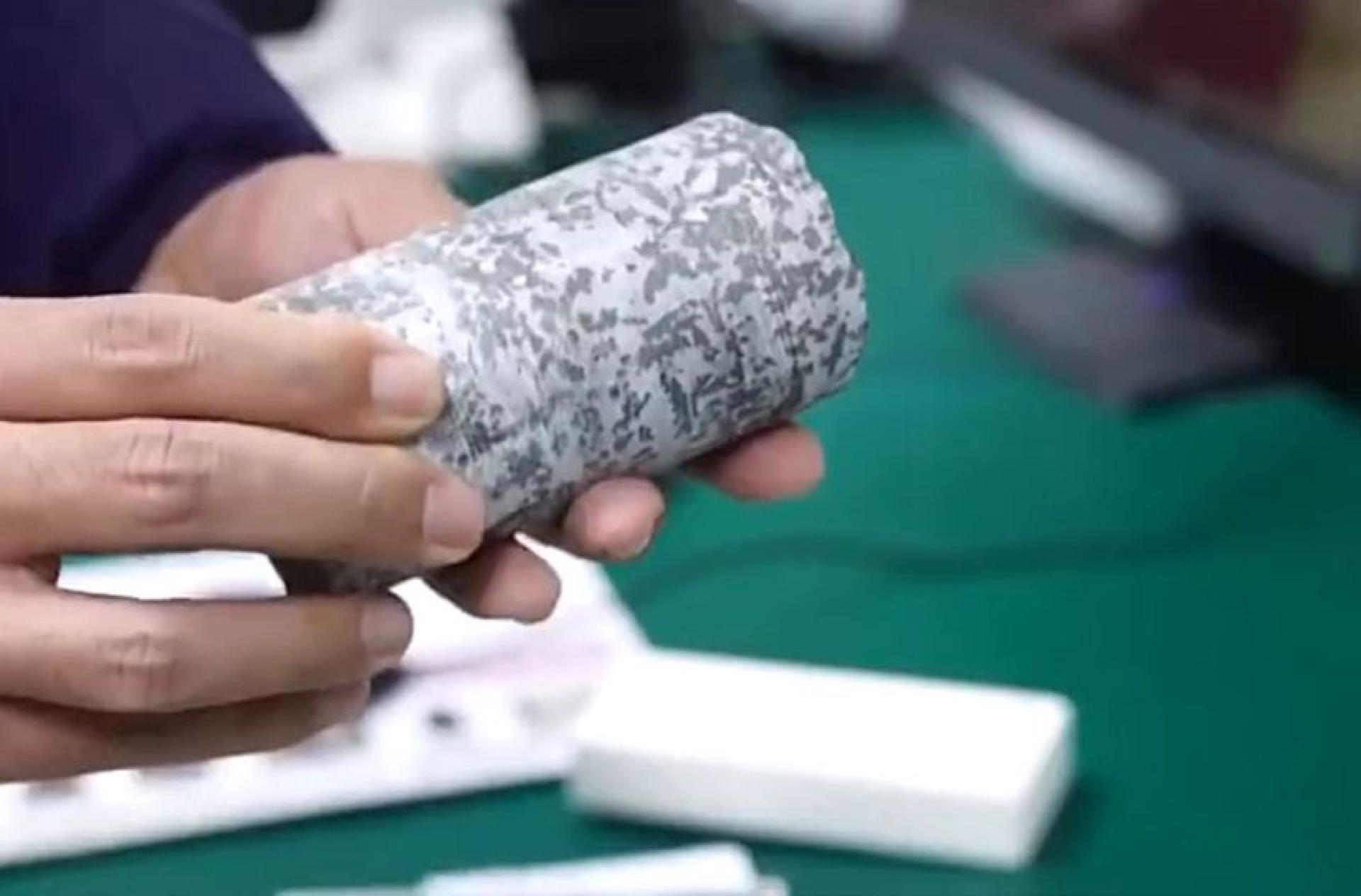
China has discovered a new mineral, officially named 'Jinxiuite'. On the 17th, the China Geological Survey of the Ministry of Natural Resources stated that, following review and voting by the International Mineralogical Association’s Commission on New Minerals, Nomenclature and Classification, a new nickel-bismuth-antimony-arsenic sulfide mineral discovered and submitted by researchers at the Chinese Academy of Geological Sciences has received formal approval. Its Chinese name has been designated as Jinxiuite.
Jinxiuite was discovered in the Longhua nickel-cobalt deposit in Jinxiu Yao Autonomous County, Guangxi Zhuang Autonomous Region. Experts noted that the Longhua nickel-cobalt deposit is exceptionally rich, with nickel and cobalt element contents of about 17.5% and 1.5% respectively—nearly 80 times higher than the conventional ore-forming criteria of 0.2% for nickel and 0.02% for cobalt.
Yan Jiayong, Director of the Research Office of Deep Mineral Exploration Theory and Technology, Chinese Academy of Geological Sciences, stated that the chemical formula of Jinxiuite consists of nickel, bismuth, sulfur, antimony, and arsenic. Essentially, it is formed by the replacement of nickel-bearing minerals formed at earlier stages, leading to a rearrangement of the crystal structure and the crystallization of an entirely new, structurally stable mineral.
Yan Jiayong pointed out that materials scientists can take inspiration from the crystal structure of metal minerals like Jinxiuite to attempt synthesizing similar artificial minerals or compounds in the laboratory, thereby developing more efficient, more stable, or lower-cost new energy materials.
Tang Hejun, Senior Engineer at the Research Office of Deep Mineral Exploration Theory and Technology, Chinese Academy of Geological Sciences, stated that the naming of new minerals generally takes two forms: one is by mineral structure (composition), the other by naming after a scientist or locality. China’s Jinxiuite is named after its locality, as it comes from Jinxiu Yao Autonomous County in Dayaoshan, Guangxi, hence the name Jinxiuite.