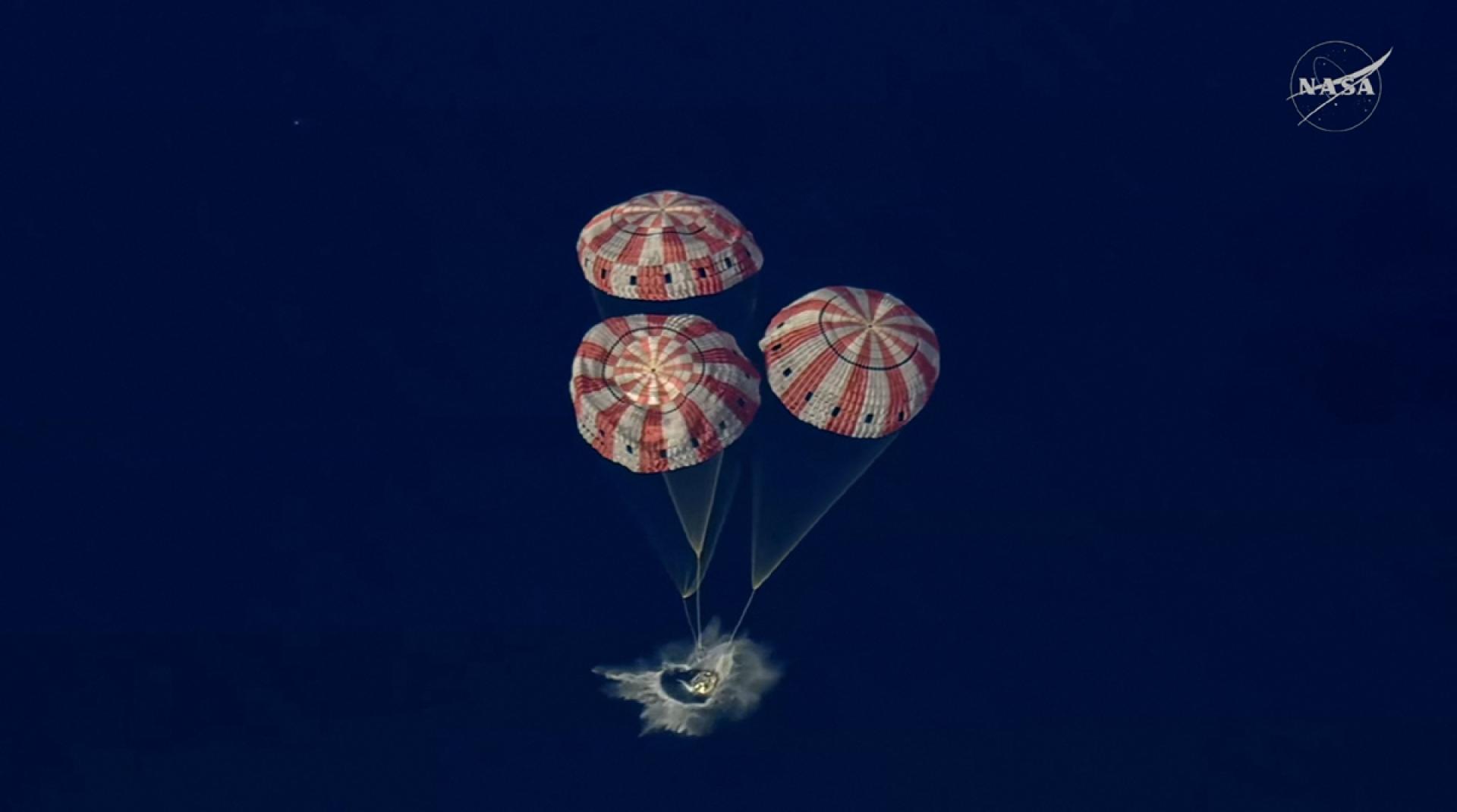
The 'Orion' spacecraft carrying out the United States 'Artemis II' manned lunar flyby mission has returned to Earth, splashing down in waters near San Diego, California on the evening of the 10th Eastern Time, marking the end of humanity's first lunar journey in over half a century.
NASA astronaut Reid Wiseman reported after splashdown that he and the other astronauts on board are currently in good condition.
At 7:33, the service module, responsible for propulsion and control in space, separated from the 'Orion' spacecraft, fully exposing its heat shield. After re-entering the atmosphere, the heat shield was jettisoned, and the parachutes were sequentially deployed to slow down the descent. At 8:07 (Malaysian time, 8:07 AM on the 11th), the spacecraft splashed down in the Pacific Ocean near San Diego. The airbags on top inflated, allowing the capsule to flip and restore an upright position.
The U.S. Navy's amphibious transport dock ship carried out recovery tasks in the splashdown area. According to plan, the astronauts would leave the spacecraft and board the transport ship within two hours, undergo medical evaluation onboard, then return to land, and finally fly to NASA's Johnson Space Center in Houston.

The four astronauts launched from Florida on April 1. During the mission, they completed a nearly seven-hour lunar flyby, reaching a distance of 252,756 miles (about 406,780 kilometers) from Earth, setting a new record for the farthest human flight—over 6,000 kilometers more than the previous record of 248,655 miles (about 400,171 kilometers) set by Apollo 13 in 1970.
'Artemis II' is the world's first crewed lunar mission since Apollo 17 in 1972. Next year's 'Artemis III' is expected to conduct docking rehearsals with the lunar lander, and in 2028, 'Artemis IV' aims to achieve the ultimate goal of landing two astronauts near the lunar south pole.