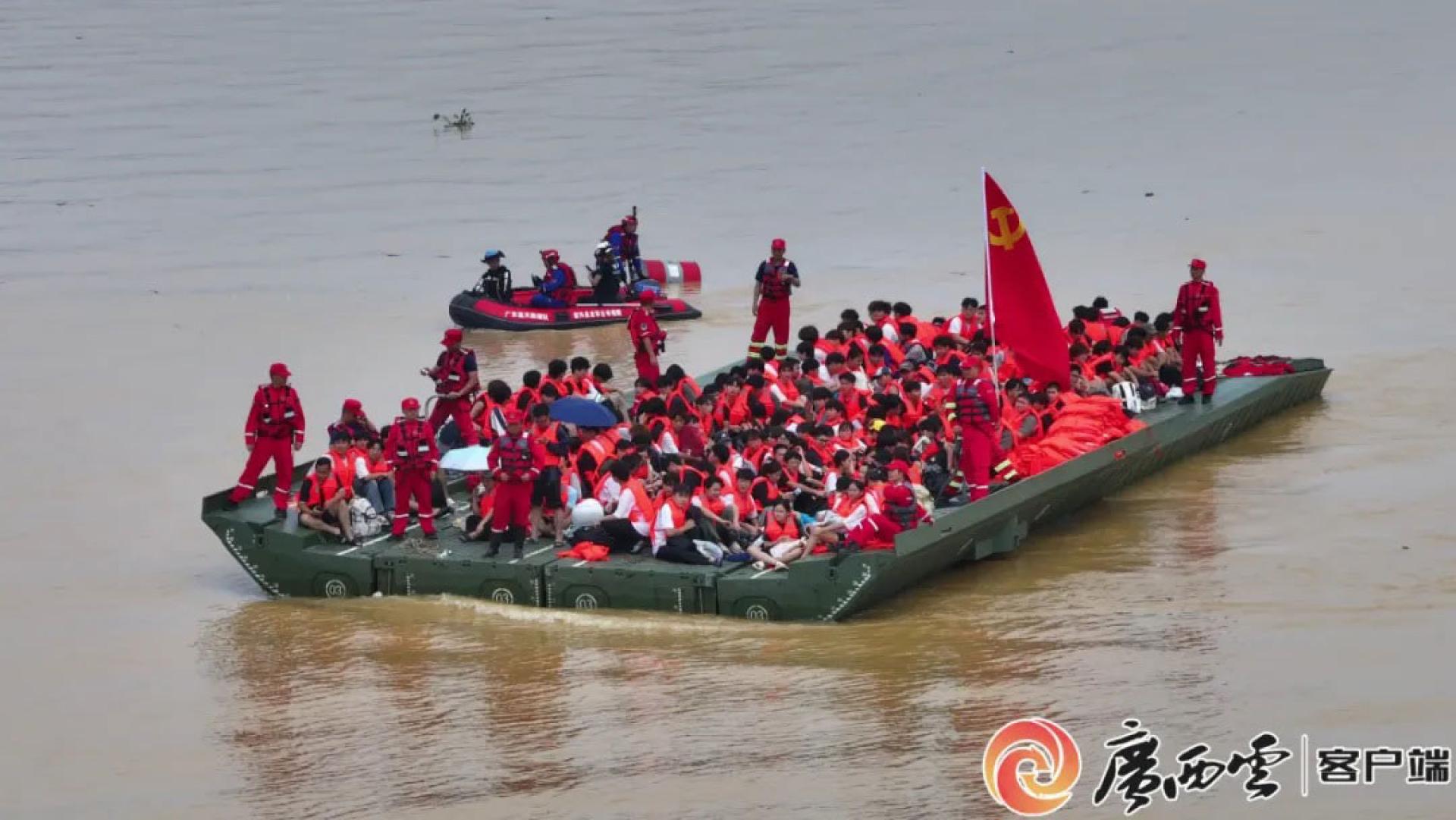
"Come and see China's real-life 'Transformers'." Recently, Chinese Foreign Ministry spokesperson Mao Ning posted a short video on overseas social platform X, drawing global attention—a video showing China Anneng Group's "power pontoon bridge" transporting stranded students during floods at the Xijiang Education Park in Guigang, Guangxi. The metal floating bridge automatically unfolded upon entering the water, transforming like a Transformer. Spokesperson Lin Jian also shared Chinese drone rescue footage on platform X, labeled "Technology for Good."
This globally-watched rescue took place against a challenging backdrop: On July 8, China Anneng Group's emergency power pontoon bridge received orders to transfer stranded faculty and students from Guangxi Vocational and Technical College of Logistics, safely relocating over 6,000 trapped faculty and students within 24 hours.
After the video was released, the spread was swift and far-reaching. Mainstream media from numerous countries, including Mexico's Nmás, Singapore's CNA Asia News Channel, Indonesia's Antara News Agency, Malaysia's Kwong Wah Daily, Thailand's TNN Tech and others, successively reposted and reported on the event. Netizens worldwide engaged in lively discussion across languages. Some foreign viewers commented, "I thought this was AI-generated," and others said, "This is the proper use of drones—not for war, but for saving lives." What people in different countries and languages saw was not "Chinese propaganda," but "Chinese strength."
The value of technology has never lied in how advanced it is, but in what it is used for. In today's global discourse on "where technology should go," China has given its answer through a multi-dimensional rescue by water, land, and air: drones dropping not bombs, but drinking water; power pontoon bridges transporting not tanks, but students. This is not a scene from a science fiction movie, but the real scenario in Guangxi, China in July 2026.
In fact, this is not the first time the "power pontoon bridge" has appeared in Chinese flood rescue operations. In the 2021 Zhengzhou heavy rain disaster and the 2025 Nanning floods, every time, it has appeared where it was needed most. From Zhengzhou to Guigang, the "rescue aircraft carrier" has entered floodwaters again and again. Behind this is China's long-term, systematic national emergency technology reserve—a layout tested in real disasters and iterated under real pressure. This is not a coincidence, but the inevitable result of institutional preparations.
The most powerful transformation of a country's "Transformer" is not to become a weapon, but to become a vessel that carries people home. As this story spreads from Guangxi to the world, the message it conveys is clear and powerful: Chinese technology is not for show, but to serve humanity when needed.
This is China's answer to "Technology for Good."
(News source: Guangxi Daily)