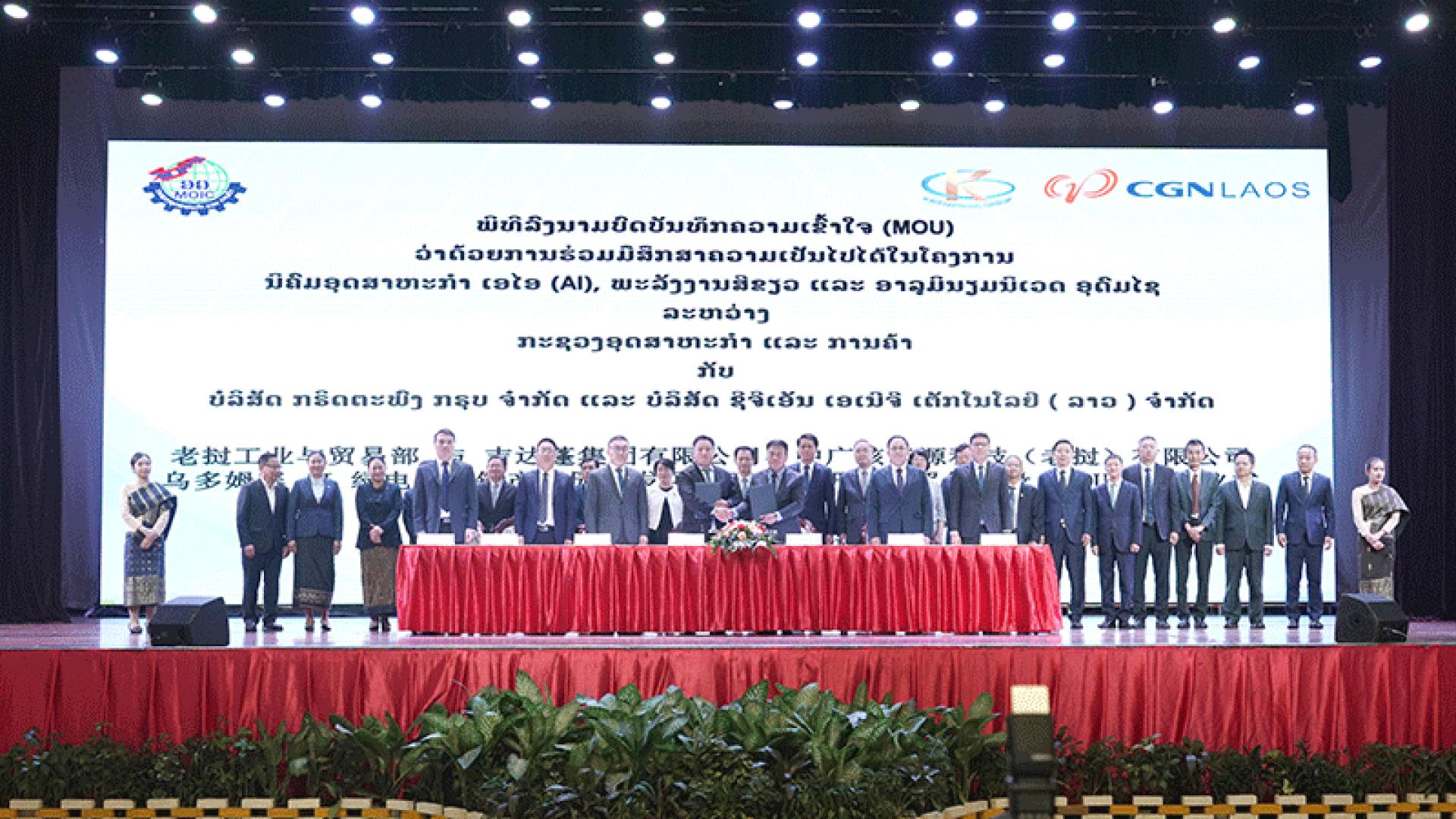
The Lao government has signed a memorandum of understanding (MoU) with Krittaphong Group and CGN Energy Technology (Laos) Co., Ltd to conduct a feasibility study for the construction of an AI-driven green aluminum industrial park in Oudomxay Province, marking a new step in Lao-Chinese green industry cooperation.
The signing ceremony was held on Monday in Vientiane, witnessed by Malaythong Kommasith. Attendees included Fang Hong, senior government officials, provincial leaders, and representatives of partner organizations.
According to the plan, the project covers an area of 6,279 hectares. If approved, it is expected to become a green industrial hub in northern Laos. The project will integrate clean energy and advanced technologies, including artificial intelligence, to develop a modern industrial system combining aluminum production and processing.
On the Chinese side, Guangxi Investment Group Co., Ltd will serve as the main industrial investor. The group plans to build a green aluminum production base with an annual capacity of 500,000 tons, supported by up to 2,000 MW of clean energy supply, and gradually develop a complete aluminum industry chain.
Malaythong pointed out that Laos has abundant clean energy resources that should be fully utilized to promote environmentally friendly industrial development. He stated that this project will help strengthen green cooperation between Laos and China, and aligns with the government's policy direction of promoting a "green industrial supply chain".
He said the plan also fits into the country’s 2026-2030 national socio-economic development plan by increasing the added value of resources, boosting national income, and creating stable jobs.
Fang Hong noted that Lao-Chinese cooperation previously focused mainly on infrastructure construction, but is now entering a new stage of high-tech and green development, especially in hydropower, wind, and solar energy sectors. She emphasized that the project must adhere to the principles of green development while promoting technological innovation and bringing tangible benefits to local communities.
As the energy cooperation partner, CGN Laos will be responsible for establishing the green power supply system. The first phase of the project, a 1,000 MW solar power station in Oudomxay, began generating electricity in December 2025, and is expected to be fully operational by April this year. In the future, additional wind and solar power projects will be developed to support long-term green energy needs.
Krittaphong Group will be responsible for local coordination, including communication with the government and communities, and ensuring the project complies with national regulations. If the research results prove feasible, the project will be connected to the Laos-China 500kV power transmission network via Lao Transmission Company, ensuring stable power supply.
This year marks the 65th anniversary of diplomatic relations between Laos and China as well as the "Laos-China Friendship Year." Officials stated that the project reflects the shared commitment of both sides to deepening cooperation under the "Belt and Road" initiative.
In addition, the signing ceremony also announced the establishment of the "Lao Institute for Clean Energy Standards," jointly set up by CGN Laos and the China Electricity Council, aiming to promote the construction of clean energy standards and the development of regional power cooperation.
According to the plan, the project covers an area of 6,279 hectares. If approved, it is expected to become a green industrial hub in northern Laos. The project will integrate clean energy and advanced technologies, including artificial intelligence, to develop a modern industrial system combining aluminum production and processing.
On the Chinese side, Guangxi Investment Group Co., Ltd will serve as the main industrial investor. The group plans to build a green aluminum production base with an annual capacity of 500,000 tons, supported by up to 2,000 MW of clean energy supply, and gradually develop a complete aluminum industry chain.
Malaythong pointed out that Laos has abundant clean energy resources that should be fully utilized to promote environmentally friendly industrial development. He stated that this project will help strengthen green cooperation between Laos and China, and aligns with the government's policy direction of promoting a "green industrial supply chain".
He said the plan also fits into the country’s 2026-2030 national socio-economic development plan by increasing the added value of resources, boosting national income, and creating stable jobs.
Fang Hong noted that Lao-Chinese cooperation previously focused mainly on infrastructure construction, but is now entering a new stage of high-tech and green development, especially in hydropower, wind, and solar energy sectors. She emphasized that the project must adhere to the principles of green development while promoting technological innovation and bringing tangible benefits to local communities.
As the energy cooperation partner, CGN Laos will be responsible for establishing the green power supply system. The first phase of the project, a 1,000 MW solar power station in Oudomxay, began generating electricity in December 2025, and is expected to be fully operational by April this year. In the future, additional wind and solar power projects will be developed to support long-term green energy needs.
Krittaphong Group will be responsible for local coordination, including communication with the government and communities, and ensuring the project complies with national regulations. If the research results prove feasible, the project will be connected to the Laos-China 500kV power transmission network via Lao Transmission Company, ensuring stable power supply.
This year marks the 65th anniversary of diplomatic relations between Laos and China as well as the "Laos-China Friendship Year." Officials stated that the project reflects the shared commitment of both sides to deepening cooperation under the "Belt and Road" initiative.
In addition, the signing ceremony also announced the establishment of the "Lao Institute for Clean Energy Standards," jointly set up by CGN Laos and the China Electricity Council, aiming to promote the construction of clean energy standards and the development of regional power cooperation.