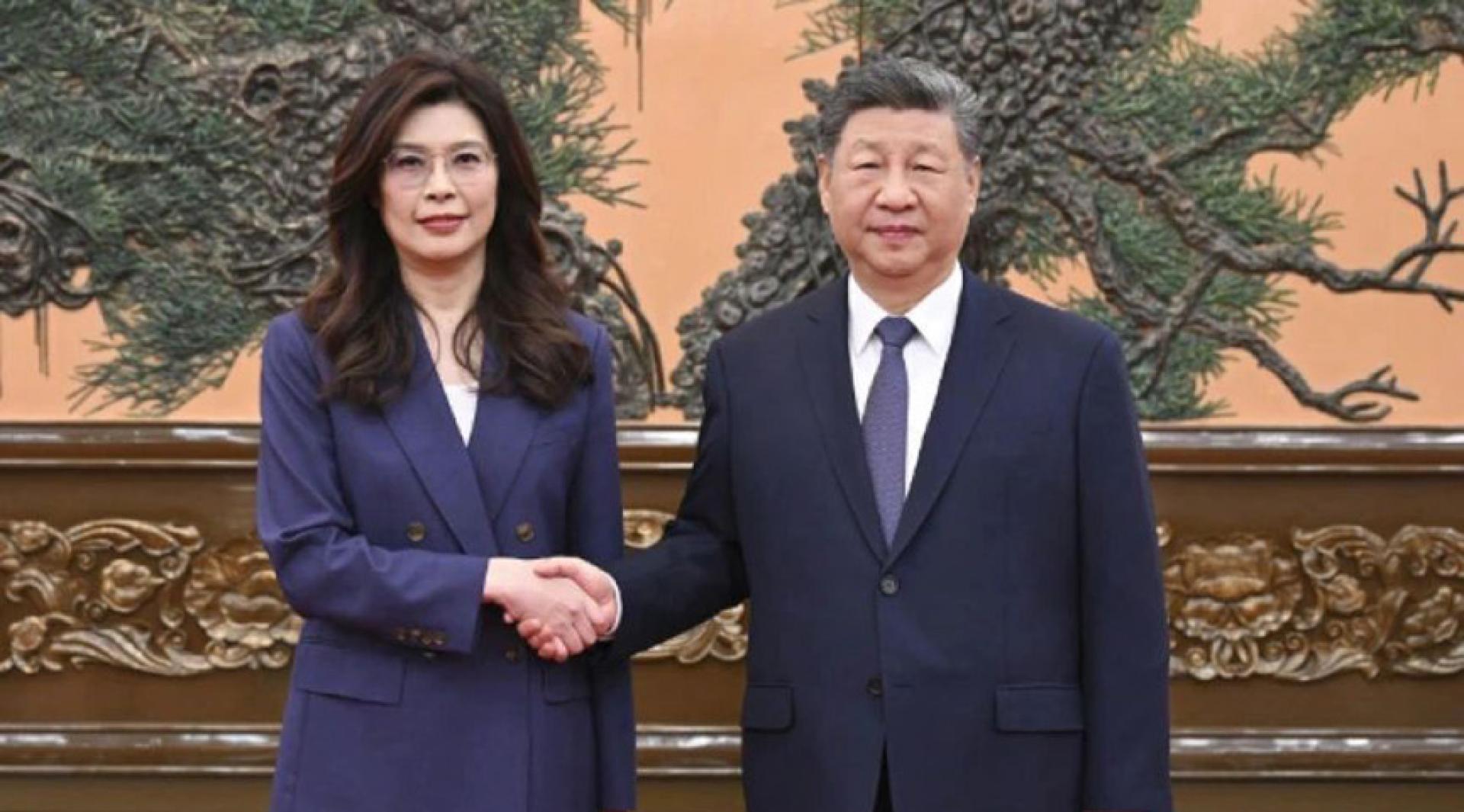
The much-anticipated meeting between Xi Jinping and Cheng Li-wen took place, with both sides' remarks showing a high degree of alignment in political statements, focusing on upholding the 1992 Consensus and opposing Taiwan independence. The cross-strait relationship was placed within the grand narrative of the Chinese nation and civilization, with peace as the core theme of the meeting. Interviewed scholars analyzed that Beijing adopted a relatively softer approach this time, not only appealing to win over the hearts and minds of the Taiwanese people but also intending to create a more peaceful and stable environment around China ahead of U.S. President Trump’s visit.
On Friday morning (April 10), Chinese Communist Party General Secretary Xi Jinping held talks with Kuomintang Chairman Cheng Li-wen at 11 a.m. in the East Hall of the Great Hall of the People in Beijing. The two first engaged in about 10 minutes of opening public remarks, followed by a one-hour closed-door meeting. Afterwards, Cheng Li-wen, along with Vice Chairmen Lee Chien-lung, Chang Jung-kung, and Hsiao Hsu-tsen, as well as Kuomintang think tank Vice Chairman Lee Hong-yuan, stayed at the Great Hall of the People to attend a banquet hosted by Xi Jinping.
According to Taiwanese media broadcasts, Xi Jinping stated in his opening remarks that he is willing, on the common political basis of upholding the 1992 Consensus and opposing Taiwan independence, to strengthen exchanges and dialogue together with all political parties, groups, and people from all sectors in Taiwan, including the Kuomintang, in order to seek peace across the strait, promote the well-being of compatriots, pursue the rejuvenation of the nation, and firmly place the future of cross-strait relations in the hands of the Chinese people.
In her address, Cheng Li-wen similarly expressed the hope that the Kuomintang and Communist parties would jointly promote the institutionalization of cross-strait peace, and, on the common political basis of upholding the 1992 Consensus and opposing Taiwan independence, further plan and construct an institutionalized and sustainable mechanism for dialogue and cooperation, to make the peaceful development of cross-strait relations irreversible.
Wang Hsin-hsien, Director of the International Relations Research Center at National Chengchi University in Taiwan, told Lianhe Zaobao in an interview that Xi Jinping’s remarks showed that Beijing this time did not further stress the “one China principle within the 1992 Consensus,” nor explicitly mention the “two systems solution” or strongly highlight opposition to outside interference, but handled the issue in a more moderate way, which is "better" for the Kuomintang.
As for whether Cheng Li-wen's institutionalization proposal implicitly refers to cross-strait political consultations, Wang Hsin-hsien believes Cheng's statement targets “institutionalization of cross-strait peace,” that is, restoring institutionalized mechanisms for cross-strait and inter-party interaction.
In addition to the common political foundation, both sides in this meeting also elevated cross-strait linkages to the level of ethnicity and civilization.
Xi Jinping stated that compatriots on both sides of the strait belong to the Chinese nation, that “sons and daughters on both sides of the strait share Chinese roots and the Chinese spirit”; Cheng Li-wen said that what both parties have always pursued is how to bring the Chinese nation from decline to rejuvenation, and claimed that “the great rejuvenation of the Chinese nation is the common rejuvenation of the people on both sides of the strait.”
On the issue of peace, Xi Jinping pointed out that the world today is not peaceful, peace is especially precious, both sides of the strait are Chinese, one family, and “the desire for peace, development, exchanges and cooperation is the shared aspiration.” Cheng Li-wen further concretized peace into system design, advocating that both sides should transcend political confrontation and seek institutional solutions to prevent and avoid war.
In addition, Cheng Li-wen also said that “the Taiwan Strait will no longer be a focal point of potential conflict, and will certainly not become a chessboard for outside intervention,” echoing Xi Jinping’s statement “to firmly place the future of cross-strait relations in the hands of the Chinese people,” highlighting that both sides have formed a clear convergence in their statements on opposing external intervention in Taiwan Strait affairs.
Overall, Wang Hsin-hsien believes that Xi Jinping’s remarks were obviously more restrained on several key points—“mentioning the 1992 Consensus but not ‘one China’; talking about the Chinese nation but not forging a ‘Chinese national community consciousness’”—demonstrating that Beijing is mindful of political reactions within Taiwan. At the same time, Xi’s meeting with Cheng Li-wen at this time is also intended to create a relatively peaceful and stable environment ahead of U.S. President Trump’s visit.
Wang Hsin-hsien also said that this meeting demonstrated Cheng Li-wen’s grasp of the current atmosphere in Taiwan society, which is unwilling to move towards war.
However, he believes the cross-strait issue is now more of a defensive topic for the Kuomintang: “Whether this is a plus for the Kuomintang as a whole is unclear; but for Cheng Li-wen personally, in terms of intra-party authority and her ability to lead U.S.-China-Taiwan issues, it is beneficial.”
Qi Dongtao, Senior Research Fellow at the East Asian Institute of the National University of Singapore, analyzed in an interview with Lianhe Zaobao that Xi Jinping’s opening remarks at his meeting with Cheng Li-wen were more abstract than those during meetings with previous Kuomintang chairpersons, without directly calling for cross-strait unification, but instead aiming to appeal to the hearts and minds of the people of Taiwan.
Qi Dongtao remarked that abstraction has its merits—it can avoid triggering backlash within Taiwan, and it also reflects growing mainland confidence regarding Taiwan issues.