"I only hope that after I step down, the people of the whole country can say one thing: he was an honest official, not a corrupt one. That alone would satisfy me."
At the 2000 Chinese Two Sessions’ Premier’s press conference, when asked what impression he hoped to leave with the people of China after retirement, then Premier Zhu Rongji gave the above reply. He then added, with a hint of self-deprecation: “If they’re generous enough to add that Zhu Rongji got something done, I’d be deeply grateful.”
To be an honest official, to get things done—these were Zhu Rongji’s expectations for his political career. In the eyes of the public, however, this Chinese Premier left an exceptionally deep impression: he was not only forceful and decisive, but also candid, forthright, and self-effacing.
Among all of China’s premiers, Zhu Rongji is particularly distinctive. When faced with corrupt officials, he was willing to slam the table and glare; when answering journalists, he seldom gave stock or bureaucratic replies. The image of the “Iron-Faced Premier” ran through his entire political life.
When Zhu Rongji took office as Premier in 1998, China was facing the shockwaves of the Asian Financial Crisis externally, and serious problems including heavy losses at state-owned enterprises internally. At his first Two Sessions press conference as Premier, he issued a remark that later became widely quoted: “No matter if it’s a minefield or an abyss ahead, I will forge ahead, with no hesitation, devote myself wholly, and not stop until my last breath.”
That same year, the Yangtze River suffered a catastrophic flood, and the levee at Jiujiang, Jiangxi Province, was breached. Zhu Rongji inspected the site and angrily lambasted the construction as a “tofu-dreg project,” a “bastard project,” and bluntly stated: “Human lives are at stake, this is a centennial plan and a millennial cause, and yet such a project was built—how intolerable is such corruption?” Such sharp language, rarely seen from Chinese leaders in public statements, revealed the straightforward, no-nonsense side of the new premier.
Over the next five years, Zhu Rongji pushed forward a series of reforms to state-owned enterprises, housing, and government agencies, and also advanced China’s entry into the World Trade Organization. These reforms profoundly changed the way the Chinese economy operated, but were also accompanied by considerable pain, including mass layoffs from state enterprise restructuring.
Zhu Rongji frankly admitted that the difficulties of reform “exceeded what I had expected”; but he also emphasized: “We held our ground. We made it through both of those crises. That was no easy feat, so I said in the ‘Government Work Report’: ‘Hard-won, indeed!’”
Zhu Rongji's iron-willed style was especially apparent in his attitude toward corruption and bureaucracy. Amidst China’s market transformation and the corruption it encouraged, he famously expressed his anti-corruption resolve with the so-called “coffin theory”: “To fight corruption, we must first hunt tigers, then wolves; and when it comes to tigers, we must show zero mercy. I have here prepared 100 coffins: 99 are for corrupt officials, and one for myself.”
On the Taiwan issue, Zhu Rongji was equally tough. On the eve of the 2000 Taiwan presidential election, as DPP candidate Chen Shui-bian was gaining momentum, Zhu Rongji sternly warned: “No matter who comes to power, Taiwan independence is absolutely unacceptable… Whoever seeks Taiwan independence will meet a dire end.” Nevertheless, after this warning, Chen Shui-bian was still elected.
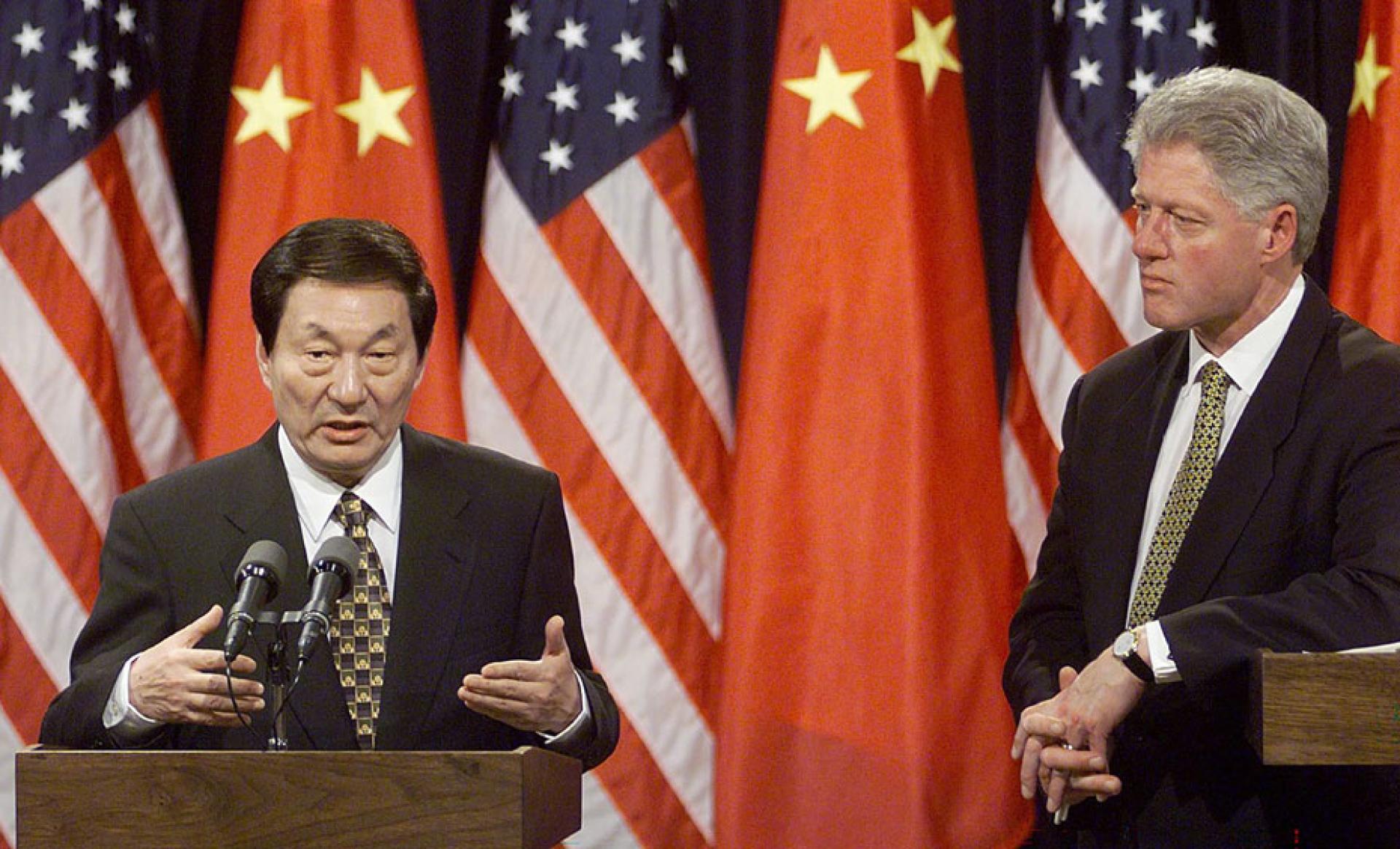
But alongside his tough edge, his humorous remarks were also remembered. In 1999, discussing US-China relations, Zhu Rongji said: “(US President) Clinton said China has just over 20 nuclear weapons while the US has more than 6,000—so what are you afraid of? But let me make it clear: whether China actually has more than 20 nuclear weapons, I genuinely don’t know myself. I also don’t know how President Clinton found out.”
In 2003, Zhu Rongji stepped down as Premier and gradually faded from public view, only occasionally appearing at key national meetings and celebrations. But the reforms he carried out during his term had a profound, lasting impact on China’s economy, and continue to provoke discussion and debate to this day.
In later years, Zhu Rongji’s sense of responsibility never faded. When asked what he planned to do after retirement, he once said: “Back in 1998, I said I would forge ahead, with no hesitation, devote myself wholly, and not stop until my last breath… But please don’t misunderstand: ‘not stop until my last breath’ does not mean I want to occupy the Premier’s seat forever… I only meant that as long as I live, as long as I have breath, I will dedicate myself to the people, and never stop until my last breath.”