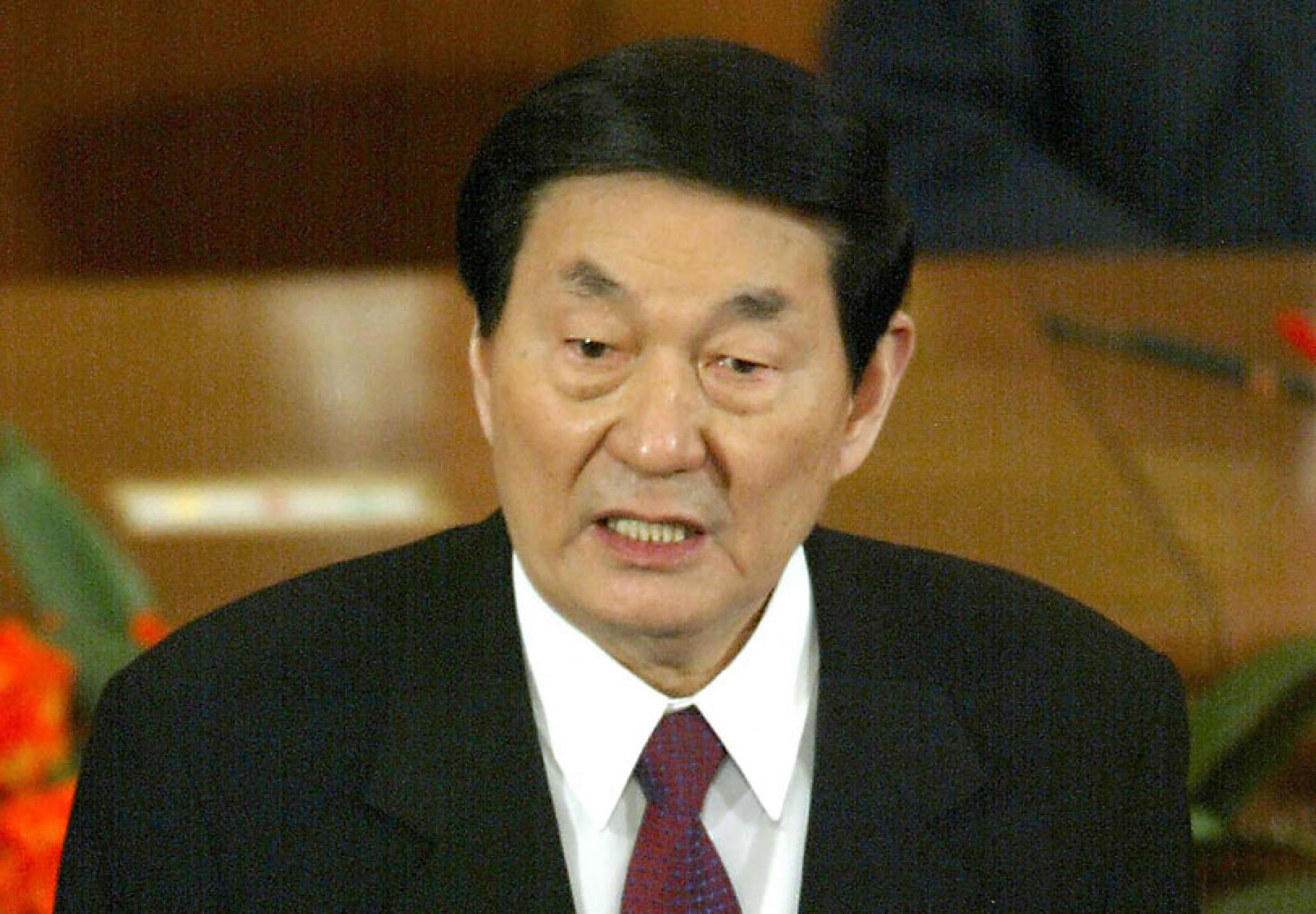
Former Politburo Standing Committee member and former Premier of the State Council of China, Zhu Rongji, passed away in Beijing at 11:06 a.m. on August 12, 2026, at the age of 98.
Zhu Rongji came from Changsha, Hunan, and graduated from the Department of Electrical Engineering at Tsinghua University as a senior engineer. He once served as a member of the 15th Politburo Standing Committee of the Communist Party of China and Premier of the State Council, and was the second central government head during the tenure of the late former General Secretary Jiang Zemin. According to Xinhuanet, Zhu Rongji was also a descendant of Mingzhuang King Zhu Xian, the eighteenth son of Ming Taizu Zhu Yuanzhang, the founding emperor of the Ming dynasty.
Zhu Rongji was suppressed within the Communist Party of China in his early years. Starting in 1958, he was purged during the Rectification Movement, Anti-Rightist Campaign, and the ten-year Cultural Revolution, and was expelled from the Party for as long as 20 years. From 1958 to 1969, he worked as a lecturer at the Cadre Evening School of the State Planning Commission (predecessor of the National Development and Reform Commission) and as an engineer at the Comprehensive Bureau of National Economy. During the Cultural Revolution in 1970, he was sent down to work for five years at the
May Seventh Cadre School" in Xiangfan, Hubei, set up by the State Planning Commission. In 1975, he returned to Beijing and worked in a technical post at an enterprise subordinate to the Ministry of Petroleum Industry.
After his Party membership was restored in 1978, Zhu Rongji took up a post at the State Economic Commission (now defunct) the following year, rising from Section Chief of the Fuel and Power Bureau and Deputy Director of the Comprehensive Bureau, and eventually became Deputy Director of the State Economic Commission.
In 1987, Zhu Rongji was parachuted into Shanghai as Deputy Secretary of the Shanghai Municipal Party Committee and later served as Mayor. After Jiang Zemin's promotion to General Secretary in 1989, Zhu Rongji concurrently served as Shanghai Party Secretary.
In April 1991, Zhu Rongji became Vice Premier of the State Council. At the 1st Plenary Session of the 14th CPC Central Committee in October 1992, he was elected to the Politburo Standing Committee; from June 1993 to June 1995, he concurrently served as Governor of the People's Bank of China. In March 1998, Zhu Rongji succeeded Li Peng, whose 10-year tenure had ended, as Premier of the State Council.
After the 15th CPC National Congress in 1997, China accelerated its transition to a market economy. At that time, large numbers of inefficient, financially subsidized state-owned enterprises still existed in China. These enterprises lacked competitiveness and were seen as a major obstacle to establishing a market economy. However, they involved the employment of large numbers of people and reform was recognized as a difficult challenge.
Jiang Zemin and Zhu Rongji demonstrated resolve, withstanding the tremendous pressure from the unemployment and re-employment of tens of millions, resulting in the bankruptcy of many state-owned enterprises, the rise of numerous private enterprises, and laying the basic framework of the market economy. However, they also attracted much criticism for this.
Dubbed the "iron-blooded premier," Zhu Rongji was known for his openness, confidence, and excellent eloquence, daring to let the media ask any questions. During his term, the premier’s press conferences expanded from one hour to more than two hours. These press conferences were not only a stage for showcasing his personal charisma but also a major window for the outside world to understand China's policy direction.
At his first premier press conference in March 1998, Zhu Rongji said, "No matter if what's ahead is a landmine field or an abyss, I will forge ahead without hesitation, dedicating myself entirely until the end." This declaration is still considered the most impactful "golden quote" from any premier’s press conference. In the following two decades, the premier’s press conference became the biggest highlight of the annual "Two Sessions" (annual sessions of the National People's Congress and the Chinese People's Political Consultative Conference).
After retiring as premier in March 2003, Zhu Rongji lived a low-key life, only occasionally appearing at important state meetings, celebrations, and universities. Zhu Rongji had a lifelong love of Peking Opera, devoting substantial time and energy to this hobby after retirement.
Zhu Rongji's last appearance at a public event was in October 2018, when he met with members of the Advisory Board of the School of Economics and Management at Tsinghua University in Beijing. He did not attend such major events as the 70th anniversary of the founding of the People's Republic of China in 2019, the 100th anniversary of the founding of the Communist Party in 2021, or the 20th Party Congress in 2022.
Zhu Rongji and his wife, Lao An, had a son (Zhu Yunlai) and a daughter (Zhu Yanlai).