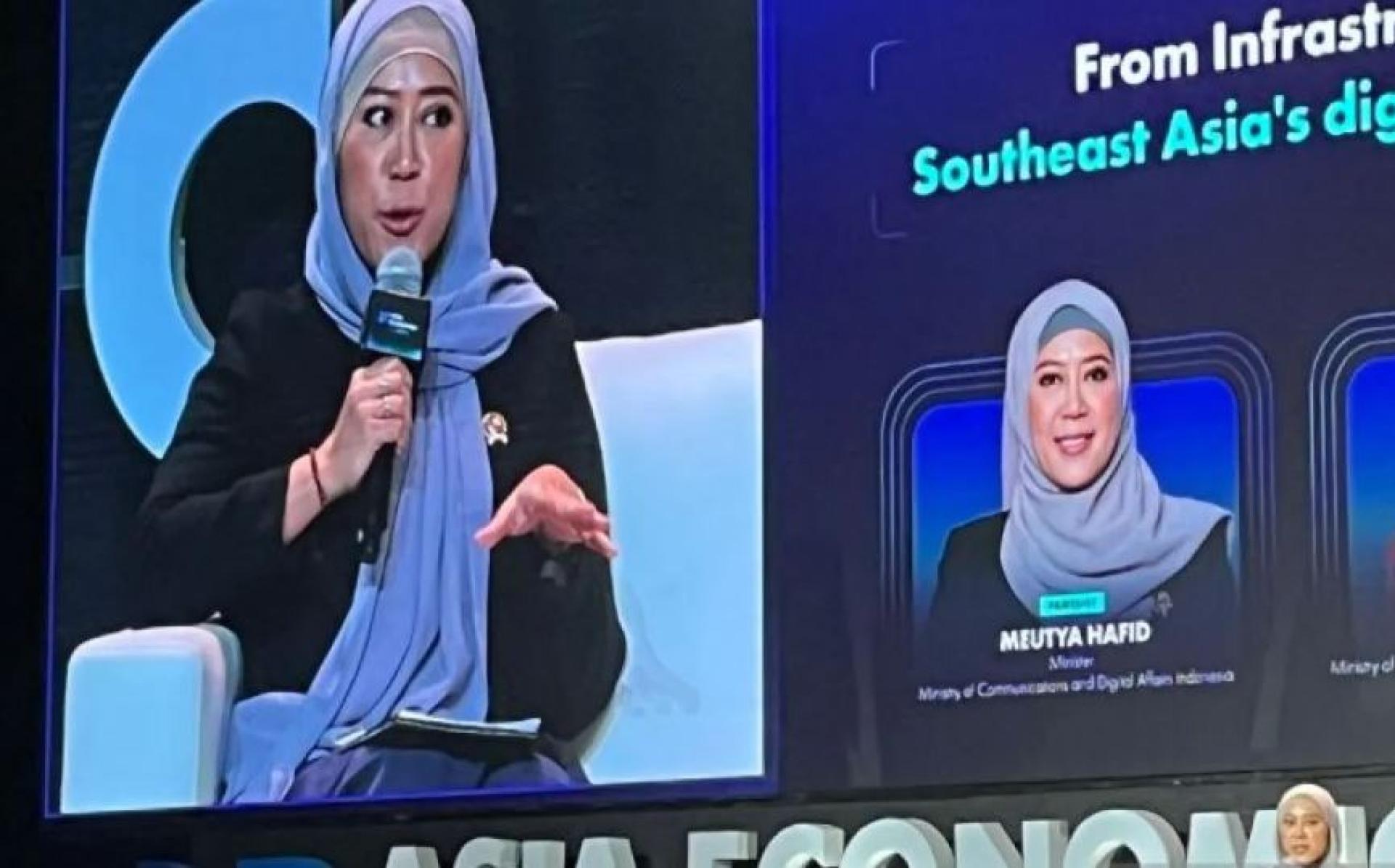
(Jakarta, 18th – Comprehensive News) Indonesia's Minister of Communication and Digital Affairs, Mutia Hafid, on Wednesday called on ASEAN countries to jointly formulate a framework for artificial intelligence (AI) governance, to prevent this technology from further widening the digital divide within the region.
Speaking at the 2026 Asian Economic Summit held in Jakarta, Hafid pointed out that while artificial intelligence can accelerate economic growth, improve productivity, and strengthen competitiveness, the lack of effective regulation also brings significant risks that cannot be ignored.
"This risk not only concerns Indonesia but the entire region. If access is unequal, artificial intelligence will deepen the gap between the haves and the have-nots—both within countries and between nations," she said.
She noted that as artificial intelligence becomes increasingly advanced, the value of data is rising by the day, and data has also become a growing target for cybercrime. Currently, the cost of committing fraud has become nearly zero, and deepfake technologies ignore national boundaries even further.
Hafid warned that if the region allows others to control its data, it is tantamount to handing over its future leadership; while global AI models that do not learn local languages and values may erode ASEAN’s cultural identity.
She emphasized that these challenges should not become a reason to slow AI development, but rather spur governments into strategic action—working together to build a governance framework that transforms risks into collective advantages.
Indonesia is currently driving ASEAN’s AI development based on three main principles: sovereignty, interoperability, and reliability. This approach emphasizes countries' autonomous control over data, computational power, and AI models, while supporting open standards, cross-border certification, and joint protection mechanisms aligned with ASEAN AI governance principles.
Hafid stated that trust should be seen as a driver rather than a barrier, and is indispensable for expanding AI applications and attracting regional investment.
She also highlighted the Digital Economy Framework Agreement (DEFA) as a key initiative to advance regional digital cooperation, pointing out that ASEAN’s digital economy is currently valued at about US$300 billion, and, if the agreement is implemented, is expected to reach US$2 trillion by 2030.
She stated that the related dividends should benefit micro, small, and medium-sized enterprises (MSMEs)—which account for about 97% of ASEAN businesses—so that digital growth can translate into broader regional prosperity.
"Let us not only move forward, but do so wisely; not only maintain connectivity, but realize empowerment. Indonesia is ready to join hands with Singapore and all ASEAN partners to jointly build a truly inclusive digital future for everyone," Hafid said.
"This risk not only concerns Indonesia but the entire region. If access is unequal, artificial intelligence will deepen the gap between the haves and the have-nots—both within countries and between nations," she said.
She noted that as artificial intelligence becomes increasingly advanced, the value of data is rising by the day, and data has also become a growing target for cybercrime. Currently, the cost of committing fraud has become nearly zero, and deepfake technologies ignore national boundaries even further.
Hafid warned that if the region allows others to control its data, it is tantamount to handing over its future leadership; while global AI models that do not learn local languages and values may erode ASEAN’s cultural identity.
She emphasized that these challenges should not become a reason to slow AI development, but rather spur governments into strategic action—working together to build a governance framework that transforms risks into collective advantages.
Indonesia is currently driving ASEAN’s AI development based on three main principles: sovereignty, interoperability, and reliability. This approach emphasizes countries' autonomous control over data, computational power, and AI models, while supporting open standards, cross-border certification, and joint protection mechanisms aligned with ASEAN AI governance principles.
Hafid stated that trust should be seen as a driver rather than a barrier, and is indispensable for expanding AI applications and attracting regional investment.
She also highlighted the Digital Economy Framework Agreement (DEFA) as a key initiative to advance regional digital cooperation, pointing out that ASEAN’s digital economy is currently valued at about US$300 billion, and, if the agreement is implemented, is expected to reach US$2 trillion by 2030.
She stated that the related dividends should benefit micro, small, and medium-sized enterprises (MSMEs)—which account for about 97% of ASEAN businesses—so that digital growth can translate into broader regional prosperity.
"Let us not only move forward, but do so wisely; not only maintain connectivity, but realize empowerment. Indonesia is ready to join hands with Singapore and all ASEAN partners to jointly build a truly inclusive digital future for everyone," Hafid said.