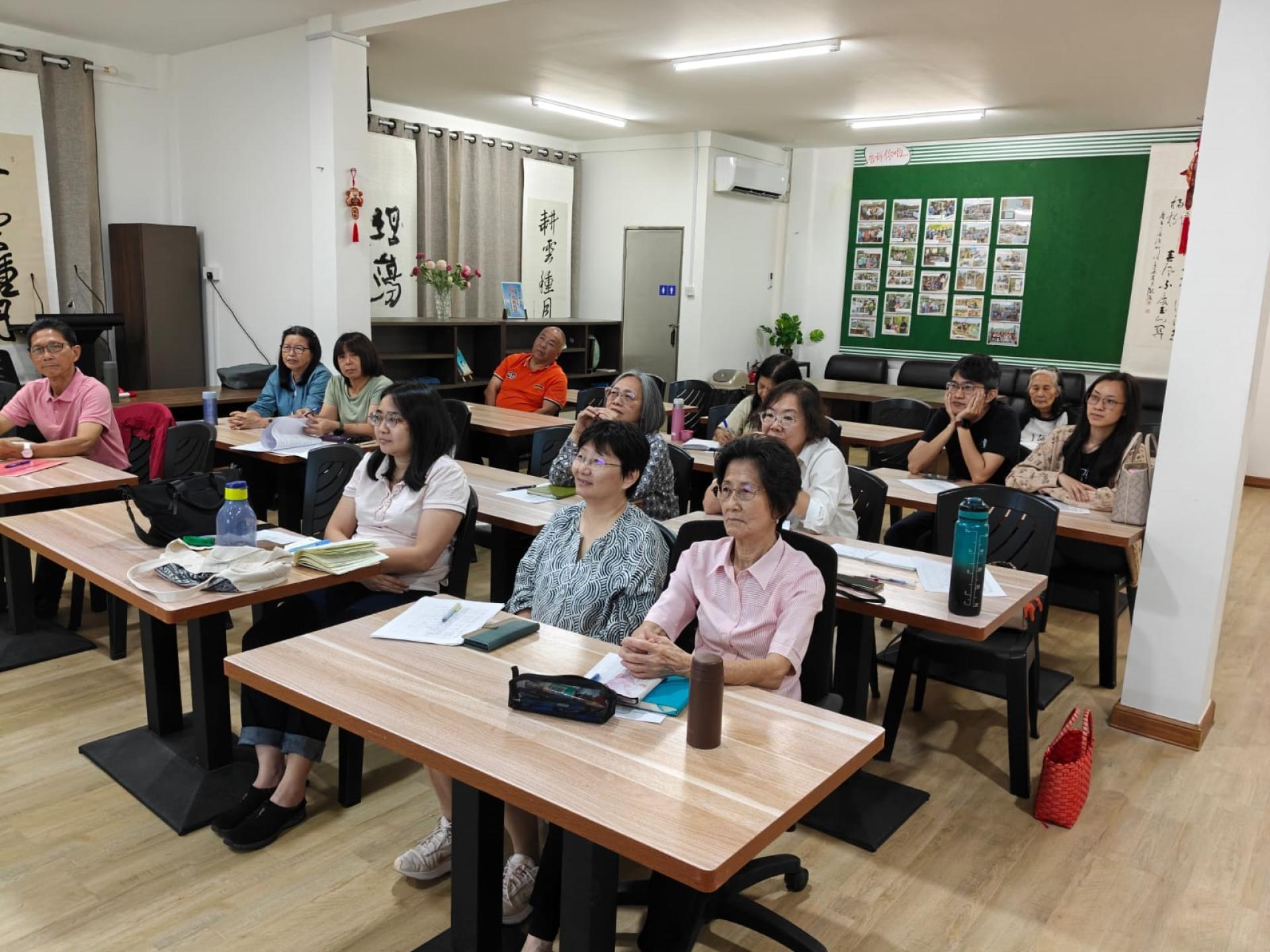
(Sibu, 11th) The first session of the 2026 ‘Cultural Academy’ featured a special lecture by Teacher Xu Lili, elucidating the benefits of learning classic literature for personal growth.
In this session of the ‘Cultural Academy’, Teacher Xu Lili gave an insightful analysis on the importance of learning classical literature for everyone.
Teacher Xu explained that Chinese traditional literature is the crystallization of thousands of years of Chinese civilization’s spirit and wisdom. From the Book of Songs and Analects to Tang and Song poetry, from historical records to various masterpieces, classic literature not only records history but also shapes the spiritual backbone of human civilization. As a vital carrier of Chinese culture, traditional literature is not only a treasure trove of knowledge but also nourishment for the spirit, lighting up the path of human life.
Teacher Xu, with profound cultural knowledge, explained through slides and examples in four points:
1. The Beauty of the Classics: Nourishing Language and Soul
The Book of Songs says: “Without literary grace, words don’t travel far.” The beauty of language originates from the beauty of thought and soul. When people recite the Book of Songs and Songs of Chu, they come into contact with the most original and pure expressions of Chinese; when learning Tang and Song poetry, they experience the most refined and heartfelt artistic language.
‘Guan Ju’ expresses restrained and pure emotions; ‘Jian Jia’ illustrates perseverance on the path of seeking; Li Bai’s “Someday the wind and waves will rise, and sail the sea with a cloud-white sail” inspires courage; Wang Wei’s “When the river seems to end, I sit and watch the clouds rise” teaches tranquility and contemplation. These classic words become spiritual treasures for life. When our hearts are filled with poetry, the world is no longer colorless.
2. The Power of Character in Classics: Shaping Moral Foundations
Traditional literature conveys profound truths through vivid characters and stories. The Analects’ “A gentleman is broad-minded, a petty man is ever anxious” teaches magnanimity and clarity; The ‘Records of the Historian: The Biography of Lian Po and Lin Xiangru’ shows exemplars of tolerance and responsibility; Qu Yuan’s “The way ahead is endless and long, I will search high and low” in ‘Li Sao’ encourages continual striving.
In ‘Romance of the Three Kingdoms’, Guan Yu’s “loyalty and righteousness reach the clouds” interprets true loyalty; in ‘Dream of the Red Chamber’, Jia Baoyu’s “Never forget, long bless and prosper” teaches the value of cherishing emotions. These values help people gain clarity when facing choices, and strength when confronting difficulties.
3. Traditional Literature Provides Cultural Roots and a Sense of Belonging
Traditional literature gives people cultural roots and spiritual support. Su Shi’s “My heart is like wood turned to ashes, my body like a boat unmoored” lets the lost know that even the ancients faced confusion but ultimately persevered; Du Fu’s “I shall climb to the summit, to view all mountains at a glance” inspires the pursuit of greater horizons; Xin Qiji’s “In youth one does not know the taste of sorrow” and “Just say, ‘what a cool autumn!’” help us realize that life’s joys and sorrows are intertwined, and beauty is often found alongside hardship.
These poems and writings build a sense of cultural stability and emotional belonging. When we recite lines that have been passed down for millennia, it becomes clear: wherever one may be, the Chinese language and culture are always the root of the soul.
4. Classics Broaden, Strengthen, and Soften the Heart
The power of literature quietly transforms us. It does not make noise, but extends a helping hand when needed. In times of disappointment, Su Shi’s “It’s neither wind nor rain, nor fair” teaches openness; in solitude, Li Bai’s “Raise my cup and invite the bright moon” tells us we are never truly alone; when encountering injustice, Mencius’s “When Heaven is about to place a great responsibility on a person” teaches that adversity is part of growth; in diligent study, Yan Zhenqing’s “The young do not realize the need for diligent study, only regretting it in old age” reminds us to treasure time. The wisdom of the ancients transforms into inner strength, helping one grow into a person with roots, resilience, and warmth.
The Book of Rites says: “Learning alone without friends makes one ignorant and uninformed.” People need spiritual companionship, and the classics are the best “friends”. In conclusion, Teacher Xu Lili earnestly encouraged everyone, especially parents and teachers, to let traditional literature become an ever-burning light in life. To inherit traditional literature is not only to pass on Chinese characters and grammar, but also to keep alight the spiritual torch across the millennia. May the transmission of knowledge and the illumination of the soul go hand in hand, may the teaching of language and the nurturing of character be held equally, and may the brilliance of Chinese literature continue to shine, lighting the way for generations to come.
Teacher Xu explained that Chinese traditional literature is the crystallization of thousands of years of Chinese civilization’s spirit and wisdom. From the Book of Songs and Analects to Tang and Song poetry, from historical records to various masterpieces, classic literature not only records history but also shapes the spiritual backbone of human civilization. As a vital carrier of Chinese culture, traditional literature is not only a treasure trove of knowledge but also nourishment for the spirit, lighting up the path of human life.
Teacher Xu, with profound cultural knowledge, explained through slides and examples in four points:
1. The Beauty of the Classics: Nourishing Language and Soul
The Book of Songs says: “Without literary grace, words don’t travel far.” The beauty of language originates from the beauty of thought and soul. When people recite the Book of Songs and Songs of Chu, they come into contact with the most original and pure expressions of Chinese; when learning Tang and Song poetry, they experience the most refined and heartfelt artistic language.
‘Guan Ju’ expresses restrained and pure emotions; ‘Jian Jia’ illustrates perseverance on the path of seeking; Li Bai’s “Someday the wind and waves will rise, and sail the sea with a cloud-white sail” inspires courage; Wang Wei’s “When the river seems to end, I sit and watch the clouds rise” teaches tranquility and contemplation. These classic words become spiritual treasures for life. When our hearts are filled with poetry, the world is no longer colorless.
2. The Power of Character in Classics: Shaping Moral Foundations
Traditional literature conveys profound truths through vivid characters and stories. The Analects’ “A gentleman is broad-minded, a petty man is ever anxious” teaches magnanimity and clarity; The ‘Records of the Historian: The Biography of Lian Po and Lin Xiangru’ shows exemplars of tolerance and responsibility; Qu Yuan’s “The way ahead is endless and long, I will search high and low” in ‘Li Sao’ encourages continual striving.
In ‘Romance of the Three Kingdoms’, Guan Yu’s “loyalty and righteousness reach the clouds” interprets true loyalty; in ‘Dream of the Red Chamber’, Jia Baoyu’s “Never forget, long bless and prosper” teaches the value of cherishing emotions. These values help people gain clarity when facing choices, and strength when confronting difficulties.
3. Traditional Literature Provides Cultural Roots and a Sense of Belonging
Traditional literature gives people cultural roots and spiritual support. Su Shi’s “My heart is like wood turned to ashes, my body like a boat unmoored” lets the lost know that even the ancients faced confusion but ultimately persevered; Du Fu’s “I shall climb to the summit, to view all mountains at a glance” inspires the pursuit of greater horizons; Xin Qiji’s “In youth one does not know the taste of sorrow” and “Just say, ‘what a cool autumn!’” help us realize that life’s joys and sorrows are intertwined, and beauty is often found alongside hardship.
These poems and writings build a sense of cultural stability and emotional belonging. When we recite lines that have been passed down for millennia, it becomes clear: wherever one may be, the Chinese language and culture are always the root of the soul.
4. Classics Broaden, Strengthen, and Soften the Heart
The power of literature quietly transforms us. It does not make noise, but extends a helping hand when needed. In times of disappointment, Su Shi’s “It’s neither wind nor rain, nor fair” teaches openness; in solitude, Li Bai’s “Raise my cup and invite the bright moon” tells us we are never truly alone; when encountering injustice, Mencius’s “When Heaven is about to place a great responsibility on a person” teaches that adversity is part of growth; in diligent study, Yan Zhenqing’s “The young do not realize the need for diligent study, only regretting it in old age” reminds us to treasure time. The wisdom of the ancients transforms into inner strength, helping one grow into a person with roots, resilience, and warmth.
The Book of Rites says: “Learning alone without friends makes one ignorant and uninformed.” People need spiritual companionship, and the classics are the best “friends”. In conclusion, Teacher Xu Lili earnestly encouraged everyone, especially parents and teachers, to let traditional literature become an ever-burning light in life. To inherit traditional literature is not only to pass on Chinese characters and grammar, but also to keep alight the spiritual torch across the millennia. May the transmission of knowledge and the illumination of the soul go hand in hand, may the teaching of language and the nurturing of character be held equally, and may the brilliance of Chinese literature continue to shine, lighting the way for generations to come.