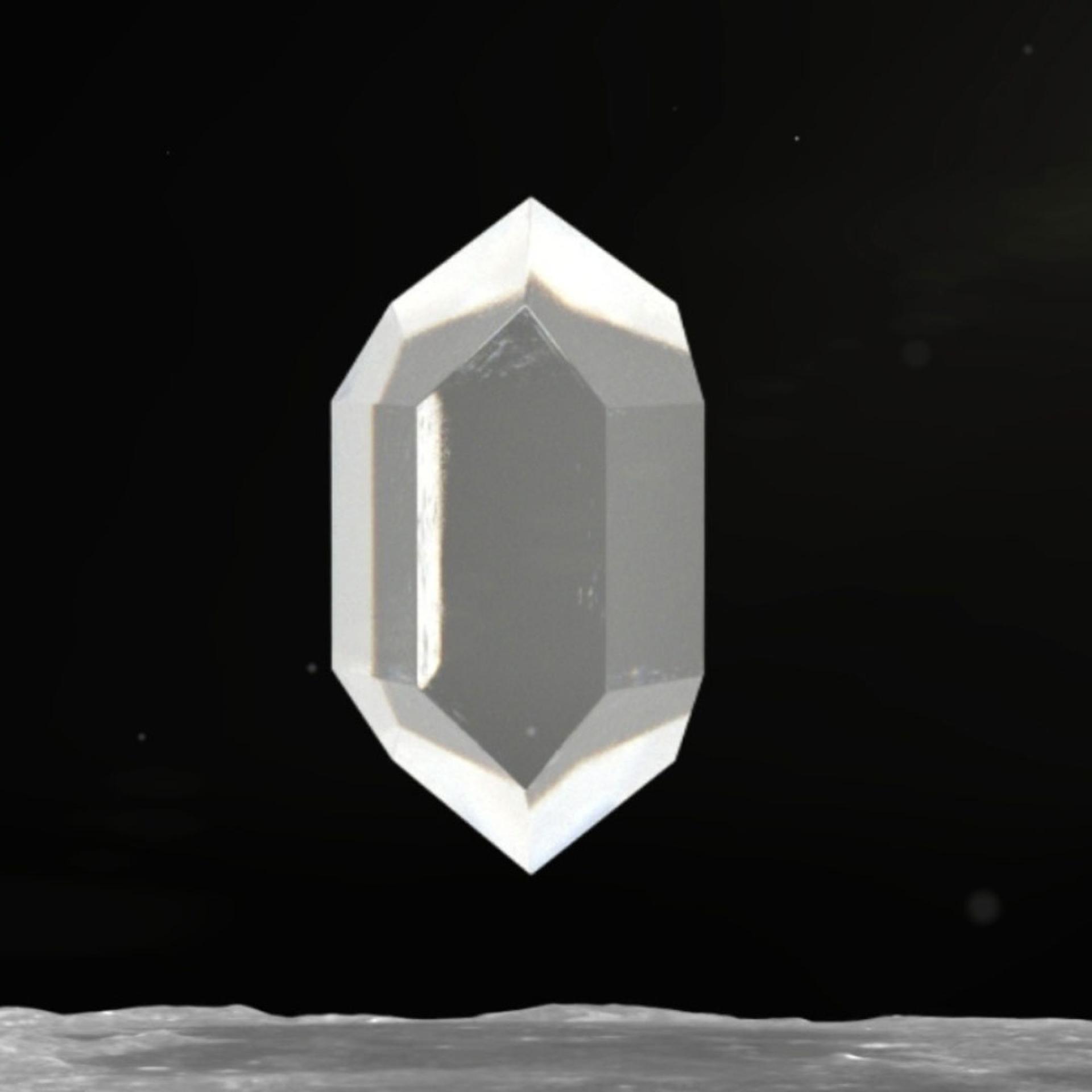
On April 24, at the launch ceremony of the main event for the eleventh "China Space Day" held in Chengdu, Sichuan, the China National Space Administration released the latest research findings from the Chang’e-5 lunar samples. Following the discovery of Changesite in 2022, Chinese scientists have now identified two more new lunar minerals from the Chang’e-5 samples, officially named Magnesium-Changesite and Cerium-Changesite. With these discoveries, the total number of new lunar minerals identified in returned lunar soil samples by humanity has risen to eight.
It is reported that both Magnesium-Changesite and Cerium-Changesite have been approved by the International Mineralogical Association’s Commission on New Minerals, Nomenclature and Classification. Both minerals belong to the family of rare earth phosphate minerals, concealed within the fine lunar soil dust, with particle sizes only a few microns across. Their crystal structures are exquisitely unique, and there are no exactly corresponding minerals on Earth. Together with the previously discovered Changesite, they belong to the merrillite group, a type of phosphate mineral commonly found in lunar, Martian, and asteroid samples, although their composition and distribution show great diversity and heterogeneity across different planetary bodies.
Experts interviewed said this discovery provides important scientific evidence for deepening research into the lunar material composition, geological evolution, and lunar origin. It is another major achievement integrating China’s deep space exploration with fundamental scientific research, and has great significance for advancing human understanding of the Moon and the universe. The discovery of these new lunar minerals rich in rare earth elements also establishes a foundational data set for assessing the Moon’s rare earth resource potential and future in-situ resource utilization.
Magnesium-Changesite was discovered by a team from the Nuclear Industry Beijing Research Institute of Geology (referred to as "BNIGRI"), in collaboration with the National Astronomical Observatories of the Chinese Academy of Sciences and Jiangxi Applied Science and Technology College. It appears as short columnar crystals with a grain size of only 2 to 30 microns, invisible to the naked eye.
Regarding the difference between Changesite and Magnesium-Changesite, Ge Xiangkun, Deputy Director of the Analytical Division at BNIGRI, explained that the key differences lie in composition and crystal structure. Using a house as an analogy, he described that while one of the "rooms" in the former is "occupied" by iron, in the latter it is "occupied" by magnesium, while the other "rooms" contain the same elements. Additionally, the "floor height" of Magnesium-Changesite is about half that of Changesite.
Li Ziying, Chief Scientist at BNIGRI, stated that different minerals form under different conditions. The higher magnesium content in Magnesium-Changesite compared to Changesite suggests it may have formed at a higher temperature. The unique composition and structure of Magnesium-Changesite offer a brand-new mineralogical sample for studying lunar formation and evolution, magmatic activity, and chemical differentiation.
Cerium-Changesite was discovered by a research team led by the Chinese Academy of Geological Sciences. It was found both in the Chang’e-5 lunar samples and in a lunar meteorite that fell within China's territory. Unlike Changesite, which is rich in heavy rare earth element yttrium, Cerium-Changesite is a calcium phosphate mineral rich in the light rare earth element cerium. It is colorless and transparent, has a glassy luster, is brittle, has conchoidal fracture, and grain sizes ranging from about 3 to 15 microns.
Academician Hou Zengqian of the Chinese Academy of Sciences pointed out that the new lunar minerals found in lunar soil collected by the US Apollo missions are richer in heavy rare earth elements, whereas the Chang’e-5 lunar samples analyzed by China have yielded minerals with pronounced enrichment in light rare earth elements. This indicates that during the lunar magmatic evolution, light and heavy rare earth elements displayed evident differentiation behaviors. This provides key mineralogical evidence for understanding the crystallization and differentiation mechanisms of materials inside the Moon, enriches our knowledge of the geochemical behavior of rare earth elements, and offers a fresh perspective for understanding the formation mechanisms of different types of rare earth ore deposits on Earth.