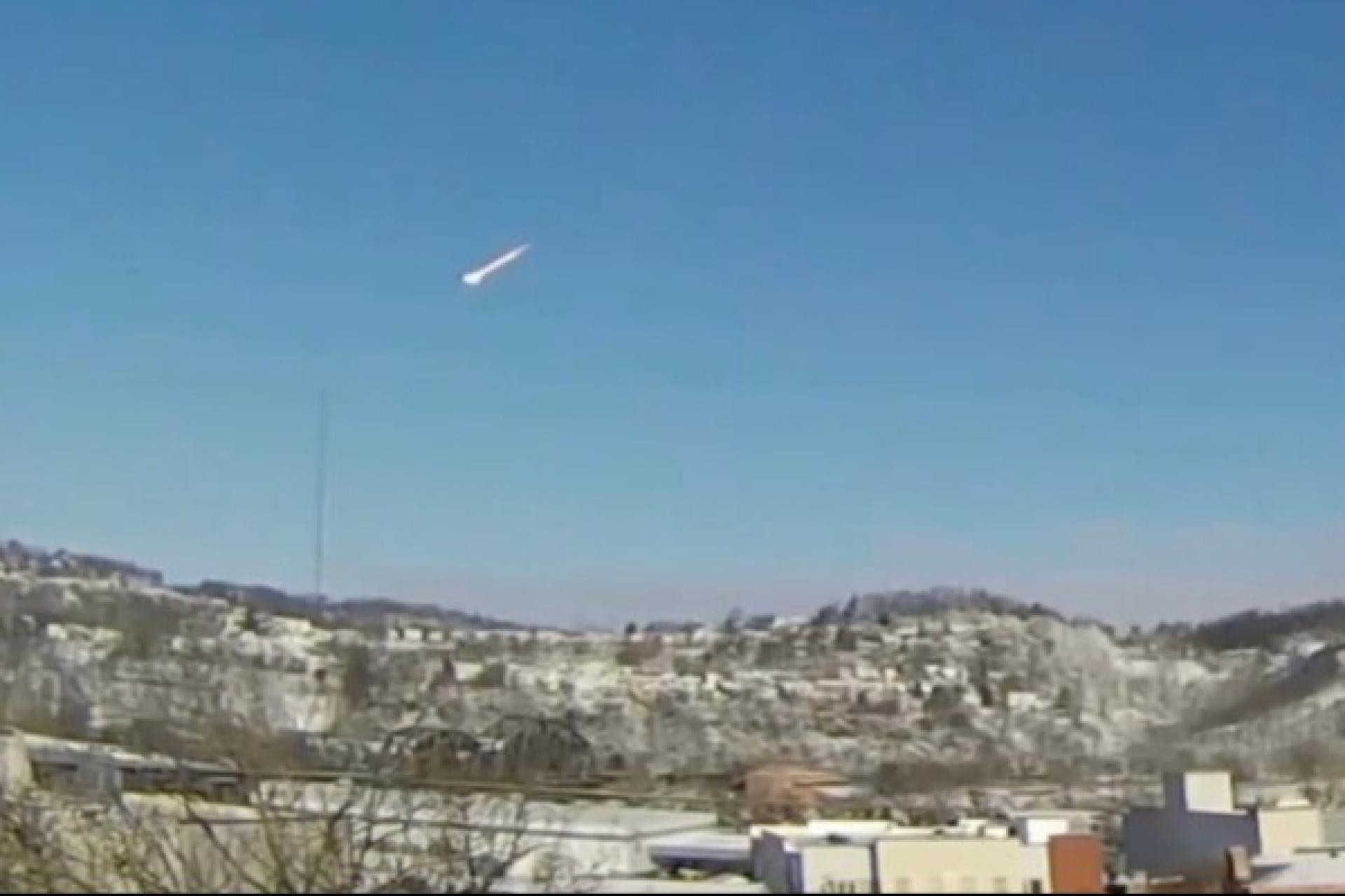
According to reports from multiple U.S. media outlets, on the morning of the 17th local time, a meteor weighing 7 tons and about 1.83 meters (nearly 6 feet) in diameter streaked across the sky over Cleveland, Ohio, in the eastern United States at a speed of 45,000 miles per hour (about 72,000 kilometers per hour), disintegrating mid-air with a massive booming noise.
Some residents mistook the event for an explosion and were in a panic. Surveillance footage shows the moment the bright fireball crossed the sky with exceptional clarity. Although the event occurred at 9 a.m., people as far as Wisconsin and Maryland also reported witnessing the phenomenon.
The American Meteor Society stated that it had received eyewitness reports from across multiple states.
According to estimates, the energy released when the meteor broke apart was equivalent to about 250 tons of TNT, producing a boom that was heard and felt as minor tremors even by staff at the Cleveland National Weather Service office. No meteorite fragments have been found yet.
Robert Lunsford, executive director and astronomer at the American Meteor Society, stated that the fireball was likely an asteroid or meteorite. On average, meteors fall over the U.S. daily, and much smaller space dust particles can enter the atmosphere up to ten times per hour.
Scientists typically rely on specialized camera networks to track meteors, but now more and more members of the public are using smartphones or surveillance cameras to record nighttime sky events, providing researchers with more data.
Meteoroids mostly originate from comets or asteroids. When they enter Earth's atmosphere, friction causes them to glow and heat up—what we see as meteors. If a meteoroid passes through the atmosphere without completely burning up, the remnants are called meteorites, which are what may reach the ground as physical specimens.
The American Meteor Society stated that it had received eyewitness reports from across multiple states.
According to estimates, the energy released when the meteor broke apart was equivalent to about 250 tons of TNT, producing a boom that was heard and felt as minor tremors even by staff at the Cleveland National Weather Service office. No meteorite fragments have been found yet.
Robert Lunsford, executive director and astronomer at the American Meteor Society, stated that the fireball was likely an asteroid or meteorite. On average, meteors fall over the U.S. daily, and much smaller space dust particles can enter the atmosphere up to ten times per hour.
Scientists typically rely on specialized camera networks to track meteors, but now more and more members of the public are using smartphones or surveillance cameras to record nighttime sky events, providing researchers with more data.
Meteoroids mostly originate from comets or asteroids. When they enter Earth's atmosphere, friction causes them to glow and heat up—what we see as meteors. If a meteoroid passes through the atmosphere without completely burning up, the remnants are called meteorites, which are what may reach the ground as physical specimens.