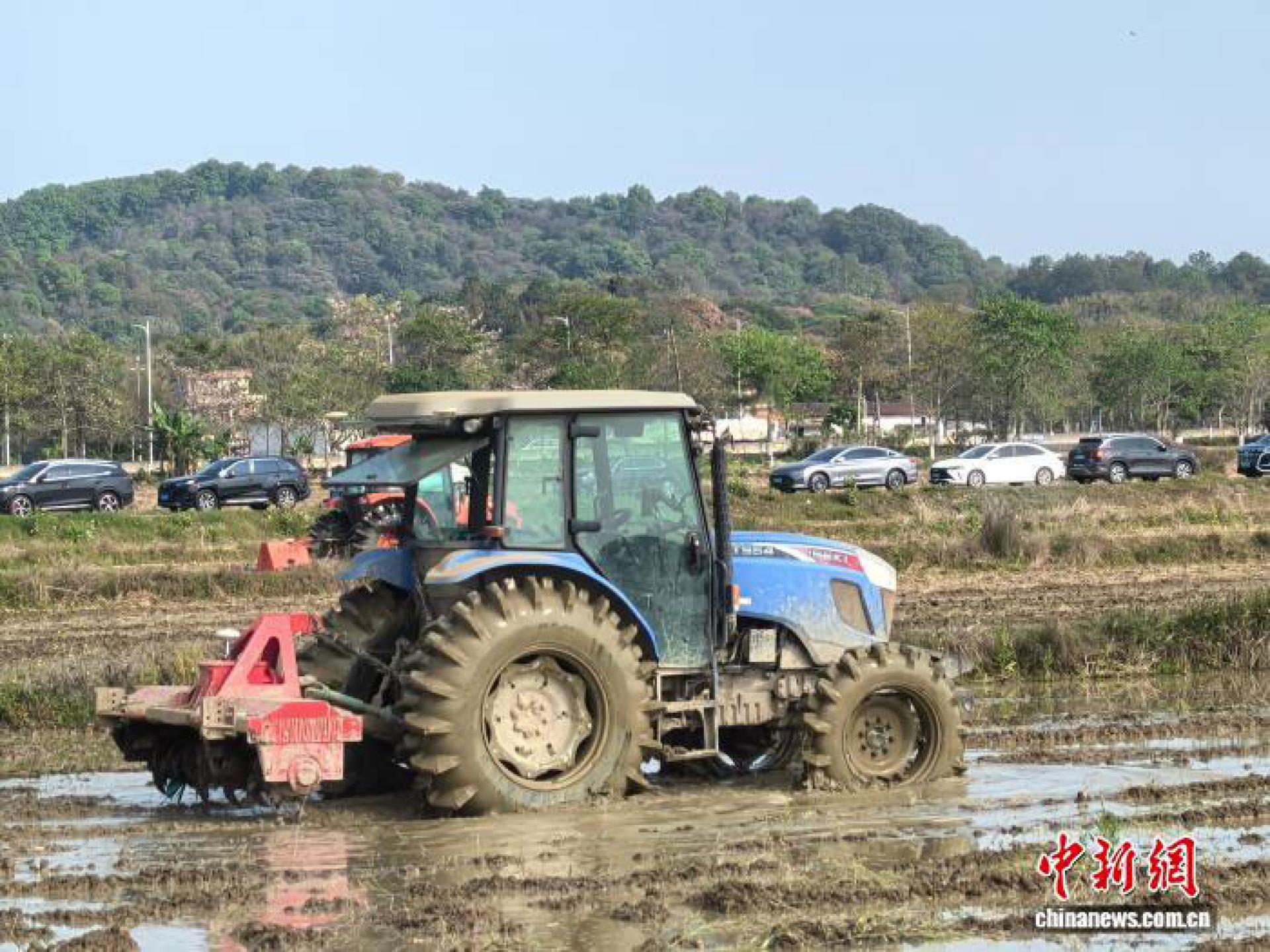
Spring returns to the land, bringing all things back to life. On the 16th, reporters visited Aotou Town in Conghua, Guangzhou, where six intelligent plant-protection drones could be seen busily at work above the expanses of farmland.
Zhao Runmao, Associate Professor at the School of Engineering, South China Agricultural University, stated in an interview with China News Service: “With manual rice transplanting, one person can plant an acre per day, while a driverless rice transplanter can plant five acres in an hour. For manual rice broadcasting, a person can only seed up to six acres of paddy per day, whereas a driverless direct seeding machine can sow five acres or more an hour. Spraying manually, one person can spray at most three acres a day, but a drone can spray 200 acres an hour. For harvesting, one person can only harvest half an acre per day manually, but a driverless harvester can harvest five to six acres in an hour.”
According to reports, this year Conghua District is vigorously promoting the widespread use of drones in spring plowing, with a focus on deploying heavy-duty models that can carry over 100 kilograms per unit, enabling large-scale fertilization and precision seeding operations. At the same time, new drones equipped with AI-powered obstacle avoidance and route planning systems are being used, significantly improving efficiency in pesticide spraying. Compared to traditional manual operations, a single drone's daily working area can reach 300 to 500 acres, improving efficiency by 50 to 100 times and reducing both agricultural material waste and labor costs.
In the core area of rice cultivation in Conghua, the unmanned farm led by the team of Academician Luo Xiwen of the Chinese Academy of Engineering has put driverless rice transplanters and smart tractors equipped with the BeiDou navigation system on the front lines. With the aid of high-precision satellite positioning, straight-line operation errors are controlled within centimeters, achieving precision seeding and standardized dense planting. Through optimal plant spacing technology, each rice seedling can receive ample light and growing space, laying the foundation for stabilizing and increasing per-acre grain yields.
Relying on the already established smart agriculture experimental zones for Silk Seedling Rice, lychees, and flowers, agricultural production in Conghua has achieved real-time environmental monitoring and remote intelligent regulation. At Aimi Daoxiang Agricultural Park, a 5G digital farmland solution has been put into application, enabling staff to view soil moisture conditions, weather changes, and other data via a mobile app, and remotely control integrated water and fertilizer facilities. From individual greenhouses to connected plots of farmland, data flows in the cloud and instructions are issued at your fingertips, and the vision of "one person managing a thousand acres" is becoming a reality.