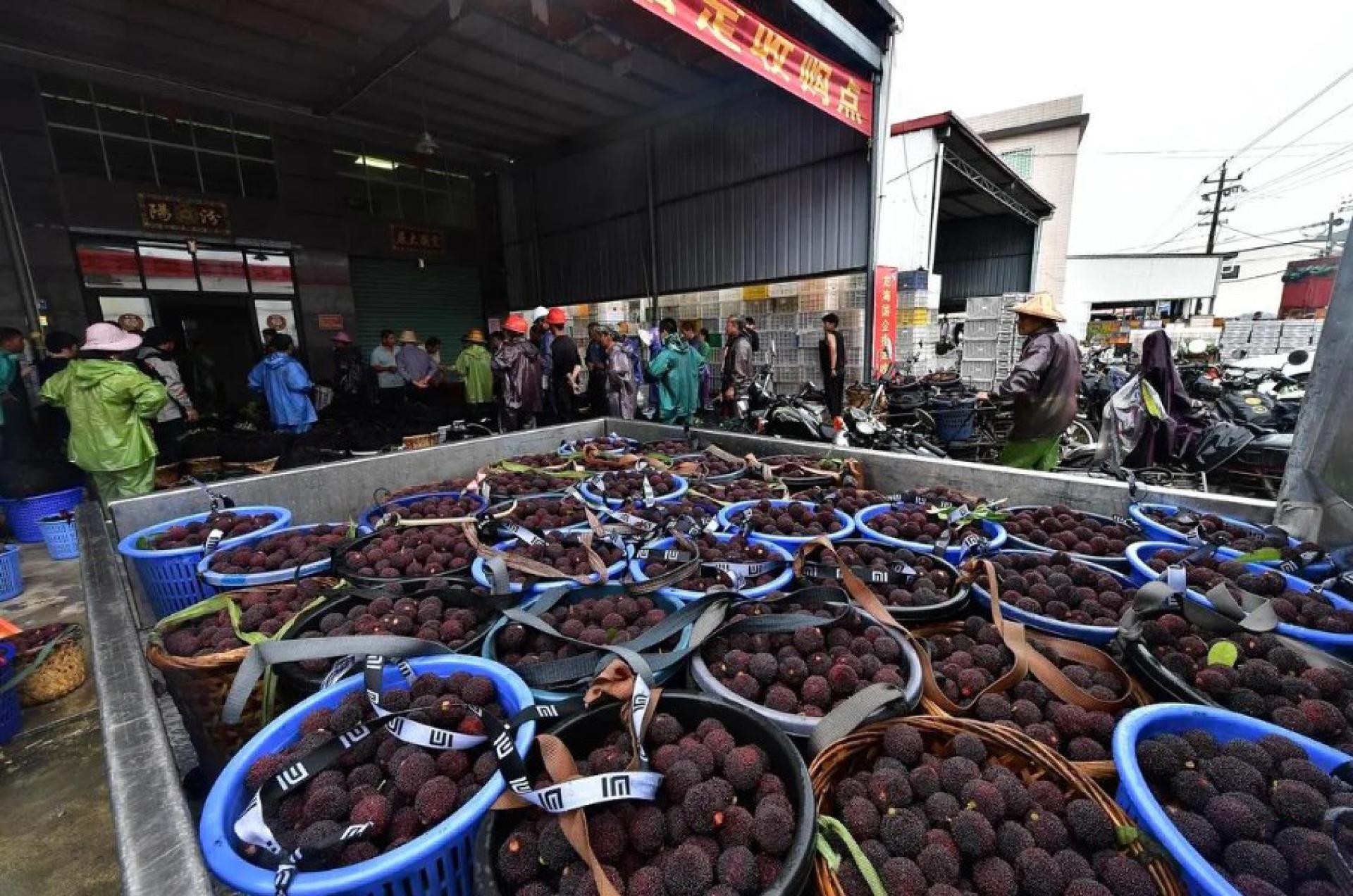
In mid-May this year, Chinese media exposed that some yangmei (Chinese bayberry) purchasing sites in Longhai District, Zhangzhou City, Fujian Province, were illegally using additives to soak yangmei, sparking widespread consumer concerns about the safety of summer seasonal fruits. Last weekend, the authorities released an accountability report, issuing public criticism to six units under Longhai District and its subordinate villages and towns for dereliction of duty and holding 23 Communist Party members and officials accountable, including two who were dismissed from their posts.
According to the WeChat public account ‘Longhai News,’ on the night of Sunday (May 24), Longhai District, Zhangzhou City, Fujian Province, reported that it had held relevant personnel accountable for the illegal use of additives in some yangmei purchasing sites.
According to the investigation results, six units, including the Longhai District Agriculture and Rural Affairs Bureau, the District Market Supervision Bureau, Fugong Town, Baishui Town, Jiaobian Village, and Houbao Village, failed to fulfill regulatory and local responsibilities, and these six units were publicly criticized according to procedures.
In addition, 23 Communist Party members and cadres were held accountable. Among them, two were dismissed, 13 were subject to disciplinary and administrative investigations, two were admonished, and six were publicly criticized.
Longhai District stated it would take this as a lesson, draw inferences from this case, strengthen the food safety defense line, and earnestly safeguard the public's "food safety on the tip of the tongue."
According to a Chinese media report on May 15, every May, yangmei in Fugong Town and Baishui Town, Longhai, Zhangzhou, Fujian, comes into peak season. Investigative journalists visited more than 10 purchasing sites and uncovered an open secret: fresh yangmei is soaked in liquid containing banned preservatives and "three-no" artificial sweeteners.
“Three-no” products refer to goods without the name of their manufacturer, no production address, and no code of hygiene (or production) license.
According to a Chinese media report on May 15, every May, yangmei in Fugong Town and Baishui Town, Longhai, Zhangzhou, Fujian, comes into peak season. Investigative journalists visited more than 10 purchasing sites and uncovered an open secret: fresh yangmei is soaked in liquid containing banned preservatives and "three-no" artificial sweeteners.
“Three-no” products refer to goods without the name of their manufacturer, no production address, and no code of hygiene (or production) license.
Reportedly, the packaging for the sweetener claims to be up to 8,000 times sweeter than sucrose, but it has no production date or ingredient list, making it a typical “three-no” product. Banned preservative sodium dehydroacetate was also seized.
It is reported that just one purchasing site can ship out over a thousand kilos per day, and more than 5,000 kilos at peak, mainly supplying wholesale markets and e-commerce platforms in Jiaxing, Zhejiang, and Shanghai.
Traders, in order to cope with supervision, would prepare several boxes of unsoaked yangmei in advance and mark them; if a random inspection occurred, these “clean samples” would be provided for checks. Doctors warn that such illegal additives may harm nerves, liver, and kidneys, with especially pronounced effects on neural development in teenagers, and may also severely disrupt human endocrine systems.
On Thursday (20th), last week, the Food Safety Office of Zhangzhou City, Fujian Province, issued a situation report saying that the city had immediately activated emergency response, set up a special task force, and promptly organized multiple departments to Fugong and Baishui Towns for joint law enforcement, rapidly investigating and addressing the issues, and checking each yangmei purchasing site mentioned in the media investigation.
Authorities found five actually involved purchasing sites, confiscated 225 kg of problematic yangmei along with a batch of illegal additives, and filed cases for investigation. They continued tracing the source, cracking down on illegal activities, retrieving a total of 540 kg of problematic yangmei, seizing 20.1 kg of illegal additives, opened 12 administrative cases, and 2 criminal cases, with five people detained. All problematic yangmei and confiscated illegal additives have been destroyed.
The report stated that from May 15, Zhangzhou organized a 45-day special rectification campaign, covering the entire harvest and sales cycle of yangmei. Officials were sent to frontline locations to cover all purchasing sites and to carry out full-process supervision.
Strict implementation of measures such as selling only yangmei that has passed inspection, requiring compliance certificates, external shipping registration, and implementing a "blacklist" system for purchasing merchants, comprehensively strengthening the supervision of yangmei from sourcing and storage to sales, to firmly prevent problematic yangmei from entering the market. From May 16 to 12:00 on May 20, authorities inspected 639 batches of yangmei, all of which were found to be compliant.
The report pointed out that yangmei is a specialty and advantageous agricultural product of Zhangzhou, and an important livelihood industry. The authorities deeply cherish it and will take this case as a lesson, using the strictest standards, supervision, punishment, and accountability to thoroughly rectify the illegal use of additives in yangmei, ensuring fruit safety, protecting the interests of consumers, fruit farmers, and law-abiding enterprises.
First, strengthen yangmei quality control, continuously implement on-site supervision and monitoring, compliance certificates and similar systems, to ensure products are traceable and safe.
Second, maintain a "zero tolerance" attitude, always maintaining high pressure, and swiftly and strictly handling all violations without leniency.
Third, use this case to launch a citywide large-scale inspection and rectification action for the food industry, reinforce control at the source, eliminate safety risks in key categories such as fruits and fresh produce, and do everything possible to safeguard public “food safety on the tip of the tongue.”
Fourth, intensify legal publicity, urge purchasers and distributors to enhance legal awareness, conduct business lawfully and with integrity, and foster a healthy industry ecology.
According to Xinhua, recently, the “yangmei scandal” has continued to ferment in public opinion. Relevant departments in Longhai District have gone deep into main yangmei-producing areas such as Fugong and Baishui Towns, carrying out rapid testing operations and imposing strict controls over purchasing, loading, and transportation stages.
At a testing site in Baishui Town, staff randomly selected yangmei samples ready to be shipped, with a particular focus on screening for sodium dehydroacetate, sodium saccharin, sodium cyclamate and other additives, recording all test data following standardized procedures to ensure test accuracy and reliability. Similar testing is underway at collection points in Fugong Town.