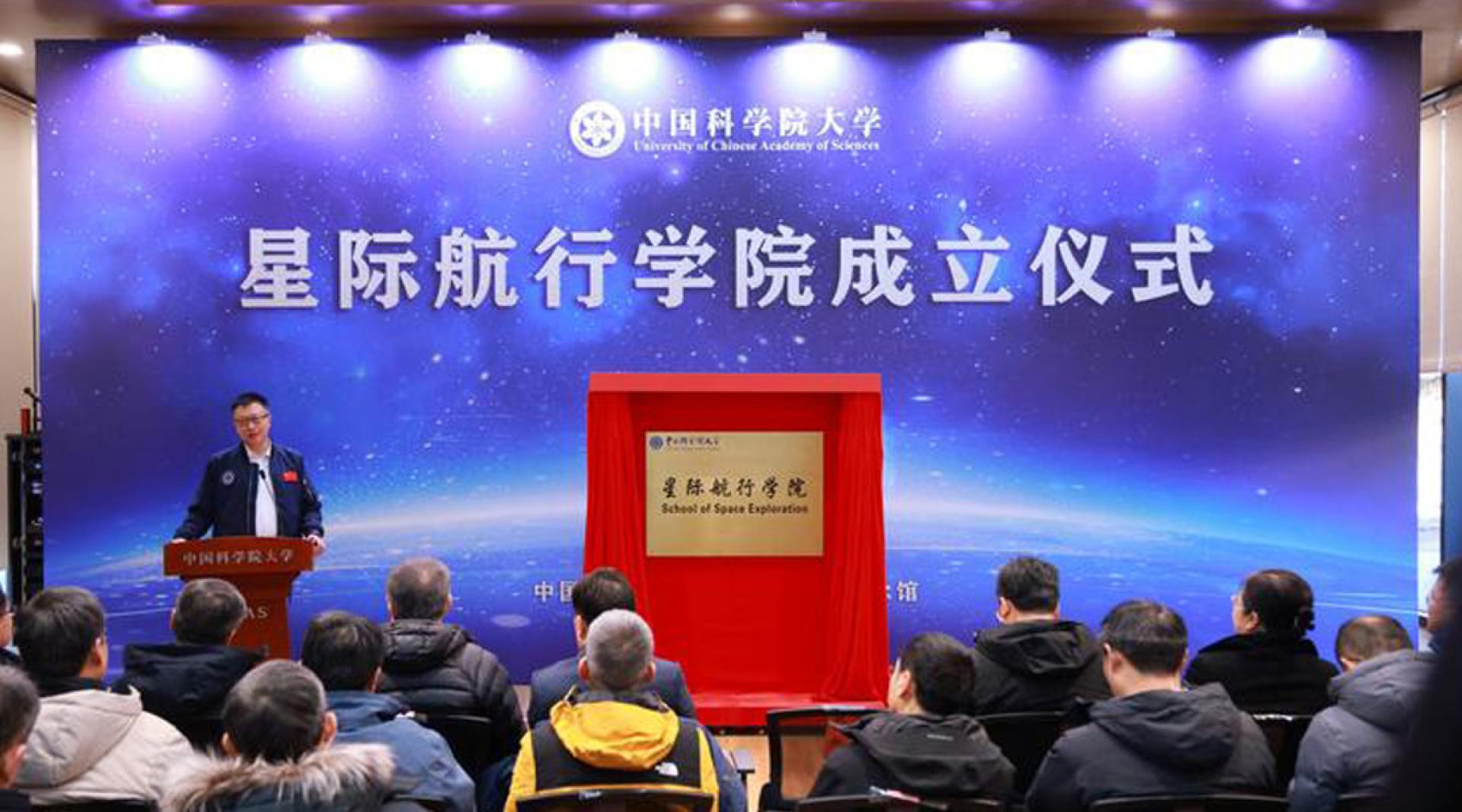
The next 10 to 20 years are seen as a critical window for China's leapfrog development in the field of interstellar navigation. Against this backdrop, the Interstellar Navigation Academy of the University of Chinese Academy of Sciences was officially inaugurated on the 27th, with plans to cultivate professionals in cutting-edge areas such as interstellar propulsion, deep space communication and navigation, and space science. This is China’s first academy dedicated to interstellar navigation, demonstrating the nation’s ambition in advancing its space endeavors.
According to reports from People’s Daily and Xinhua News Agency, on the morning of January 27, the unveiling ceremony for the Interstellar Navigation Academy of the University of Chinese Academy of Sciences was held at the Chinese Academy of Sciences and the “Two Bombs, One Satellite” Memorial Hall, marking the official establishment of the academy. The first dean is Zhu Junqiang, Director of the Strategic High Technology Research Bureau of the Chinese Academy of Sciences.
The reports noted that China’s space program is currently moving from “low Earth orbit” toward “deep space exploration,” from lunar research station planning to exoplanet exploration. The establishment of the Interstellar Navigation Academy seeks to answer the “national strategy,” advance the integrated development of education, technology, and talent, and break the talent bottleneck. This is also a key initiative by the University of Chinese Academy of Sciences to seize the commanding heights of science and technology and develop talent in the field of interstellar navigation.
This Interstellar Navigation Academy will build a course system covering 14 primary disciplines and majors, including aerospace science and technology, planetary science, and others. On the basis of 97 existing courses, 22 new core courses will be added, covering frontier directions such as principles of interstellar propulsion, interstellar navigation environment perception and utilization, planetary dynamics and habitability, interstellar sociology and governance, and more, achieving a deep integration of science, technology, and application.
The reports stated that the next 10 to 20 years will be a key window for China’s leapfrog development in the field of interstellar navigation. Pioneering innovative basic research and technological breakthroughs will reshape the pattern of deep space exploration and determine national competitiveness.
Zhu Junqiang expressed hope that the academy would become three major “highlands”: First, a highland for fundamental research in aerospace of the Chinese Academy of Sciences, providing original support for major national missions; second, a highland for cultivating high-level innovative talent; third, a highland for open international academic exchange.