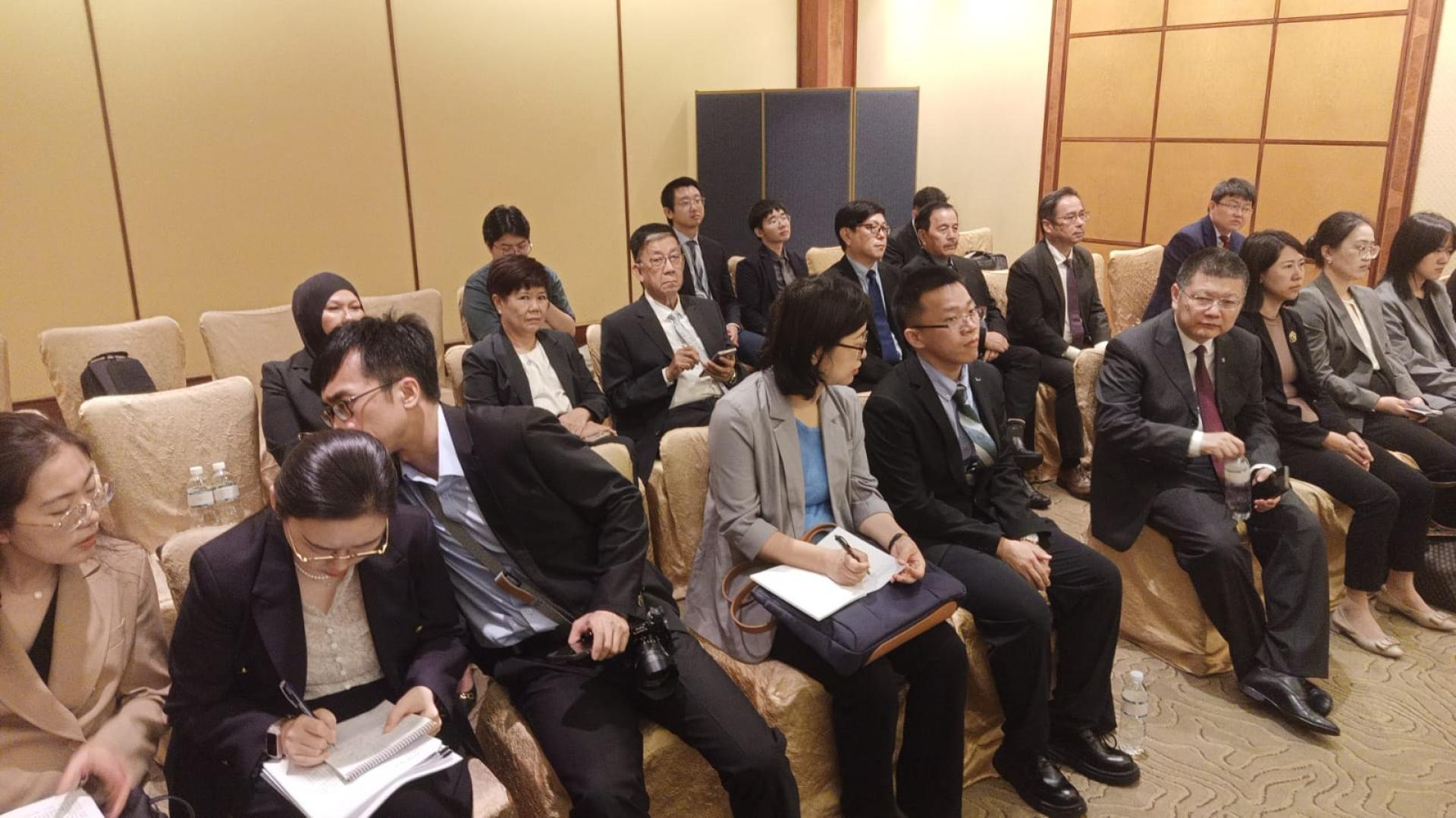
(Bandar Seri Begawan, 10th) – At the Brunei-China Bilateral Trade Relations forum, Professor Yun Changyao stated in his speech that Brunei and China share a robust and ever-expanding economic relationship, driven by strong political mutual trust and complementary development priorities. China has always been one of Brunei’s most important trading partners, with bilateral trade volume in 2024 reaching approximately US$2.8 billion. Brunei’s exports to China primarily comprise oil, petrochemical, and related downstream products, while China supplies Brunei with machinery, consumer goods, building materials, and technological solutions.
He made the above remarks at the “Contributing People-to-People Strength to Building a Brunei-China Community with a Shared Future” Brunei-China Civil Society Dialogue, co-hosted by the Chinese People’s Association for Peace and Disarmament and the Brunei-China Friendship Association. The event was held grandly at the Jerudong Empire Hotel in Brunei.
He stated that Chinese investment plays a key role in Brunei’s industrial transformation. The Hengyi Petrochemical Complex on Pulau Muara Besar, as a flagship project under the Belt and Road Initiative, supports Brunei’s strategic shift towards a diversified downstream energy industry. Cooperation between the two countries in fields such as infrastructure, agriculture, aquaculture, digital technology, and education is also growing, reflecting the shared direction of Brunei’s “Vision 2035” and China’s drive for high-quality, green development.
“Beyond trade and investment, both countries are placing increasing emphasis on people-to-people exchanges, tourism recovery, and academic cooperation. Overall, bilateral relations are transitioning from a resource-based trade model toward greater diversification. Such cooperation not only supports Brunei’s economic diversification but also deepens China’s constructive engagement in Southeast Asia.”
“The Brunei-China relationship also has potential for deeper cooperation beyond the traditional energy sector. Promising areas include expanding cooperation on downstream petrochemicals and new energy materials, advancing renewable energy projects such as solar, hydrogen, and energy storage, as well as accelerating digital economy collaboration through artificial intelligence, cloud services, and smart city applications. Both countries can also enhance cooperation in modern agriculture and aquaculture, including developing halal-compliant food processing industries for the Chinese market; tourism, creative industries, and film and television cooperation (such as Indonesia’s production of ‘Assalamualaikum Beijing: Lost in Ningxia’) also contribute to promoting cultural exchanges.”
He pointed out that under the frameworks of the Belt and Road Initiative and BIMP-EAGA, there is broad prospect for cooperation in logistics and connectivity, potentially making Brunei a boutique logistics hub in the region. Deepening cooperation in education, scientific research, and talent cultivation, along with linking SMEs and innovation ecosystems, will further enrich and strengthen the diversity and resilience of bilateral relations.
“Culture plays a core role in sustaining economic cooperation. Economic and trade exchanges are not just about financial transactions—they are based on trust, understanding, and a shared vision. For Brunei-China economic relations to achieve long-term sustainable development, cooperation must be aligned with Brunei’s ‘Vision 2035,’ deepen people-to-people exchanges, and promote genuine understanding of each other’s cultures and values.”
He concluded by saying that raising public awareness of each country’s development priorities, such as the Belt and Road Initiative and the concept of a “community with a shared future for mankind,” will help expand grassroots support and reduce misunderstandings. Promoting economic cooperation based on cultural awareness and mutual learning will enable the two countries to forge a resilient partnership amid regional and global changes.
He made the above remarks at the “Contributing People-to-People Strength to Building a Brunei-China Community with a Shared Future” Brunei-China Civil Society Dialogue, co-hosted by the Chinese People’s Association for Peace and Disarmament and the Brunei-China Friendship Association. The event was held grandly at the Jerudong Empire Hotel in Brunei.
“Beyond trade and investment, both countries are placing increasing emphasis on people-to-people exchanges, tourism recovery, and academic cooperation. Overall, bilateral relations are transitioning from a resource-based trade model toward greater diversification. Such cooperation not only supports Brunei’s economic diversification but also deepens China’s constructive engagement in Southeast Asia.”
“The Brunei-China relationship also has potential for deeper cooperation beyond the traditional energy sector. Promising areas include expanding cooperation on downstream petrochemicals and new energy materials, advancing renewable energy projects such as solar, hydrogen, and energy storage, as well as accelerating digital economy collaboration through artificial intelligence, cloud services, and smart city applications. Both countries can also enhance cooperation in modern agriculture and aquaculture, including developing halal-compliant food processing industries for the Chinese market; tourism, creative industries, and film and television cooperation (such as Indonesia’s production of ‘Assalamualaikum Beijing: Lost in Ningxia’) also contribute to promoting cultural exchanges.”
He pointed out that under the frameworks of the Belt and Road Initiative and BIMP-EAGA, there is broad prospect for cooperation in logistics and connectivity, potentially making Brunei a boutique logistics hub in the region. Deepening cooperation in education, scientific research, and talent cultivation, along with linking SMEs and innovation ecosystems, will further enrich and strengthen the diversity and resilience of bilateral relations.
“Culture plays a core role in sustaining economic cooperation. Economic and trade exchanges are not just about financial transactions—they are based on trust, understanding, and a shared vision. For Brunei-China economic relations to achieve long-term sustainable development, cooperation must be aligned with Brunei’s ‘Vision 2035,’ deepen people-to-people exchanges, and promote genuine understanding of each other’s cultures and values.”
He concluded by saying that raising public awareness of each country’s development priorities, such as the Belt and Road Initiative and the concept of a “community with a shared future for mankind,” will help expand grassroots support and reduce misunderstandings. Promoting economic cooperation based on cultural awareness and mutual learning will enable the two countries to forge a resilient partnership amid regional and global changes.