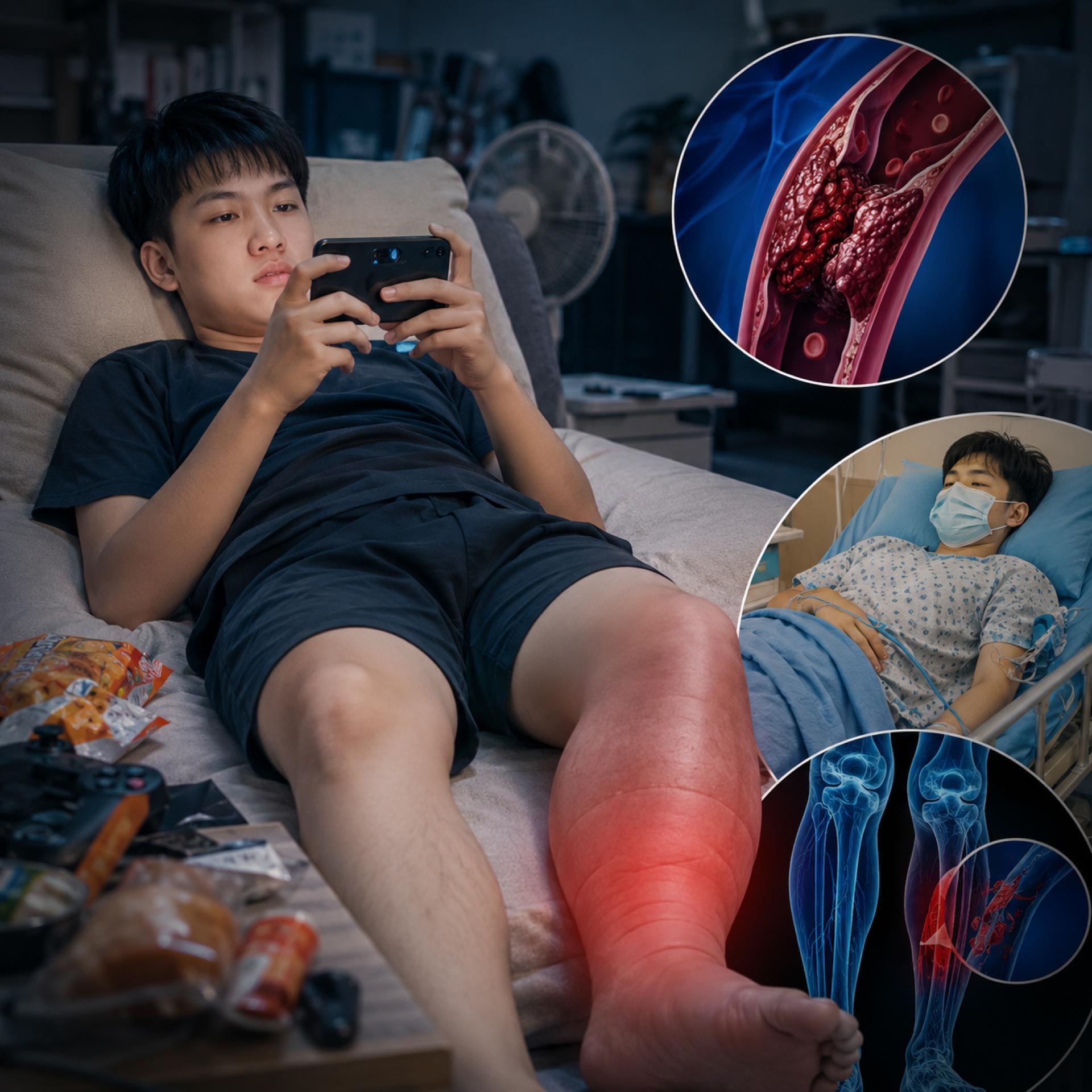
A male student in Zhejiang, China, who had just completed his college entrance exams, spent nearly every day of his summer vacation lying in bed or on the couch playing on his phone and gaming for more than 5 hours each day. As a result, due to prolonged inactivity, his right leg became severely swollen and painful, and he was ultimately diagnosed with deep vein thrombosis (DVT) in his lower limbs, which nearly left him unable to walk.
According to Chinese media reports, a hospital in Taizhou, Zhejiang, recently received the student, surnamed "Xiao Wang." His family revealed that after the college entrance exams ended, Xiao Wang stayed at home almost all the time, spending long hours lying down to play on his phone and game, with extremely low activity levels.
About half a month ago, Xiao Wang began to experience swelling, thickening, and persistent soreness in his right calf, with the pain growing more pronounced when walking. At first, his family thought it was merely muscle strain from sitting too long, so they didn’t seek medical attention right away. Only after the symptoms progressively worsened did they take him to the hospital for evaluation.
After examination, doctors confirmed that Xiao Wang had developed DVT in his lower limbs and needed to be urgently hospitalized for treatment.
The attending physician pointed out that Xiao Wang may have had a constitution with higher risk for blood clots, but the key trigger for the disease was still prolonged sitting, lying down, and lack of activity. The doctor emphasized that even without a hereditary tendency for blood clots, young people who remain in the same position for extended periods are also at risk for clot formation.
Blood Clots Trending Younger
The doctor noted that venous thromboembolism has become the third most common cardiovascular disease, following myocardial infarction and stroke.
Previously, most patients were older adults, but in recent years the number of young patients has steadily increased alongside changes in lifestyle habits. Prolonged bed rest, sitting for long periods, or spending a lot of time on the phone or gaming can all slow blood circulation in the lower limbs and increase the risk of clot formation.
Doctors recommend that for every 30 minutes to an hour spent sitting or lying down, one should get up, walk around, or do some leg kicks. If prolonged bed rest is necessary due to special circumstances, "ankle pump exercises" can be performed while in bed—repeatedly flexing and pointing the feet—to promote venous blood return in the lower limbs and reduce the risk of clots.
⚠ Seek Medical Attention Promptly for These 3 Major Symptoms
Doctor’s reminder: If the following symptoms occur, seek medical attention promptly; if accompanied by chest tightness, chest pain, or difficulty breathing, immediate hospital care is required.
Warning SignsSymptom 1 | Noticeable swelling and thickening in one thigh or calf, with obvious difference in the size of the two legs.
Symptom 2 | Persistent heaviness, tightness, or soreness in one leg, with significantly increased pain when pressing the calf or walking.
Symptom 3 | Skin on the affected side is reddened and feels warmer to the touch.
Symptom 2 | Persistent heaviness, tightness, or soreness in one leg, with significantly increased pain when pressing the calf or walking.
Symptom 3 | Skin on the affected side is reddened and feels warmer to the touch.
Emergency Alert: If symptoms like chest tightness, chest pain, difficulty breathing, palpitations, or coughing up blood occur, this may indicate the blood clot has detached and caused a pulmonary embolism. Seek emergency treatment at a hospital right away.
🩺 Doctor's 4 Tips for Preventing Blood Clots
Prevention TipsScheduled Movement | For every hour of sitting, get up and move for 5 to 10 minutes. Avoid staying in one position for too long.
Ankle Pump Exercise | Repeatedly flex and point your toes to promote blood circulation and venous return in the lower limbs.
Deep Breathing | Deep breaths and occasional coughing can increase negative pressure in the chest cavity, helping blood return more smoothly to the heart.
Balanced Diet | Eat more fruits, vegetables, and high-fiber foods, reduce high-fat and high-sugar diets, and stay well hydrated to reduce blood viscosity and the risk of clots.
Ankle Pump Exercise | Repeatedly flex and point your toes to promote blood circulation and venous return in the lower limbs.
Deep Breathing | Deep breaths and occasional coughing can increase negative pressure in the chest cavity, helping blood return more smoothly to the heart.
Balanced Diet | Eat more fruits, vegetables, and high-fiber foods, reduce high-fat and high-sugar diets, and stay well hydrated to reduce blood viscosity and the risk of clots.