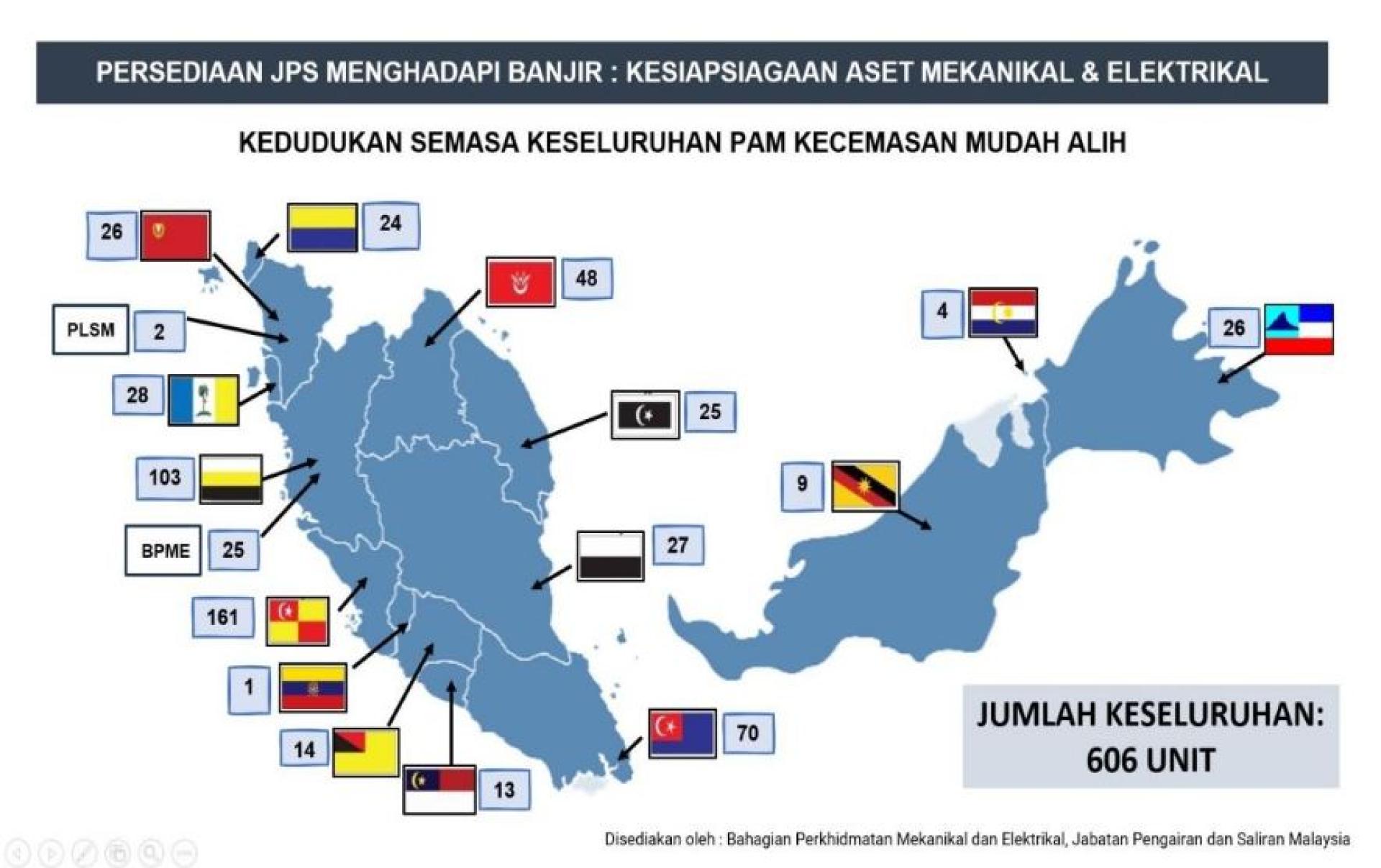
KUALA LUMPUR, Aug 10 (Bernama) -- A total of 606 portable emergency pumps of various specifications have been deployed nationwide and are ready to be mobilised as needed to address the El Nino phenomenon.
The Department of Irrigation and Drainage (DID) said the measure was part of its operational preparedness efforts on the ground when river or dam water levels fell to critical levels.
The portable pumps would be used to channel water supplies to agricultural areas, irrigation schemes and areas experiencing water supply disruptions, as well as to support forest and peatland fire-fighting operations with the Fire and Rescue Department (JBPM) and relevant agencies.
“The department also coordinates the integrated use of assets involving federal and state government assets and the National Disaster Management Agency (NADMA), while expanding technical assistance to Integrated Agricultural Development Areas (IADA) and other agencies according to current needs.
“Preventive maintenance programmes are carried out regularly to ensure all portable pumps and hydromechanical infrastructure remain in optimal condition before the drought begins. All requests for assistance are coordinated by the department, and the assets can be mobilised to affected locations within 24 hours,” it said.
In line with the national water sector’s digitalisation agenda, the department uses the Supervisory Control and Data Acquisition (SCADA) system and Pump Tracking System to monitor pump and water gate operations in real time, enabling disruptions or potential damage to be detected early and reducing the risk of water supply disruptions during the El Nino phenomenon.
Previously, the Malaysian Meteorological Department (MetMalaysia), in its Long Range Weather Outlook updated on July 29, forecast that the El Nino phenomenon would continue until early 2027.
The situation is expected to result in lower rainfall in several areas along the west, east and southern coasts of Peninsular Malaysia, central and western Sarawak, and eastern Sabah, increasing the risk of drought and placing greater pressure on the country's water resources.
DID also said that it was monitoring 56 dams nationwide to ensure the effective integrated management of water resources, agricultural irrigation and flood mitigation, in line with the National Water Policy (DAN) and NADMA Directive No. 1 of 2024.
The monitoring covers dams under the supervision of DID, the Ministry of Agriculture and Food Security (MAFS), the Sabah Water Department (JANS) and the State Water Regulatory Division (BKSA) through the InfoKemarau Portal and Reservoir Information Management System (RIMS).
“Water releases from dams are carried out in accordance with standard operating procedures (SOPs) to ensure sufficient water supplies for domestic and agricultural use, as well as the safety of the dams. DID also works with state water supply operators to optimise the operation of water intake towers to ensure continuity of water supply to consumers,” it said.
In addition, DID has developed the National Water Balance Management System (NAWABS) as a national water balance management platform to help forecast drought risks and support early mitigation measures by providing projections of water resource availability up to two months ahead and early warnings up to 14 days in advance.
NAWABS currently operates in seven major river basins - Sungai Kedah, Sungai Muda, Sungai Bernam, Sungai Klang, Sungai Melaka, Sungai Kelantan and Sungai Similajau basins - and is expected to be expanded to 12 more river basins by 2028.
“NAWABS information is strengthened through the water resources assessment report prepared weekly by DID.
“The report contains information on river flow rates, dam storage levels and developments in drought conditions, which is shared with NADMA, the Ministry of Energy Transition and Water Transformation (PETRA), the National Water Services Commission (SPAN), DID top management and state offices,” it said.
The information serves as an important reference for determining mitigation measures, such as coordinating cloud seeding operations, issuing early drought warnings and planning water supply management in affected areas.
The portable pumps would be used to channel water supplies to agricultural areas, irrigation schemes and areas experiencing water supply disruptions, as well as to support forest and peatland fire-fighting operations with the Fire and Rescue Department (JBPM) and relevant agencies.
“The department also coordinates the integrated use of assets involving federal and state government assets and the National Disaster Management Agency (NADMA), while expanding technical assistance to Integrated Agricultural Development Areas (IADA) and other agencies according to current needs.
“Preventive maintenance programmes are carried out regularly to ensure all portable pumps and hydromechanical infrastructure remain in optimal condition before the drought begins. All requests for assistance are coordinated by the department, and the assets can be mobilised to affected locations within 24 hours,” it said.
In line with the national water sector’s digitalisation agenda, the department uses the Supervisory Control and Data Acquisition (SCADA) system and Pump Tracking System to monitor pump and water gate operations in real time, enabling disruptions or potential damage to be detected early and reducing the risk of water supply disruptions during the El Nino phenomenon.
Previously, the Malaysian Meteorological Department (MetMalaysia), in its Long Range Weather Outlook updated on July 29, forecast that the El Nino phenomenon would continue until early 2027.
The situation is expected to result in lower rainfall in several areas along the west, east and southern coasts of Peninsular Malaysia, central and western Sarawak, and eastern Sabah, increasing the risk of drought and placing greater pressure on the country's water resources.
DID also said that it was monitoring 56 dams nationwide to ensure the effective integrated management of water resources, agricultural irrigation and flood mitigation, in line with the National Water Policy (DAN) and NADMA Directive No. 1 of 2024.
The monitoring covers dams under the supervision of DID, the Ministry of Agriculture and Food Security (MAFS), the Sabah Water Department (JANS) and the State Water Regulatory Division (BKSA) through the InfoKemarau Portal and Reservoir Information Management System (RIMS).
“Water releases from dams are carried out in accordance with standard operating procedures (SOPs) to ensure sufficient water supplies for domestic and agricultural use, as well as the safety of the dams. DID also works with state water supply operators to optimise the operation of water intake towers to ensure continuity of water supply to consumers,” it said.
In addition, DID has developed the National Water Balance Management System (NAWABS) as a national water balance management platform to help forecast drought risks and support early mitigation measures by providing projections of water resource availability up to two months ahead and early warnings up to 14 days in advance.
NAWABS currently operates in seven major river basins - Sungai Kedah, Sungai Muda, Sungai Bernam, Sungai Klang, Sungai Melaka, Sungai Kelantan and Sungai Similajau basins - and is expected to be expanded to 12 more river basins by 2028.
“NAWABS information is strengthened through the water resources assessment report prepared weekly by DID.
“The report contains information on river flow rates, dam storage levels and developments in drought conditions, which is shared with NADMA, the Ministry of Energy Transition and Water Transformation (PETRA), the National Water Services Commission (SPAN), DID top management and state offices,” it said.
The information serves as an important reference for determining mitigation measures, such as coordinating cloud seeding operations, issuing early drought warnings and planning water supply management in affected areas.