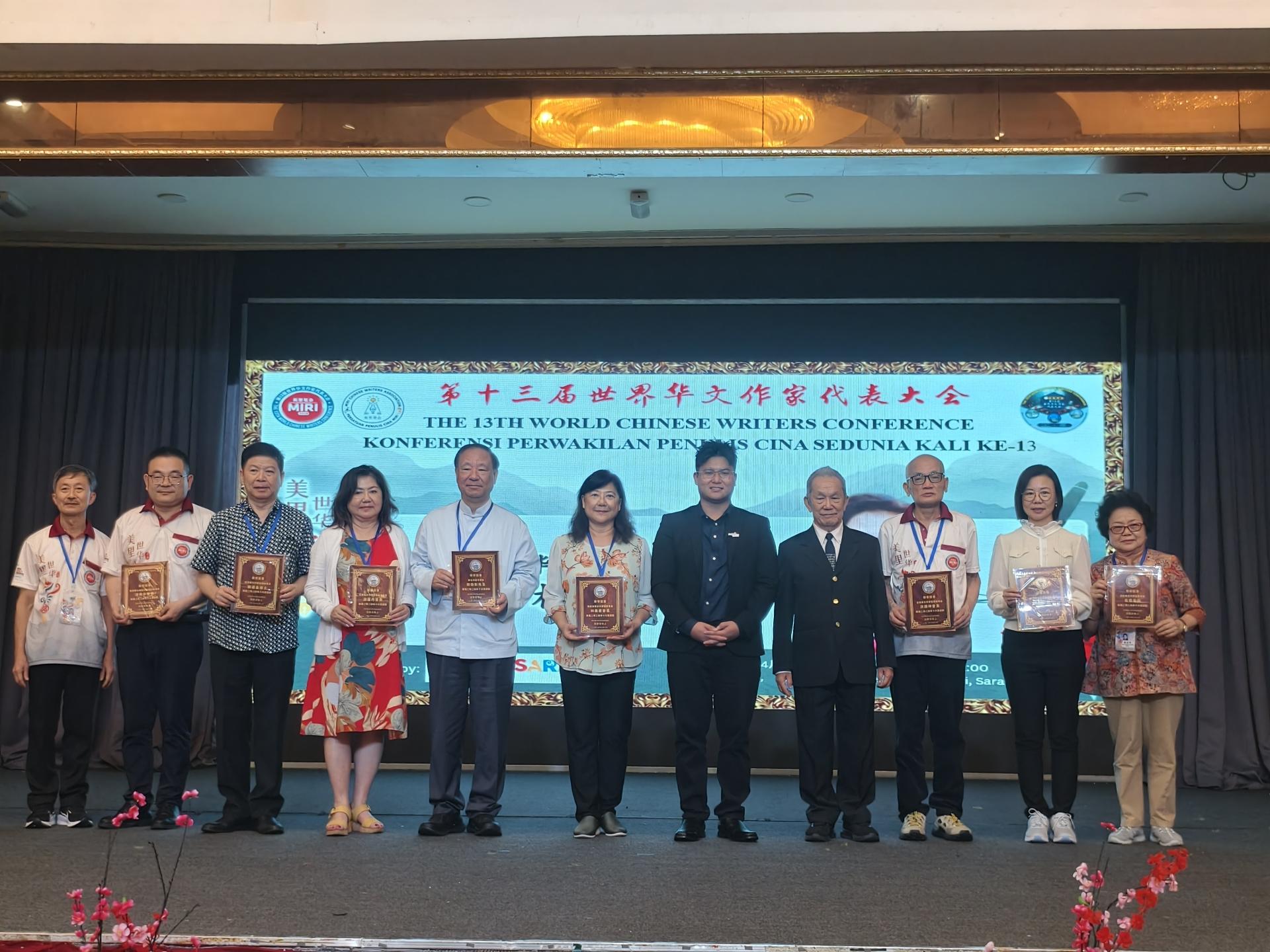
(Miri, 26th) Xu Jingping, President of the Miri Writers' Association and Chairman of the Preparatory Committee for the 13th World Chinese Writers' Conference, stated that literature is not only a tool for communication and expression, but also an important medium for connecting communities and consolidating identity. The 'World Chinese Literary Night' is a moment to bring literary hearts together and illuminate the brilliance of Chinese literature.
He made these remarks in his speech last night at the 'World Chinese Literary Night' of the 13th World Chinese Writers' Conference, held by the Miri Writers' Association at the Meritz Hotel.
In his speech, Xu Jingping pointed out that on this evening filled with literary atmosphere and humanistic warmth, writers from around the world gathered in Borneo because of words, jointly witnessing the exchange and development of Chinese literature.
He said that Chinese writing demonstrates significant shared value and practical functions in contemporary society. It not only carries the role of communication and expression, but also plays a key role in news dissemination, educational development, and public discourse, enabling the sharing of knowledge and circulation of ideas.
He pointed out that language and writing are also major forces in cultivating the temperament of individuals and society, allowing civilization to continue to grow in daily life.
Speaking about the relationship between writing and writers, he expressed that writing is a lifelong practice. Writers are not only manipulators of words, but also observers and recorders of the times. Writing is both a response to history and a reflection upon the self. Through their works, writers dialogue with the times and safeguard the warmth of humanity.
"Respect for writers lies not only in applause and honors, but also in cherishing creative freedom and embracing diversity of thought."
He pointed out that in the world of literature, there is both cooperation and competition among writers. The two are not oppositional, but are mutually motivating forces. Cooperation allows people to transcend geographic and cultural boundaries, while competition drives continuous improvement and self-surpassing. Through interaction, literary prosperity and the deepening of thought are promoted.
Xu Jingping also emphasized that writing carries the responsibility of nurturing the next generation. Young people are the future of literature and the key to cultural inheritance. They should be encouraged to participate in creation and inspired to think, so as to build their identity through language.
He said that what literature conveys is not only words, but also deep emotions and a sense of responsibility. A young person nourished by words will have greater depth and empathy, and be able to shoulder the mission of the era.
"Literature has never been a lonely pursuit. It connects people, crossing borders and eras."
He expressed hope that everyone will gain friendship through exchanges, hold fast to their original aspirations in creation, and continue to sail with their pens in the vast ocean of humanity in the future.
In his speech, Xu Jingping pointed out that on this evening filled with literary atmosphere and humanistic warmth, writers from around the world gathered in Borneo because of words, jointly witnessing the exchange and development of Chinese literature.
He said that Chinese writing demonstrates significant shared value and practical functions in contemporary society. It not only carries the role of communication and expression, but also plays a key role in news dissemination, educational development, and public discourse, enabling the sharing of knowledge and circulation of ideas.
He pointed out that language and writing are also major forces in cultivating the temperament of individuals and society, allowing civilization to continue to grow in daily life.
Speaking about the relationship between writing and writers, he expressed that writing is a lifelong practice. Writers are not only manipulators of words, but also observers and recorders of the times. Writing is both a response to history and a reflection upon the self. Through their works, writers dialogue with the times and safeguard the warmth of humanity.
"Respect for writers lies not only in applause and honors, but also in cherishing creative freedom and embracing diversity of thought."
He pointed out that in the world of literature, there is both cooperation and competition among writers. The two are not oppositional, but are mutually motivating forces. Cooperation allows people to transcend geographic and cultural boundaries, while competition drives continuous improvement and self-surpassing. Through interaction, literary prosperity and the deepening of thought are promoted.
Xu Jingping also emphasized that writing carries the responsibility of nurturing the next generation. Young people are the future of literature and the key to cultural inheritance. They should be encouraged to participate in creation and inspired to think, so as to build their identity through language.
He said that what literature conveys is not only words, but also deep emotions and a sense of responsibility. A young person nourished by words will have greater depth and empathy, and be able to shoulder the mission of the era.
"Literature has never been a lonely pursuit. It connects people, crossing borders and eras."
He expressed hope that everyone will gain friendship through exchanges, hold fast to their original aspirations in creation, and continue to sail with their pens in the vast ocean of humanity in the future.