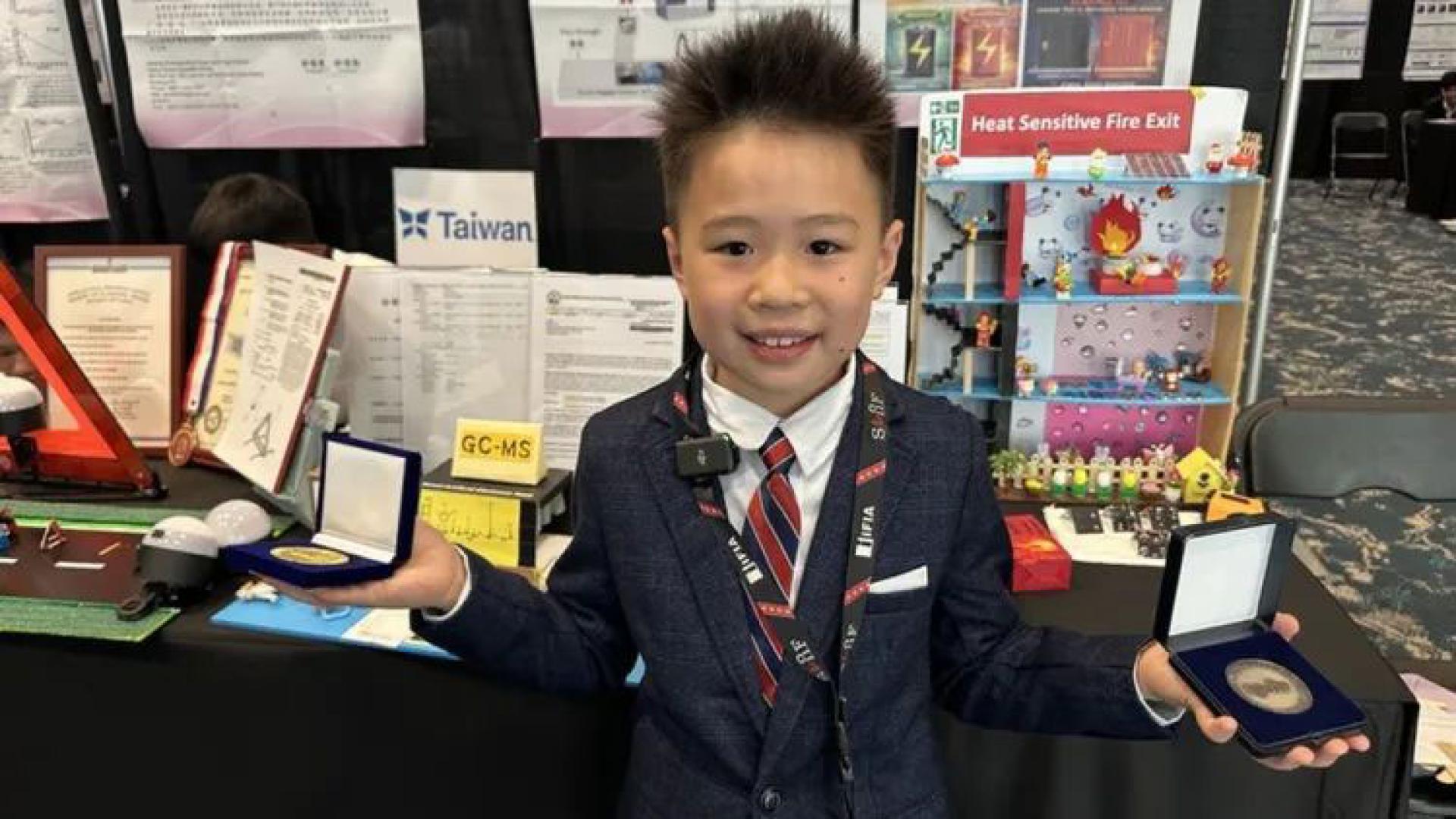
10-year-old Taiwanese student Hsu Ting-Wei recently shone at the Silicon Valley International Invention Exhibition in the United States, winning a gold medal with his "New-Type Artificial Electronic Nose" and further claiming the IFIA Best Invention Award from the International Federation of Inventors' Associations. As one of the youngest participants at the event, he designed this AI system with hopes that it could be used for airport security in the future, to detect drugs, prohibited foods, and other substances.
The "New-Type Artificial Electronic Nose" is an intelligent, non-contact security inspection platform that combines a real-time air sampling system, gas chromatography-mass spectrometry, and AI odor recognition technology, and can be installed behind airport X-ray baggage inspection equipment.
According to Hsu Ting-Wei, the system first analyzes different substances and builds a feature map database, which can then be used for rapid comparison and screening with AI. He hopes that, in the future, it will not only be able to stop pork products potentially carrying African Swine Fever virus from entering the country, but also help US customs identify drugs such as fentanyl.
He also specifically mentioned that if the artificial electronic nose could take on part of the inspection work, it could reduce opportunities for sniffer dogs to be in direct contact with drugs and dangerous substances. “This way, the dogs won’t be as tired and wouldn’t have to inhale drugs.”
In addition to winning a gold medal and the Best Invention Award for his "New-Type Artificial Electronic Nose," Hsu Ting-Wei also won a silver medal for another project—"High-Temperature Color-Changing Escape Door."
Hsu Ting-Wei said he enjoys inventing because he believes technology can change lives. Compared to overly profound research, he prefers projects that can actually be applied to daily life and solve practical problems.
At this Silicon Valley International Invention Exhibition, several other works designed by Chinese youth also won awards. Quite a few have already started applying AI technology to solve specific real-life problems.
For example, there is an application called "Min Detective GO" that uses AI to detect potential allergens, helping users spot risks earlier; another, the "Warning Engineering Helmet" integrates gas, temperature and humidity monitoring, communication, LED hazard indication, and voice alarms to enhance construction site safety.
Other students designed a "Rhythmic Tank," attempting to tackle inadequate exercise and excessive screen time among children through gaming; another platform, "Ball Learning Platform," combines mechanical transmission, magnetism, gas sensing, electronic control, and AI gesture recognition, turning abstract STEM knowledge into hands-on learning experiences.
From these inventions, it is clear that for the new generation of students, AI is no longer a high-level technology that requires specialized research, but is gradually becoming an everyday tool to solve real-world problems. The fact that 10-year-old Hsu Ting-Wei won the Best Invention Award with his "Electronic Nose" is a microcosm of this change.