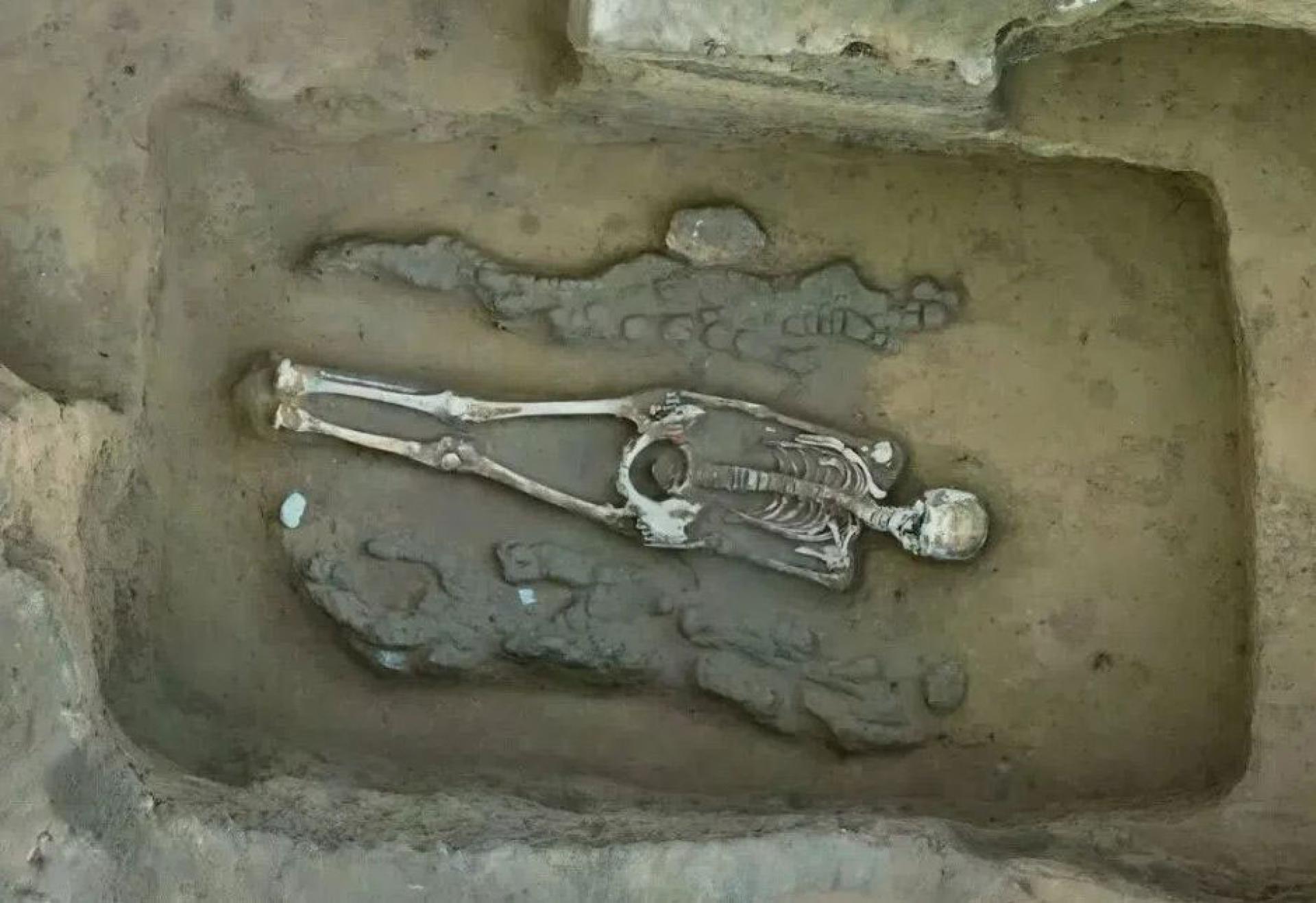
A new archaeological discovery in China reveals that as early as the Longshan period, there were already clear physical combinations of 'dragon and phoenix' images in northern China.
The archaeology team from the Zhaizita Stone City Site of the Inner Mongolia Autonomous Region Institute of Cultural Relics and Archaeology has found a group of 'dragon and phoenix' clay figurines in a Longshan era tomb. Experts have confirmed that these clay figurines are the earliest known, most clearly shaped physical combination of 'dragon and phoenix' in northern China to date.
The Zhaizita Stone City site is located in Zhungeer Banner, Ordos City, Inner Mongolia, and is a Longshan-period stone city site covering a total area of 420,000 square meters.
Sun Jinsong, Director of the Inner Mongolia Autonomous Region Institute of Cultural Relics and Archaeology, introduced that the clay figurines discovered this time came from a rectangular earth pit shaft tomb. The tomb occupant was found lying on his back with limbs straight, head facing northeast, and a jade bi with inlaid turquoise was buried by the right side of his neck. The 'dragon and phoenix' clay figurines were symmetrically distributed on both sides of the tomb occupant’s body. The 'dragon'-shaped clay figurine was on the tomb occupant’s right side, with its head facing the same direction as the tomb occupant. The 'phoenix'-shaped clay figurine was on the tomb occupant’s left side, with a posture of soaring and rising.
According to dating results, the tomb occupant died around 2300 BCE. Stable isotope analysis of the enamel collagen from the tomb occupant’s teeth showed a diet based on millet agriculture, but with animal protein or other special food resources consumed far more than the average person. This indicates that the tomb occupant enjoyed a higher level of material resources and social status during his lifetime.
Sun Jinsong said that the 'dragon and phoenix' clay figurines at the Zhaizita Stone City site are the earliest and most clearly modeled physical combination of dragon and phoenix discovered so far in northern China, pushing the appearance of figurative 'dragon and phoenix' back to the Longshan period. This provides valuable material for studying the spiritual beliefs and burial concepts of the ancestors of the Longshan period. In addition, this discovery shows that the Hetao region made a unique contribution to the creation of early spiritual culture in China, providing evidence for the pluralistic and unified structure of Chinese civilization.