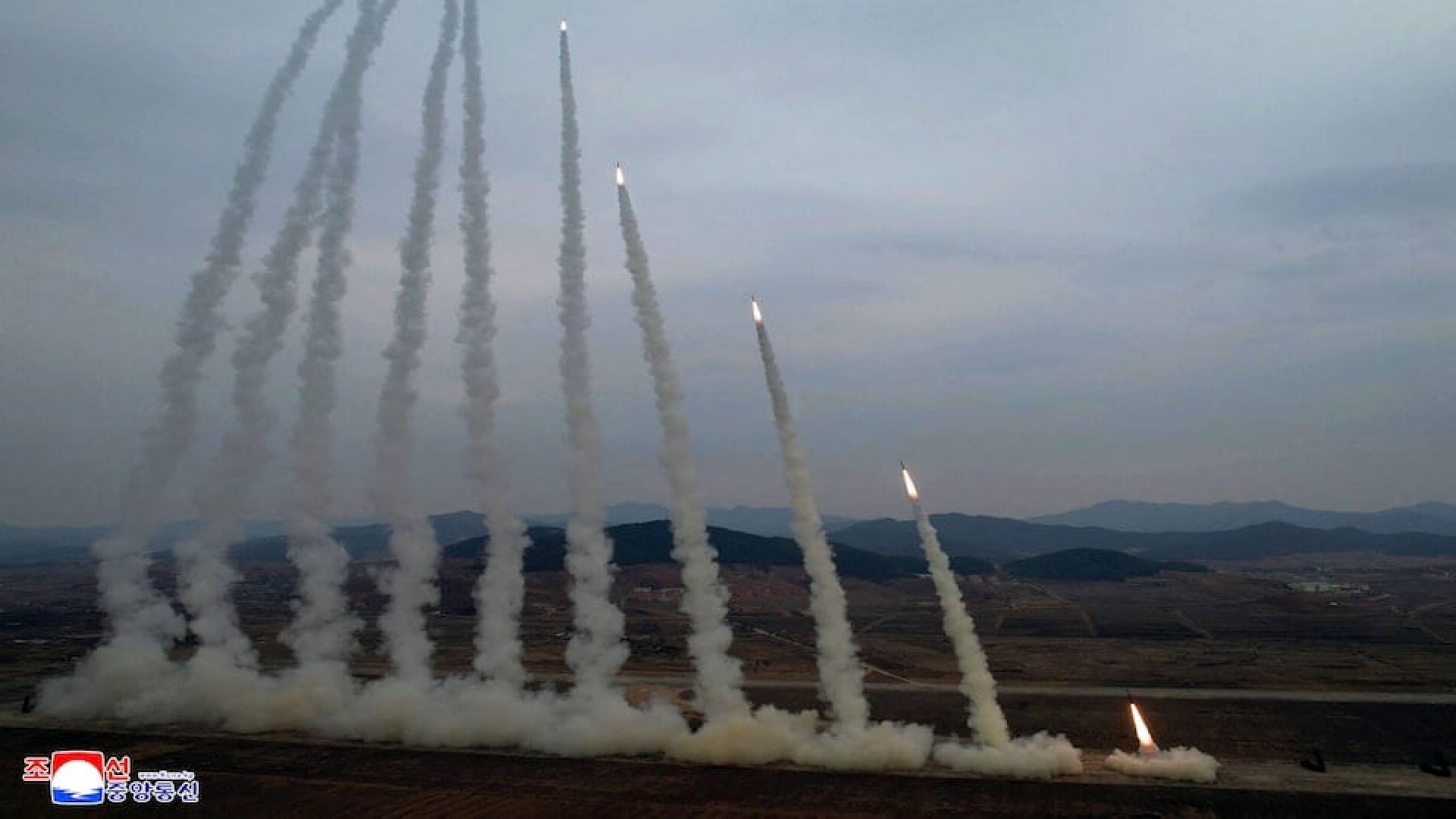
The Korean Central News Agency (KCNA) reported on Thursday that North Korea tested a variety of weapon systems over three consecutive days this week, including ballistic missiles and cluster bombs. Experts analyze that the intensive weapons tests show North Korea's hardline stance toward South Korea remains unchanged.
KCNA indicated that the tested items also included a mobile short-range air defense missile system.
The tests took place on the 6th, 7th, and 8th, as part of North Korea's regular research and upgrading of its weapons systems.
The South Korean military had earlier stated that North Korea fired multiple short-range ballistic missiles in two rounds on Wednesday, and launched an 'unidentified flying object' on Tuesday.
According to KCNA, this exercise 'confirmed that the ground-to-ground tactical ballistic missile "Hwasongpho-11 Ka" equipped with a cluster warhead can turn any target within a range of 6.5 to 7 hectares into ashes.'
Cluster munitions scatter dozens or even hundreds of small submunitions over a wide area, and are controversial because they pose risks to civilians.
Other systems tested include an 'electromagnetic weapon system' and a 'carbon-fiber dummy warhead dispersal device,' which KCNA described as having the character of 'strategic assets.'
The report pointed out that 'low-cost materials' were also used in this launch to test the engine's 'maximum load capacity.'
The South Korean military stated that one of the short-range missiles fired in the second round on Wednesday flew over 700 kilometers.
Before this, North Korea had already launched several short-range ballistic missiles toward the East Sea (Sea of Japan), with a flight distance of about 240 kilometers.
This marks the 4th and 5th known ballistic missile tests by North Korea this year. Analysts believe these tests are Pyongyang sending a message to Seoul: even though South Korea has made several gestures of goodwill, North Korea's tough stance toward South Korea remains unchanged.