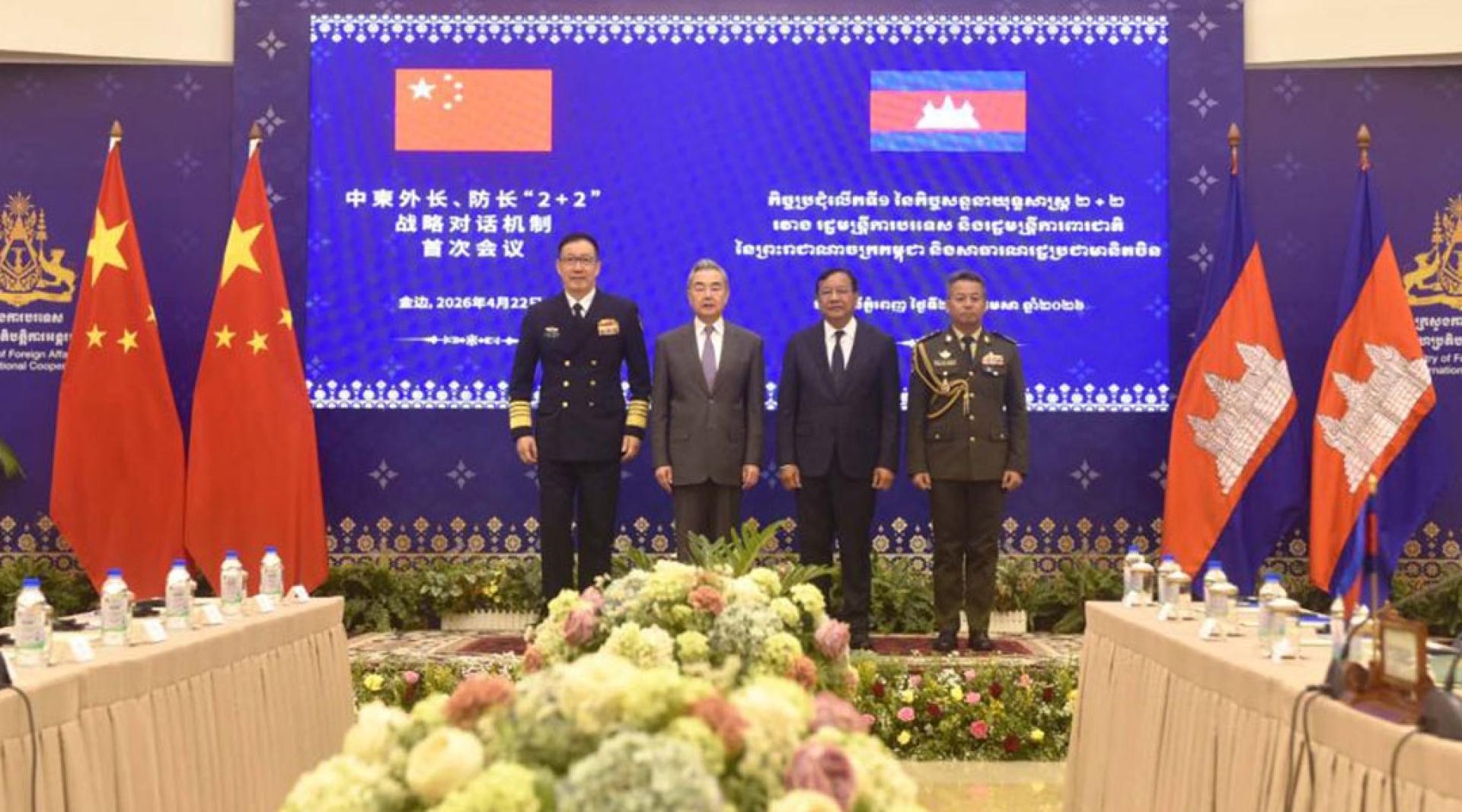
The first meeting of the “2+2” strategic dialogue mechanism between Chinese and Cambodian foreign and defense ministers was held on the 22nd in Phnom Penh. Foreign Minister Wang Yi and Defense Minister Dong Jun, together with Cambodian Deputy Prime Minister and Foreign Minister Prak Sokhonn and Deputy Prime Minister and Defense Minister Tea Seiha, co-chaired the meeting. The discussions covered bilateral relations, political and defense security cooperation, and the international and regional situation, reaching broad consensus.
Wang Yi stated that China is willing to work with Cambodia to make the mechanism a strategic platform for enhancing cooperation in political and defense security, consolidating the important foundation of mutual support and solidarity between China and Cambodia. He proposed that both sides deepen cooperation on political security, strengthen exchange of governance experience, improve their own governing capacities, and firmly hold the initiative in development and security in their own hands.
China supports Cambodia and Thailand's implementation of the China-Cambodia-Thailand tripartite Fuxian meeting consensus, making good use of existing bilateral mechanisms, strengthening dialogue, rebuilding mutual trust, and resuming relations. China is willing to provide a platform for more comprehensive and effective communication between Cambodia and Thailand. China will continue to support Cambodia’s accelerated development and revitalization, continuously improving people's livelihoods, and is willing to continue to provide humanitarian assistance for the resettlement of border residents and promote poverty alleviation demonstration projects. Dong Jun pointed out that the current international and regional security situation is complex and ever-changing. China is willing to deepen military security mutual trust with Cambodia and write a new chapter in the friendship between the two militaries, “as genuine as real gold.”
Prak Sokhonn stated that Cambodia is willing to continuously enrich the “Diamond Hexagon” cooperation framework and pragmatic cooperation such as the “Industrial Development Corridor” and “Fish-Rice Corridor” with China, while also strengthening multilateral collaboration. Tea Seiha also said he is willing, under the current bilateral framework, to summarize experience, pool joint efforts, and actively explore new paths of cooperation.
Both sides agreed that in the face of the current international situation, they should maintain strategic sobriety and determination, safeguard political and regime security, support each other’s core interests, and solidly advance pragmatic cooperation in various fields; coordinate high-quality development with high-level security; oppose any force attempting to sow discord in the China-Cambodia ironclad friendship; deepen bilateral law enforcement and defense cooperation; jointly crack down on online gambling and telecom fraud, and safeguard cyber security; actively cooperate within the four major global initiatives, support resolving regional disputes through dialogue and negotiation, jointly oppose unilateral bullying and power politics, and defend global free trade and international fairness and justice.