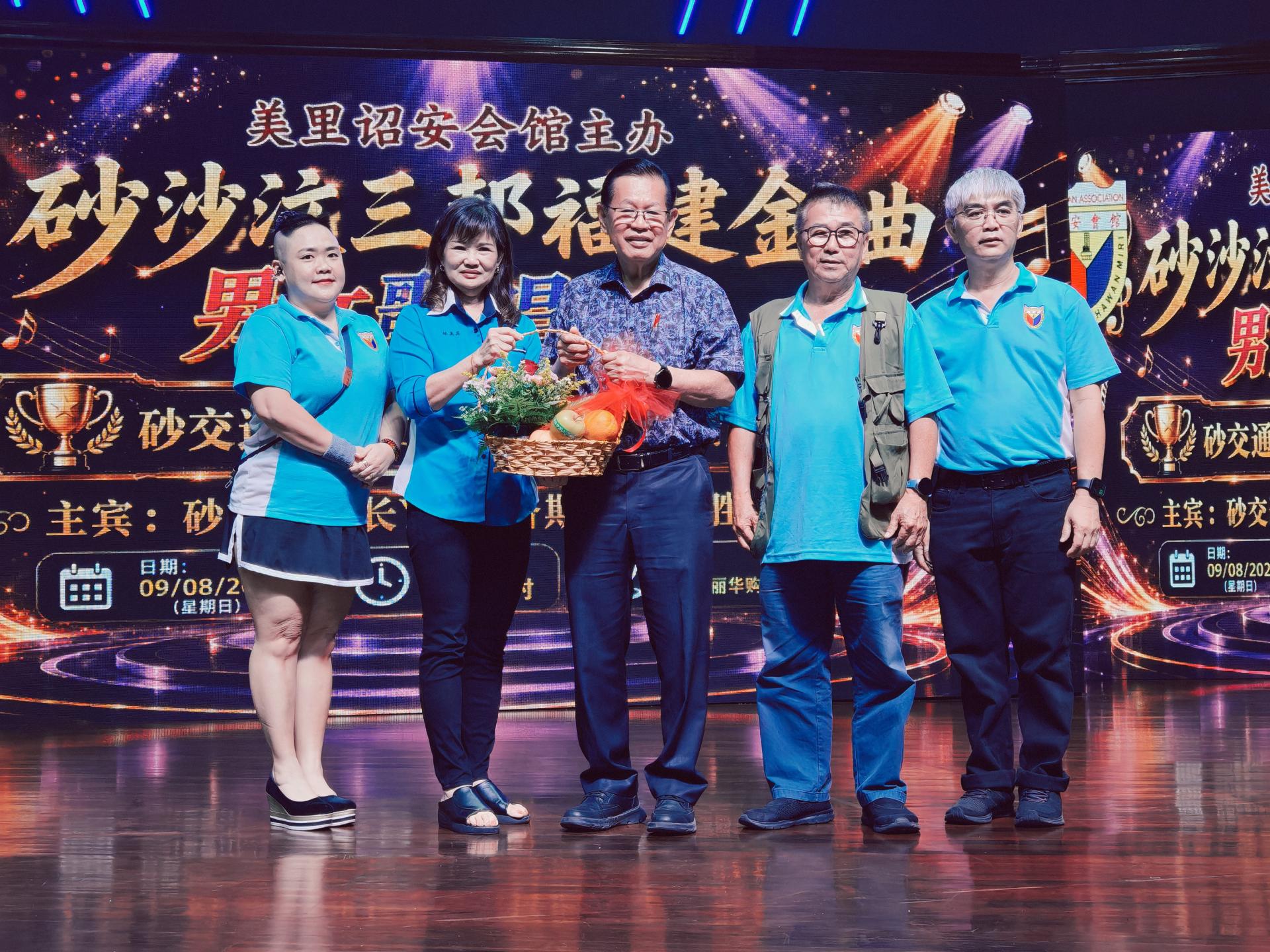
(Miri, 10th) Sarawak Minister of Transport and Senadin State Assemblyman Dato Sri Lee King Sing stated that by organizing dialect singing competitions, not only can traditional culture be promoted, but the younger generation can also be encouraged to learn and use their own mother tongue dialects, thus continuing Chinese cultural roots.
He made these remarks yesterday as the guest of honor at the Sarawak, Sabah & Brunei Hokkien Golden Melody Male and Female Singing Contest, organized by the Miri Chaoan Association at Boulevard Shopping Mall.
He said compared to general Mandarin singing competitions, Hokkien song performance is more challenging because participants must not only master the melody, but also possess a good foundation in the dialect in order to sing accurately and rightly.
“Promoting Hokkien songs is essentially promoting our dialect culture. Nowadays, many families rarely use dialects—most young people use Mandarin or English as their primary language, leading to the gradual decline of dialects.”
He pointed out that platforms such as singing competitions can encourage young people to be exposed to and learn dialects, and through practice and performance, they can naturally deepen their grasp of their mother tongue.
Lee King Sing also praised the organizers for inviting participants from Sabah and Brunei, stating that this not only raises the standard of the competition and expands interaction, but also allows more outsiders to learn about Miri.
“Activities like this can also help promote tourism development. Contestants bring their families to visit Miri, and besides participating in the competition, they can also tour local attractions.”
He also suggested that in the future, various clan associations can organize more singing competitions in different dialects, such as Cantonese, Hakka, and Fuzhou songs, to comprehensively promote the development and inheritance of Chinese dialect culture.
He emphasized that dialects are an important part of Chinese culture, and if not actively promoted and passed on, they may gradually disappear in the future.
“Our generation must take on the responsibility to pass dialects down from generation to generation.”
In addition, he affirmed the success of this event, and called on local associations to actively cultivate more singing talents, increase local participation, and ensure the continuous development and growth of the event. He also thanked singers from Sabah and other regions for traveling a long way to participate, adding brilliance to the event.
He made these remarks yesterday as the guest of honor at the Sarawak, Sabah & Brunei Hokkien Golden Melody Male and Female Singing Contest, organized by the Miri Chaoan Association at Boulevard Shopping Mall.
He said compared to general Mandarin singing competitions, Hokkien song performance is more challenging because participants must not only master the melody, but also possess a good foundation in the dialect in order to sing accurately and rightly.
He pointed out that platforms such as singing competitions can encourage young people to be exposed to and learn dialects, and through practice and performance, they can naturally deepen their grasp of their mother tongue.
Lee King Sing also praised the organizers for inviting participants from Sabah and Brunei, stating that this not only raises the standard of the competition and expands interaction, but also allows more outsiders to learn about Miri.
“Activities like this can also help promote tourism development. Contestants bring their families to visit Miri, and besides participating in the competition, they can also tour local attractions.”
He also suggested that in the future, various clan associations can organize more singing competitions in different dialects, such as Cantonese, Hakka, and Fuzhou songs, to comprehensively promote the development and inheritance of Chinese dialect culture.
He emphasized that dialects are an important part of Chinese culture, and if not actively promoted and passed on, they may gradually disappear in the future.
“Our generation must take on the responsibility to pass dialects down from generation to generation.”
In addition, he affirmed the success of this event, and called on local associations to actively cultivate more singing talents, increase local participation, and ensure the continuous development and growth of the event. He also thanked singers from Sabah and other regions for traveling a long way to participate, adding brilliance to the event.