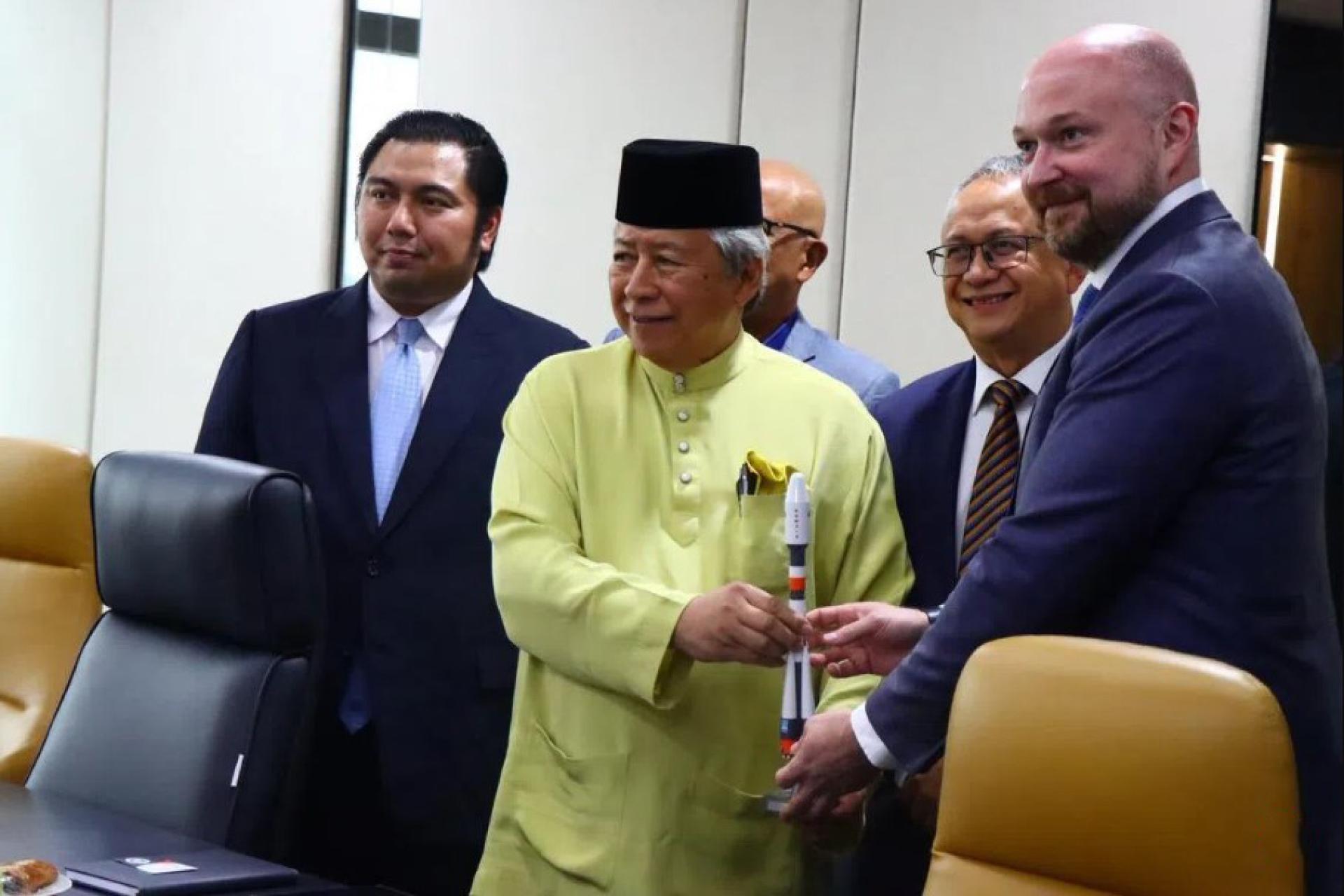
(Sabah, 2nd) Russian space launch service provider Glavkosmos is currently in discussions with Qhazanah Sabah, the Sabah government's investment arm, on the feasibility of establishing a spaceport in Sabah.
Qhazanah Sabah Chairman Anifah revealed on Facebook on Friday (January 30) that he hosted a delegation led by Glavkosmos Deputy General Manager for Business Affairs, Vitaly Safonov, that day.
Glavkosmos is a subsidiary of Russia’s state-owned space corporation Roscosmos, with over 40 years of experience in the aerospace field. It is the commercial operator for Soyuz 2.1 launch vehicles taking off from Russian spaceports. Glavkosmos has successfully launched more than 300 launch vehicles from various launch sites.
Anifah, who is the brother of Sabah Governor Musa Aman and Malaysia’s former Foreign Minister, said that after conducting studies, Glavkosmos has identified Sabah as the most suitable location in Southeast Asia for orbital space launches, including missions to low Earth orbit and sun-synchronous orbit.
He said research shows that Sabah possesses strategic advantages for development into a rocket launch base and is suitable for conducting low Earth orbit and sun-synchronous orbit launches. The rocket separation stage can safely fall into the northern and eastern seas of Sabah, posing no risk to land areas.
Anifah pointed out that if the Sabah spaceport project is implemented, it is expected to create high-income jobs for over 2,000 people and stimulate the participation and support of Malaysia’s related industries in space launch activities.
He said: “I welcome this potential collaboration and hope that discussions between Glavkosmos and Qhazanah Sabah will continue to move forward, ultimately bringing positive outcomes to Sabah and Malaysia.” Also present at the meeting was Qhazanah Sabah CEO Mohamad Dan Shah.
Azlikamil Napiah, Director General of the Malaysian Space Agency (MYSA), pointed out last September that Malaysia may become the first Southeast Asian country to have a space launch facility before 2029, with facilities being considered in Pahang, Sarawak, or Sabah.
He noted that these plans are in line with the National Space Policy 2030, and, if Malaysia succeeds in positioning itself as a regional space industry hub, space-related industries could contribute more than RM10 billion to the country’s GDP.
The Malaysian government has been actively developing the aerospace sector in recent years. On March 4, 2019, Malaysia approved the merger of the National Space Agency and the Remote Sensing Agency to establish the Malaysian Space Agency, as the first step in implementing the "National Space Policy 2030."
On February 14 this year, the Sabah Government announced cooperation with Ukraine’s largest aerospace enterprise, Yuzhnoye, to build the world’s 16th rocket launch site. However, there have been no further updates since the announcement.
Glavkosmos is a subsidiary of Russia’s state-owned space corporation Roscosmos, with over 40 years of experience in the aerospace field. It is the commercial operator for Soyuz 2.1 launch vehicles taking off from Russian spaceports. Glavkosmos has successfully launched more than 300 launch vehicles from various launch sites.
Anifah, who is the brother of Sabah Governor Musa Aman and Malaysia’s former Foreign Minister, said that after conducting studies, Glavkosmos has identified Sabah as the most suitable location in Southeast Asia for orbital space launches, including missions to low Earth orbit and sun-synchronous orbit.
He said research shows that Sabah possesses strategic advantages for development into a rocket launch base and is suitable for conducting low Earth orbit and sun-synchronous orbit launches. The rocket separation stage can safely fall into the northern and eastern seas of Sabah, posing no risk to land areas.
Anifah pointed out that if the Sabah spaceport project is implemented, it is expected to create high-income jobs for over 2,000 people and stimulate the participation and support of Malaysia’s related industries in space launch activities.
He said: “I welcome this potential collaboration and hope that discussions between Glavkosmos and Qhazanah Sabah will continue to move forward, ultimately bringing positive outcomes to Sabah and Malaysia.” Also present at the meeting was Qhazanah Sabah CEO Mohamad Dan Shah.
Azlikamil Napiah, Director General of the Malaysian Space Agency (MYSA), pointed out last September that Malaysia may become the first Southeast Asian country to have a space launch facility before 2029, with facilities being considered in Pahang, Sarawak, or Sabah.
He noted that these plans are in line with the National Space Policy 2030, and, if Malaysia succeeds in positioning itself as a regional space industry hub, space-related industries could contribute more than RM10 billion to the country’s GDP.
The Malaysian government has been actively developing the aerospace sector in recent years. On March 4, 2019, Malaysia approved the merger of the National Space Agency and the Remote Sensing Agency to establish the Malaysian Space Agency, as the first step in implementing the "National Space Policy 2030."
On February 14 this year, the Sabah Government announced cooperation with Ukraine’s largest aerospace enterprise, Yuzhnoye, to build the world’s 16th rocket launch site. However, there have been no further updates since the announcement.