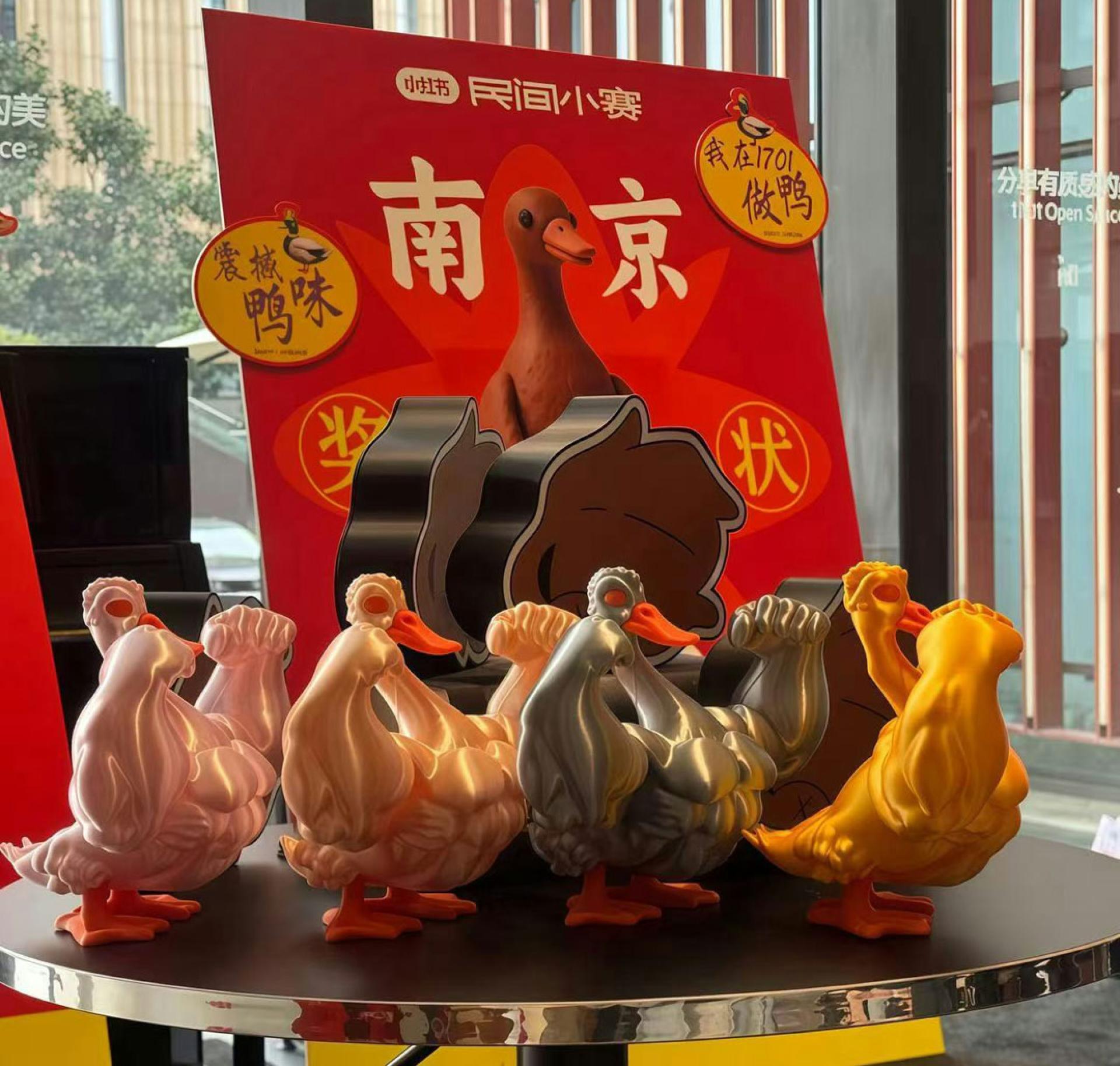
Recently, a Live House in Yuhuatai District, Nanjing, Jiangsu Province, was packed to the brim for a feverish “Nanjing Duck King Competition” spontaneously organized by netizens. A total of 138 duck shops were nominated online, with 37 contestants grouped by district taking the stage to creatively promote their favorite duck shop—some told stories, some rapped, all using unique and inventive approaches. Audience members, clutching little yellow duck toys, tasted the entries while casting their votes to pick the day’s “Duck King.” The scene included not only local residents, but also foodies who traveled in by high-speed train from Shanghai and Anhui.
In addition to the Nanjing Duck King Competition, there’s also the Beijing Black Puffer Jacket Contest, Shanghai Low-Budget Pretentious Competition, Guangzhou Slipper King Contest, Wuhan Walk-and-Eat Contest, and more. These types of grassroots “mini-contests” that originate from the public are sweeping offline events and sparking widespread discussions online as well.
On Xiaohongshu (Rednote), the topic of “grassroots creative mini-contests” has garnered over 100 million views and nearly 600,000 discussions. Users spontaneously create or join creative competitions focusing on art, food, lifestyle, pets, trends, and more. While these seemingly nonsensical daily contests may appear lighthearted, they not only highlight city-specific quirks but also reflect young people’s collective longing for a sense of ease and self-expression in the fast-paced urban grind.
What grabs the eye most about these “mini-contests” is their distinctive “urban flavor.” Each contest theme is like a mirror, reflecting the nuanced details of city life.
In places like Guangzhou and Wuhan, grassroots “mini-contests” exude even more “smoke and fire”—a lived-in, street-level vigor. In Guangzhou, renowned as the “land of slippers,” over 300 pairs of all kinds took the stage at the “Slipper King Contest.” Someone wore flip-flops and demonstrated a “high-speed train dash,” another held a mock funeral for a pair of worn-out slippers, while others shared workplace stories and humorously rebelled against rules using their slippers as props.
These contests are not deliberately poking fun at any region; rather, they’re how young people use trending memes to express love for their city. Fan Xiaoshu said that when the topics connect with everyday life and the environment is relaxed enough, it becomes the most sought-after offline experience.
On social media platforms, there are also bizarre contests like “the slantiest tree,” “the most standard cherry tomato,” “strawberry beauty pageant,” and countless more. What’s being judged is no longer winning or losing, but “making every day worth an award.”
Why have these absurd “mini-contests” gone viral? Analysts point to a core reason: the yearning of today’s youth to “be seen.”
Nowadays, “working stiffs” are suffocating in the urban grind. “Grassroots mini-contests” smash the barriers—no perfection required, no KPIs to chase, only authenticity. Xiao Fu told reporters that when those ordinary, never-before-noticed details of life are put on stage, everyone naturally wants to join in. Introverts can quietly watch from the audience, extroverts can take the stage and unleash themselves, and the shared happiness and emotion at the scene naturally translates into online buzz.
Observers note that identity anxiety and emotional isolation are now collective symptoms, and “grassroots mini-contests” build “lifestyle social circles” around shared interests, where genuine sharing resonates with netizens. These low-cost, highparticipation offline activities deliver a sense of ease and relaxation, while also filling the emptiness and repetition of online scrolling.
On Xiaohongshu (Rednote), the topic of “grassroots creative mini-contests” has garnered over 100 million views and nearly 600,000 discussions. Users spontaneously create or join creative competitions focusing on art, food, lifestyle, pets, trends, and more. While these seemingly nonsensical daily contests may appear lighthearted, they not only highlight city-specific quirks but also reflect young people’s collective longing for a sense of ease and self-expression in the fast-paced urban grind.
What grabs the eye most about these “mini-contests” is their distinctive “urban flavor.” Each contest theme is like a mirror, reflecting the nuanced details of city life.
In places like Guangzhou and Wuhan, grassroots “mini-contests” exude even more “smoke and fire”—a lived-in, street-level vigor. In Guangzhou, renowned as the “land of slippers,” over 300 pairs of all kinds took the stage at the “Slipper King Contest.” Someone wore flip-flops and demonstrated a “high-speed train dash,” another held a mock funeral for a pair of worn-out slippers, while others shared workplace stories and humorously rebelled against rules using their slippers as props.
These contests are not deliberately poking fun at any region; rather, they’re how young people use trending memes to express love for their city. Fan Xiaoshu said that when the topics connect with everyday life and the environment is relaxed enough, it becomes the most sought-after offline experience.
On social media platforms, there are also bizarre contests like “the slantiest tree,” “the most standard cherry tomato,” “strawberry beauty pageant,” and countless more. What’s being judged is no longer winning or losing, but “making every day worth an award.”
Why have these absurd “mini-contests” gone viral? Analysts point to a core reason: the yearning of today’s youth to “be seen.”
Nowadays, “working stiffs” are suffocating in the urban grind. “Grassroots mini-contests” smash the barriers—no perfection required, no KPIs to chase, only authenticity. Xiao Fu told reporters that when those ordinary, never-before-noticed details of life are put on stage, everyone naturally wants to join in. Introverts can quietly watch from the audience, extroverts can take the stage and unleash themselves, and the shared happiness and emotion at the scene naturally translates into online buzz.
Observers note that identity anxiety and emotional isolation are now collective symptoms, and “grassroots mini-contests” build “lifestyle social circles” around shared interests, where genuine sharing resonates with netizens. These low-cost, highparticipation offline activities deliver a sense of ease and relaxation, while also filling the emptiness and repetition of online scrolling.