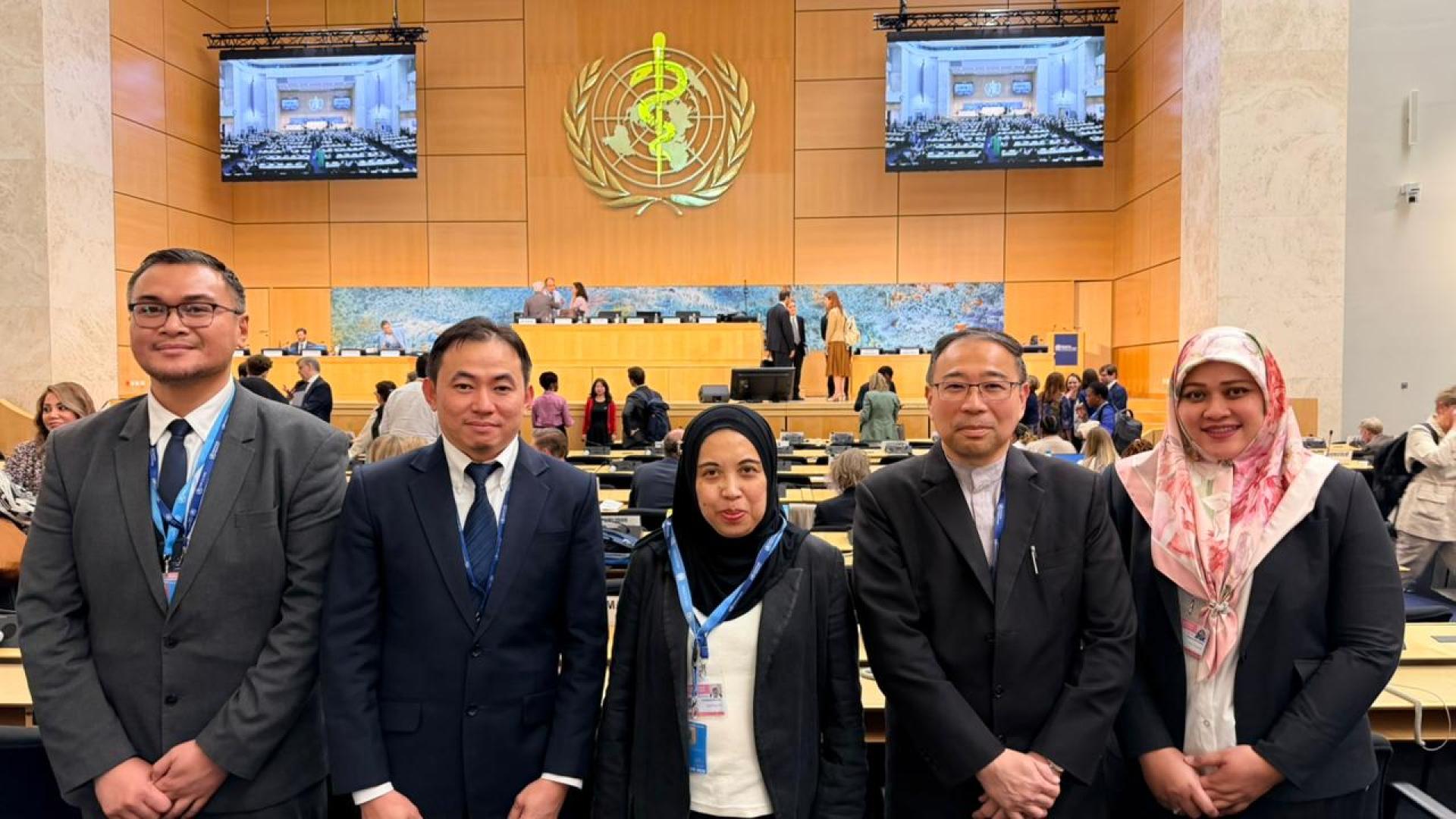
(Bandar Seri Begawan, 25th) The 79th World Health Assembly (WHA79) was grandly held in Geneva, Switzerland from May 18 to 23, 2026. With the theme of "Reshaping Global Health: A Shared Responsibility," this session focused on global public health priorities and aimed to shape the direction of future global health policies. Brunei’s delegation, led by Dk Mazlizah, Brunei’s Permanent Representative to the United Nations Office in Geneva, and composed of senior officials from the Ministry of Health, attended the assembly.
At the plenary session, Dk Mazlizah delivered a speech on behalf of Brunei.
She pointed out that, although certain progress has been made globally according to the 2025 Results Report of WHO's Thirteenth General Programme of Work, many gaps persist which may prevent the timely achievement of the health-related Sustainable Development Goals by 2030. The recent outbreak of hantavirus and the declaration of the Ebola epidemic as a "public health emergency of international concern" have once again sounded the alarm for the world: no country can be fully protected in isolation, which strongly resonates with the assembly's theme of "shared responsibility."
To this end, Brunei clearly put forward three core health priorities at the assembly: strengthening global health financing—sustainable and flexible global health funding must be enhanced to ensure the World Health Organization is able to maintain rapid response and efficient operation.
Advancing digital health transformation: prioritizing core public health investments such as AI-based disease surveillance, digital health platforms, and real-time epidemic intelligence. As well as enhancing multilateral trust and equity: health security must be built on a foundation of trust. Although negotiations over the Pathogen Access and Benefit-sharing Attachments will require more time, all parties must step up multilateral dialogue to ensure that countries can equitably benefit from scientific, technological, and epidemic response achievements.
Meanwhile, the Brunei delegation emphasized that prevention is the cornerstone for building resilient health systems. In order to protect vulnerable groups and strengthen public confidence, Brunei has taken concrete actions—not only integrating pneumococcal conjugate vaccines into its National Immunization Program (Expanded Programme on Immunization—EPI), but also starting to provide pregnant women with the TDAP vaccine (tetanus, diphtheria, and acellular pertussis).
On the other hand, this assembly delved deeply into many key topics, including pandemic preparedness, the 2030 Immunization Agenda, universal health coverage, antimicrobial resistance, control of non-communicable diseases, and access to medicines. Brunei’s active participation fully demonstrates the country’s enduring commitment to international health cooperation and global solidarity.
In addition, by pursuing innovation, capacity building, and policy coordination, Brunei will continue advancing its own health priorities and working with the international community to jointly build a more resilient and equitable global health system.
At the plenary session, Dk Mazlizah delivered a speech on behalf of Brunei.
To this end, Brunei clearly put forward three core health priorities at the assembly: strengthening global health financing—sustainable and flexible global health funding must be enhanced to ensure the World Health Organization is able to maintain rapid response and efficient operation.
Advancing digital health transformation: prioritizing core public health investments such as AI-based disease surveillance, digital health platforms, and real-time epidemic intelligence. As well as enhancing multilateral trust and equity: health security must be built on a foundation of trust. Although negotiations over the Pathogen Access and Benefit-sharing Attachments will require more time, all parties must step up multilateral dialogue to ensure that countries can equitably benefit from scientific, technological, and epidemic response achievements.
Meanwhile, the Brunei delegation emphasized that prevention is the cornerstone for building resilient health systems. In order to protect vulnerable groups and strengthen public confidence, Brunei has taken concrete actions—not only integrating pneumococcal conjugate vaccines into its National Immunization Program (Expanded Programme on Immunization—EPI), but also starting to provide pregnant women with the TDAP vaccine (tetanus, diphtheria, and acellular pertussis).
On the other hand, this assembly delved deeply into many key topics, including pandemic preparedness, the 2030 Immunization Agenda, universal health coverage, antimicrobial resistance, control of non-communicable diseases, and access to medicines. Brunei’s active participation fully demonstrates the country’s enduring commitment to international health cooperation and global solidarity.
In addition, by pursuing innovation, capacity building, and policy coordination, Brunei will continue advancing its own health priorities and working with the international community to jointly build a more resilient and equitable global health system.