(Sultan City, 25th) The Ji De Care Association’s ‘Cultural School’ continued the cultural momentum sparked by the recent visit to the 35th Anniversary of Brunei-China Diplomatic Relations Commemoration ‘Tide Rises in the East – Poetic Zhejiang’ exhibition, by presenting students yesterday with a richly layered and profound special course on Chinese culture. The curriculum encompassed aspects such as ancient history, traditional arts, folk festivals, the evolution of characters, historical figures, and classical text reading, among other facets.
In the history section, lecturer Shen Renxiang systematically explained the historical context from the Paleolithic and Neolithic periods to the Bronze Age, with special emphasis on the Kuahuqiao Culture and Hemudu Culture of about 8,000 to 7,000 years ago. Through charts and images, he illustrated cultural characteristics of each period, focusing particularly on archaeological discoveries in the lower Yangtze River region, giving students a deep sense of the profound historical fabric of Chinese civilization.
The arts session was led by Ms. Xing Xiuzhu, who, from a professional artist’s perspective, shared the ‘fish rubbing’ (gyotaku) art form, which was presented for the first time in Brunei at the ‘Tide Rises in the East – Poetic Zhejiang’ exhibition. She not only explained in detail the historical origins and techniques of fish rubbing, but also shared her insights gained from exchanges with participating artist Master Zhou Yi, exhibiting numerous fish rubbing works to give students a more direct and in-depth understanding of this unique art form.
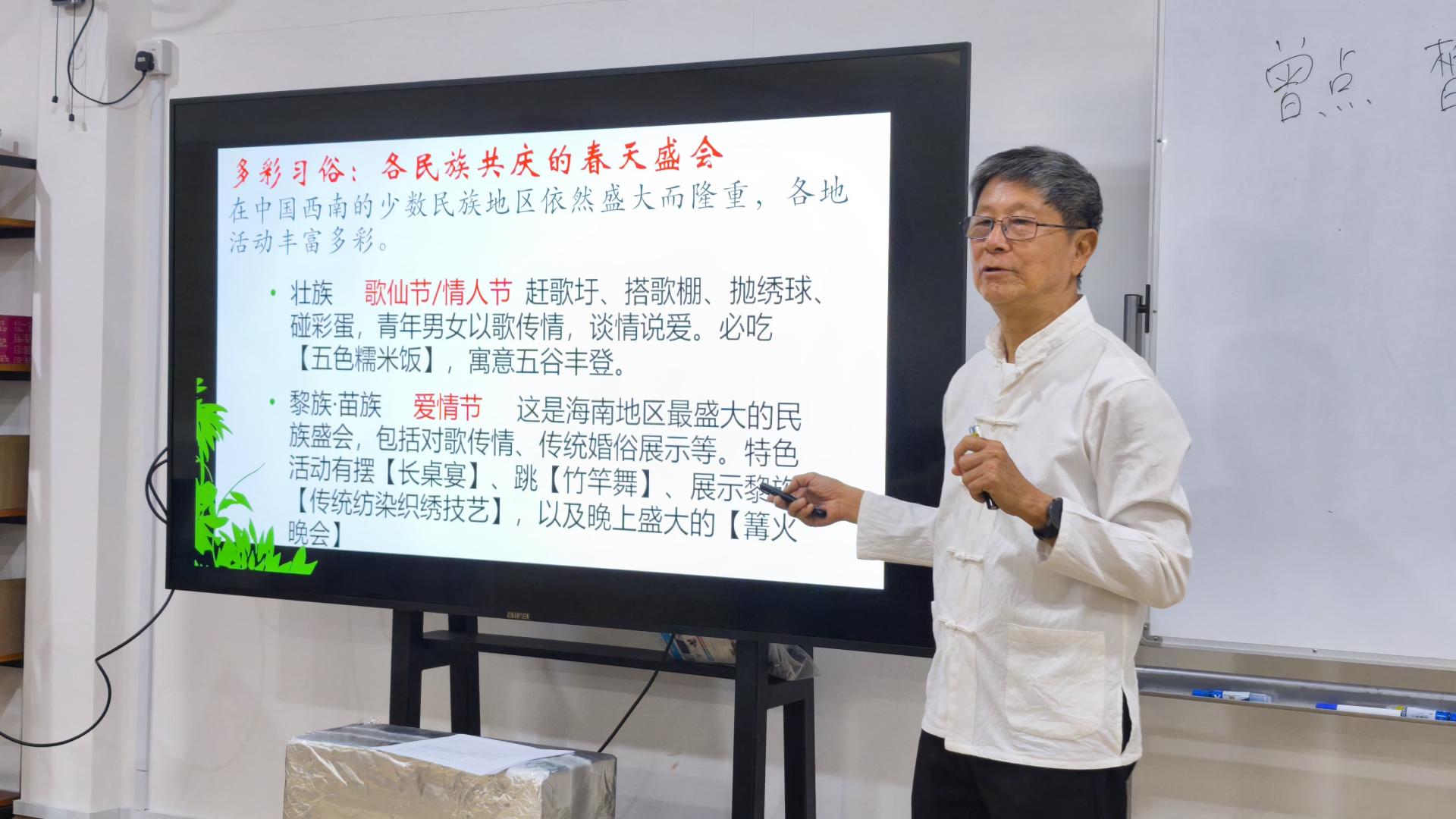
The folk customs module focused on the ‘Shangsi Festival’ of the lunar calendar’s third month, introducing legends of the Northern Emperor, Confucius’s spring outings, Wang Xizhi’s ‘purification by the stream’ and the ‘floating wine cups in the winding stream’ gathering, as well as the rituals honoring cultural ancestors. Additionally, it covered the rich and colorful festival customs among China’s various ethnic groups, showcasing the cultural depth and everyday flavor of traditional holidays.
The ‘Explaining Chinese Characters’ unit used the character ‘寺’ (temple/monastery) as an example, elucidating that its original meaning was not ‘temple’, and further elaborated on derived characters such as ‘持’ (hold), ‘待’ (wait), ‘等’ (wait/class), ‘特’ (special), ‘诗’ (poem), ‘时’ (time), ‘侍’ (attend), ‘恃’ (rely), ‘峙’ (stand), and ‘痔’ (hemorrhoid). Through exploring phonetic and semantic evolution, it helped students understand the relationships between the form and meaning of Chinese characters, as well as rules of language development.
The historical figures section focused on the national hero Yue Fei, introducing his life and deeds and appreciating his renowned work ‘Man Jiang Hong’, inspiring students’ veneration for historical figures and patriotic sentiments.
The ‘Cultural School’ curriculum is thorough and clearly structured, combining academic depth with real-world relevance, and will continue to promote the dissemination and exchange of outstanding traditional Chinese culture through diverse themed programs.
The arts session was led by Ms. Xing Xiuzhu, who, from a professional artist’s perspective, shared the ‘fish rubbing’ (gyotaku) art form, which was presented for the first time in Brunei at the ‘Tide Rises in the East – Poetic Zhejiang’ exhibition. She not only explained in detail the historical origins and techniques of fish rubbing, but also shared her insights gained from exchanges with participating artist Master Zhou Yi, exhibiting numerous fish rubbing works to give students a more direct and in-depth understanding of this unique art form.
The folk customs module focused on the ‘Shangsi Festival’ of the lunar calendar’s third month, introducing legends of the Northern Emperor, Confucius’s spring outings, Wang Xizhi’s ‘purification by the stream’ and the ‘floating wine cups in the winding stream’ gathering, as well as the rituals honoring cultural ancestors. Additionally, it covered the rich and colorful festival customs among China’s various ethnic groups, showcasing the cultural depth and everyday flavor of traditional holidays.
The ‘Explaining Chinese Characters’ unit used the character ‘寺’ (temple/monastery) as an example, elucidating that its original meaning was not ‘temple’, and further elaborated on derived characters such as ‘持’ (hold), ‘待’ (wait), ‘等’ (wait/class), ‘特’ (special), ‘诗’ (poem), ‘时’ (time), ‘侍’ (attend), ‘恃’ (rely), ‘峙’ (stand), and ‘痔’ (hemorrhoid). Through exploring phonetic and semantic evolution, it helped students understand the relationships between the form and meaning of Chinese characters, as well as rules of language development.
The historical figures section focused on the national hero Yue Fei, introducing his life and deeds and appreciating his renowned work ‘Man Jiang Hong’, inspiring students’ veneration for historical figures and patriotic sentiments.
The ‘Cultural School’ curriculum is thorough and clearly structured, combining academic depth with real-world relevance, and will continue to promote the dissemination and exchange of outstanding traditional Chinese culture through diverse themed programs.