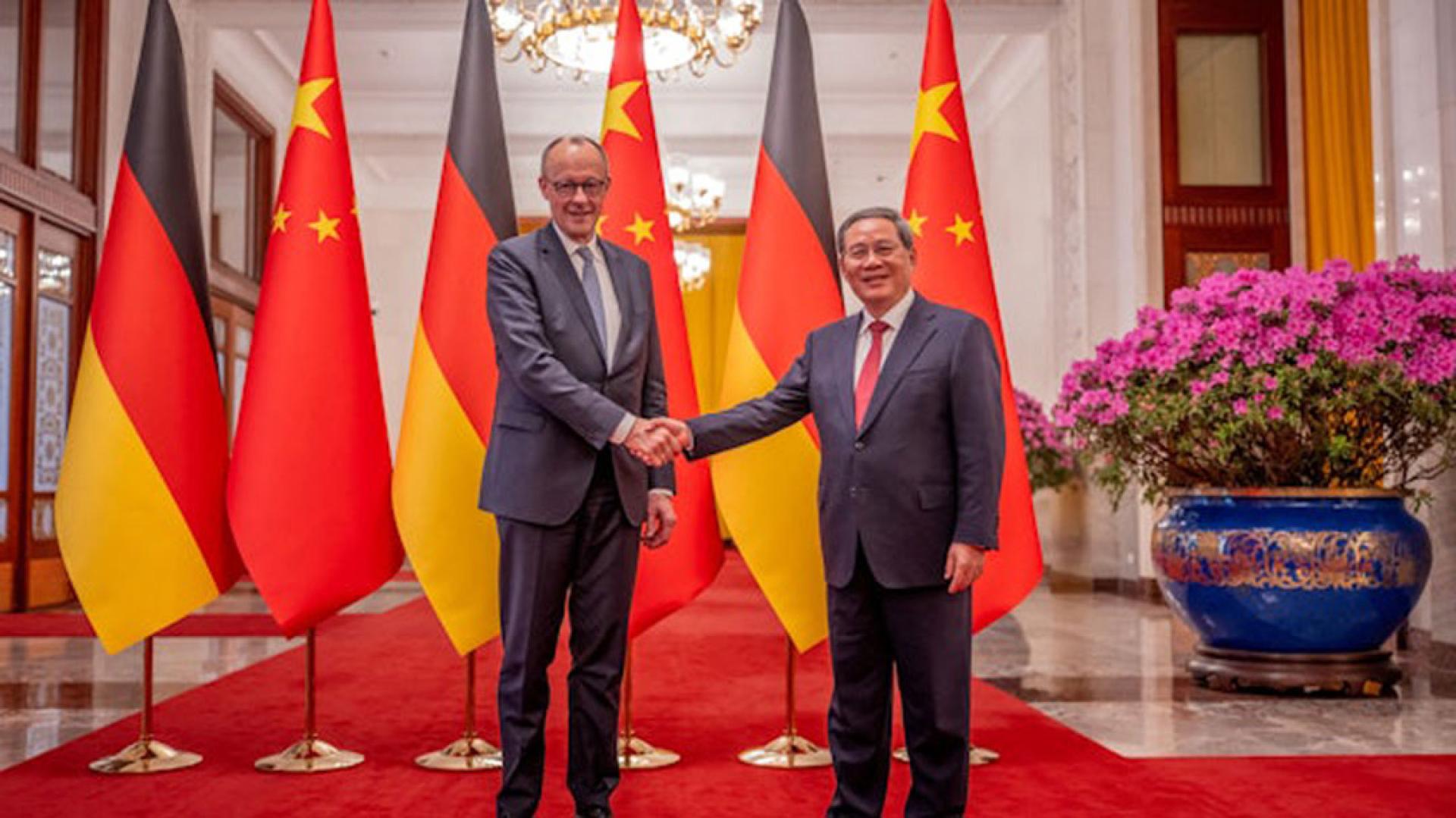
Chinese Premier Li Qiang stated that the fundamental pattern of complementary economic and industrial advantages between China and Germany has not changed; the scope for cooperation far exceeds that of competition. He added that by fostering a healthy relationship of both competition and cooperation, the two sides can develop better together.
According to China News Service, Li Qiang made these remarks on the afternoon of the 25th at the Great Hall of the People in Beijing, where he and German Chancellor Merz jointly attended a China-Germany Economic Advisory Committee meeting.
Li Qiang said that in recent times, global economic instability and uncertainty have generally been on the rise. As two of the world’s major economies, China and Germany, through close and ongoing cooperation, have not only expanded opportunities for their respective development but also injected momentum into the world economy.
He noted that the world economy is still facing considerable challenges, with unilateralism and protectionism on the rise or even prevailing in some countries and regions, causing serious disruption to the international economic and trade order. The more severe the situation, the more China and Germany should strengthen cooperation. Only through cooperation can risks be most effectively addressed; only by pursuing development can security be ensured.
Li Qiang emphasized that both the Chinese and German economies are currently showing signs of recovery and improvement. During the upcoming “15th Five-Year Plan” period, there will be even greater prospects for bilateral economic and trade cooperation. The fundamental pattern of complementary economic and industrial advantages between China and Germany has not changed; the scope for cooperation far exceeds that of competition. By shaping a positive relationship of both competition and cooperation, the two sides can develop better together.
He suggested that both sides focus their efforts on three key areas to achieve mutually beneficial and higher-level outcomes. The first is to strengthen the foundation of traditional cooperation. Companies from both countries can continue to deepen collaboration in fields such as machinery, equipment, and chemicals, accelerate business localization, and continuously enhance resilience and efficiency.
The second is to seize new opportunities for future development. He supports enterprises and research institutions from both countries fostering two-way flows of innovation resources, deepening joint technological research, building platforms together, and sharing achievements. They could also explore third-party markets together.
The third is to create a favorable environment for investment and entrepreneurship. China will resolutely expand its high-level opening to the outside world and actively address reasonable concerns raised by German and other foreign enterprises. He hopes the German government will provide an open, fair, and non-discriminatory business environment so companies from both countries can cooperate and compete according to market principles. He also hopes that entrepreneurs from China and Germany will play an important role in promoting bilateral economic and trade cooperation, enhancing communication and understanding, and supporting the stability of bilateral relations.