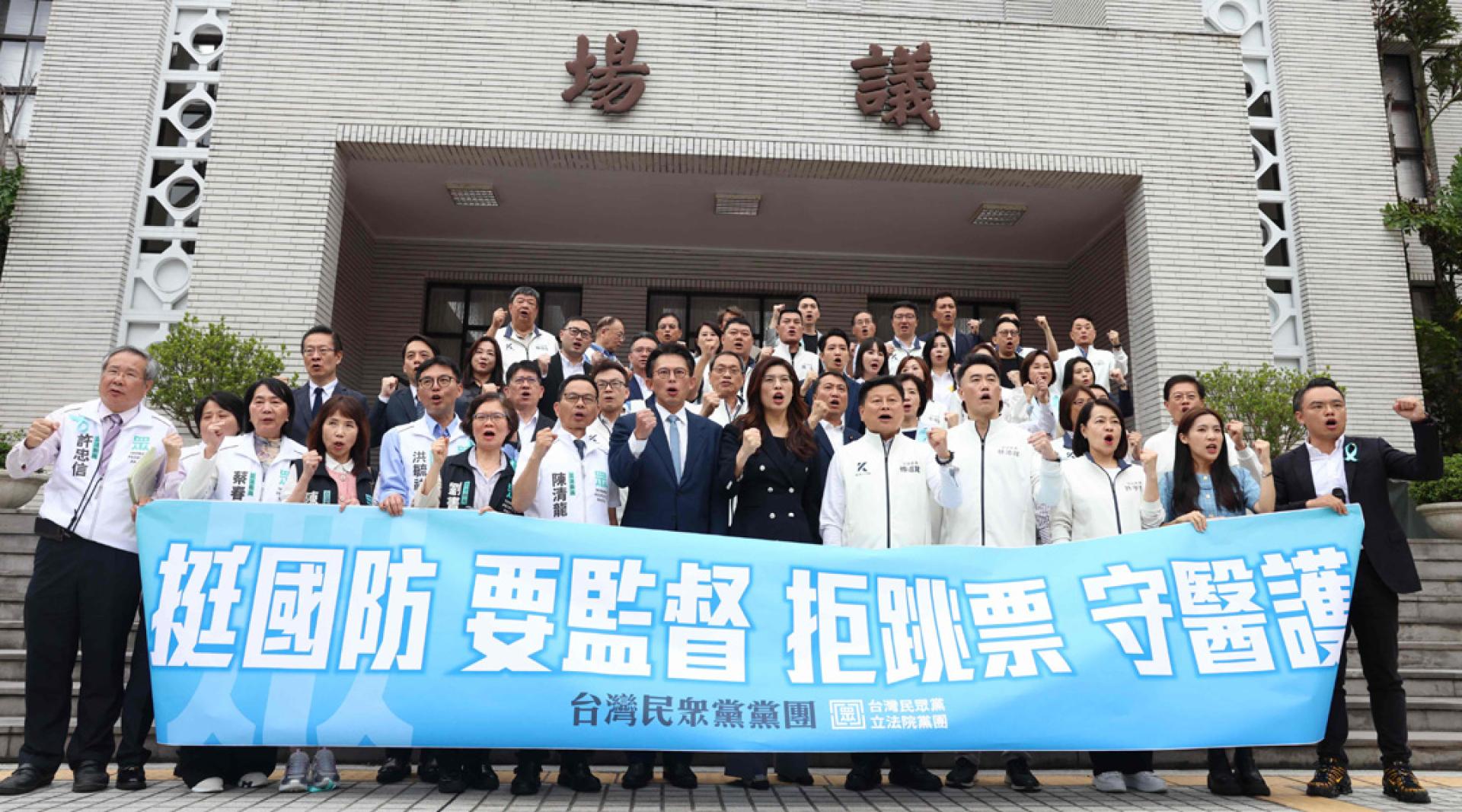
The Legislative Yuan in Taiwan passed a 780 billion NTD (about 97.6 billion MYR) military procurement bill on the 8th. In response to a question from a Central News Agency journalist, the U.S. State Department stated that the United States supports Taiwan in acquiring critical defensive capabilities commensurate with the threats it faces, but also pointed out that further delays in funding other planned defense capabilities would constitute a "concession to the Chinese Communist Party."
Taiwan President Lai Ching-te last year proposed an additional eight-year national defense budget of NTD 1.25 trillion to counter mainland China, but it was blocked by the opposition led by the Kuomintang (KMT), which pushed for a scaled-down version of the proposal.
On third reading, the Legislative Yuan passed the KMT-backed 780 billion NTD special defense budget bill, the scope of which is limited to U.S. arms purchases for which a price has been quoted. In addition to the first batch of price quotes for five arms sales deals worth 300 billion NTD, if the U.S. provides a second batch of quotes within one year, the upper limit will be 480 billion NTD.
The 1.25 trillion NTD special defense budget bill had included U.S. arms purchases, commercial procurement, and commissioned manufacturing. However, the opposition parties insisted that, due to significant drawbacks, the bill should be limited to U.S. arms procurement only.
Ministry of National Defense: Damaging to the Integrity of Force Build-up Planning
Taiwan's Ministry of National Defense stated that the legislature's decision to pass the 780 billion NTD procurement bill, completely excluding commercial purchases and commissioned manufacturing, undermines the overall integrity of force build-up planning.
In response, a U.S. State Department spokesperson replied to journalists' questions via email, stating, "While we are encouraged by the passage of this special defense budget after an unhelpful delay, the U.S. notes that further deferring funding for other planned capabilities would be a concession to the Chinese Communist Party."
Lai Ching-te: Hopes Legislature Will Quickly Build Seven Key Defense Capabilities
Lai Ching-te wrote on social media that passing the military procurement bill is only the first step and hopes the Legislative Yuan will quickly construct seven key defense capabilities.
On Facebook, Lai noted that the legislature had voted on parts of the "Special Act for Strengthening Defense Resilience and Asymmetric Warfare Capability Procurement," enabling the advancement of important equipment acquisitions, including the HIMARS multiple launch rocket system. Lai said this was a hard-won step forward after nearly six months of communication.
He emphasized that this is only the first step and not a complete answer, stating that although the approval of U.S. military procurement addresses some urgent needs, several critical areas—including Taiwan-produced and commissioned drones, establishing a defense supply chain, command and decision-support systems, defense-independent commissioning, and joint Taiwan-U.S. R&D—have not been fully included. These are necessary for strengthening Taiwan's defense resilience, building asymmetric warfare capability, and sustaining prolonged operations—Taiwan's seven key defense capabilities.
Lai stressed that any gap would affect the overall integrity of the defense system; any delay increases the security risk jointly borne by the Taiwanese people. He thus urged the legislature—both ruling and opposition parties—to build on this achievement, further collaborate, and accelerate the completion of the seven capabilities so that no key combat strength is left out.