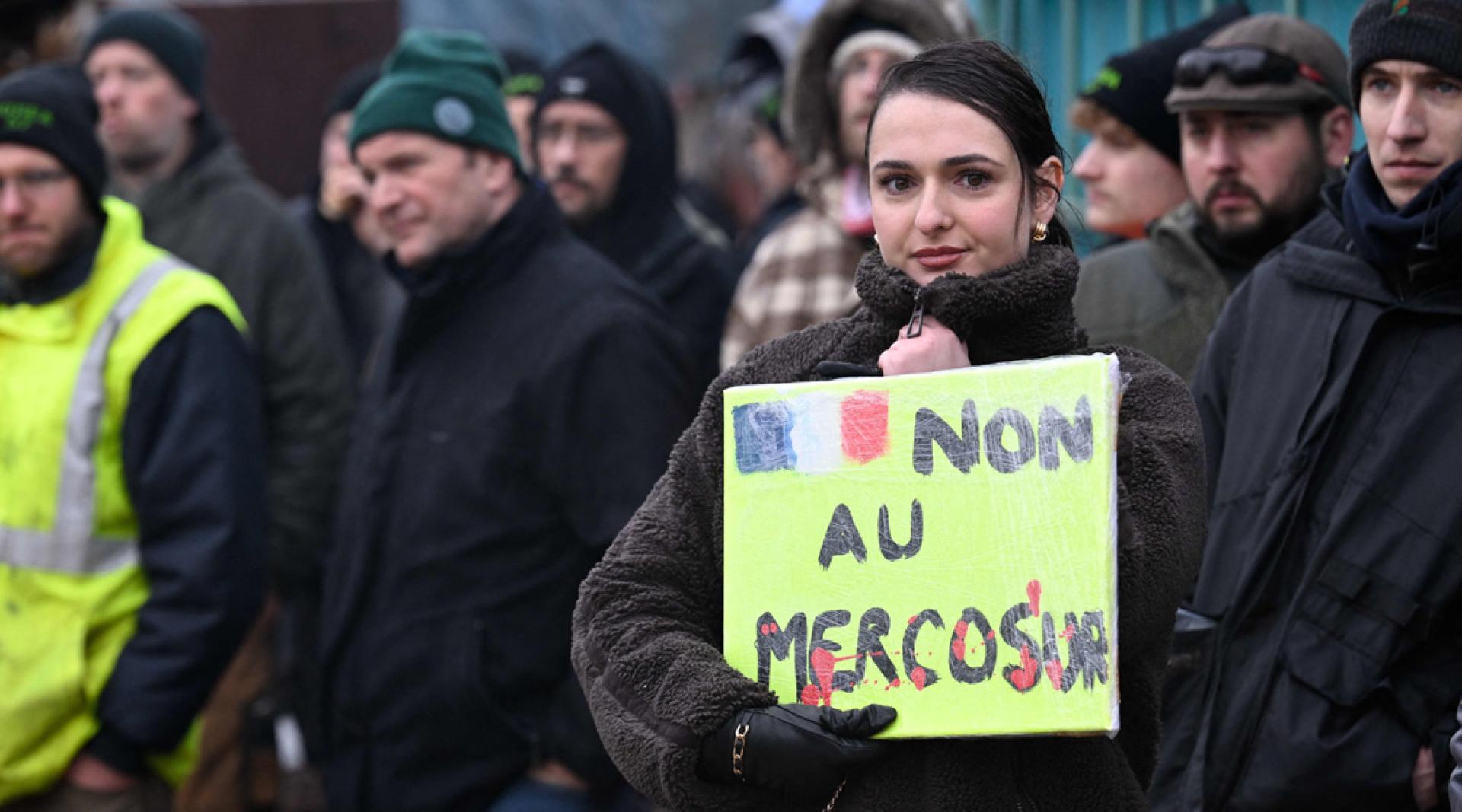
The European Union recently approved the “Mercosur” free trade agreement, with European Commission President Ursula von der Leyen scheduled to visit Paraguay on the 17th to sign the deal. Why was this agreement, after more than 25 years of negotiations, finalized at this moment? Experts analyze that there are factors “targeting China” behind it; the EU is not pleased to see Latin America continue leaning toward China and is also looking at South America's rich rare earth resources.
Mercosur (Southern Common Market) member countries currently include Brazil, Paraguay, Argentina, and Uruguay, with Bolivia about to join.
According to the Central News Agency, on the 17th, von der Leyen will join European Council President Costa to go to Paraguay to sign the “EU-Mercosur Free Trade Agreement,” which involves Argentina, Brazil, Uruguay, and Paraguay. The agreement will create a massive free trade area covering over 700 million people.
On the 9th, the EU approved the agreement in a vote supported by most member states, but France, Austria, Hungary, Poland, and Ireland voted against it, with fierce farmer protests erupting in France. Why did these negotiations, which started in 1999, achieve a historic breakthrough? Many experts attribute this to “geopolitics.” Besides US tariffs forcing Europe to proactively seek alternative markets, the EU faces heavy pressure to “find another path” amid China’s devastating impact on European industries through subsidized policies and low-priced dumping.
China’s Influence in Latin America Has Risen Dramatically in Recent Years
Italian media “La Formica” cited, Demare, an economic expert at the European Council on Foreign Relations (ECFR), pointed out that the significance of this agreement goes far beyond trade. Latin America is now a key ground in the strategic competition between the West and China; in recent years China’s influence in Latin America has risen dramatically. For the EU, not signing this agreement means pushing Latin American economies further onto China’s track; “Latin American economies will become increasingly dependent on Beijing.”
Given that China often uses rare earth resources as an international political bargaining chip, Demare also noted that Mercosur countries possess resources that are crucial for the EU’s green energy transition, especially Brazil, which holds about 20% of the world’s reserves of graphite, nickel, manganese, and rare earths, as well as the world’s largest reserves of niobium. Niobium is a strategic metal in the aerospace sector and has been listed on the EU’s critical raw materials list. Argentina, meanwhile, possesses one of the world’s top three lithium reserves, with lithium being a key material for electric vehicle batteries.
Europe Wants to Reduce the Risk of Dependence on China
Demare stated that this agreement is part of Europe’s “strategy to reduce dependence on China.” By lowering export tariffs to Mercosur, particularly in chemical and mechanical sectors, Europe can incentivize EU companies to choose Latin America over building production lines in China.