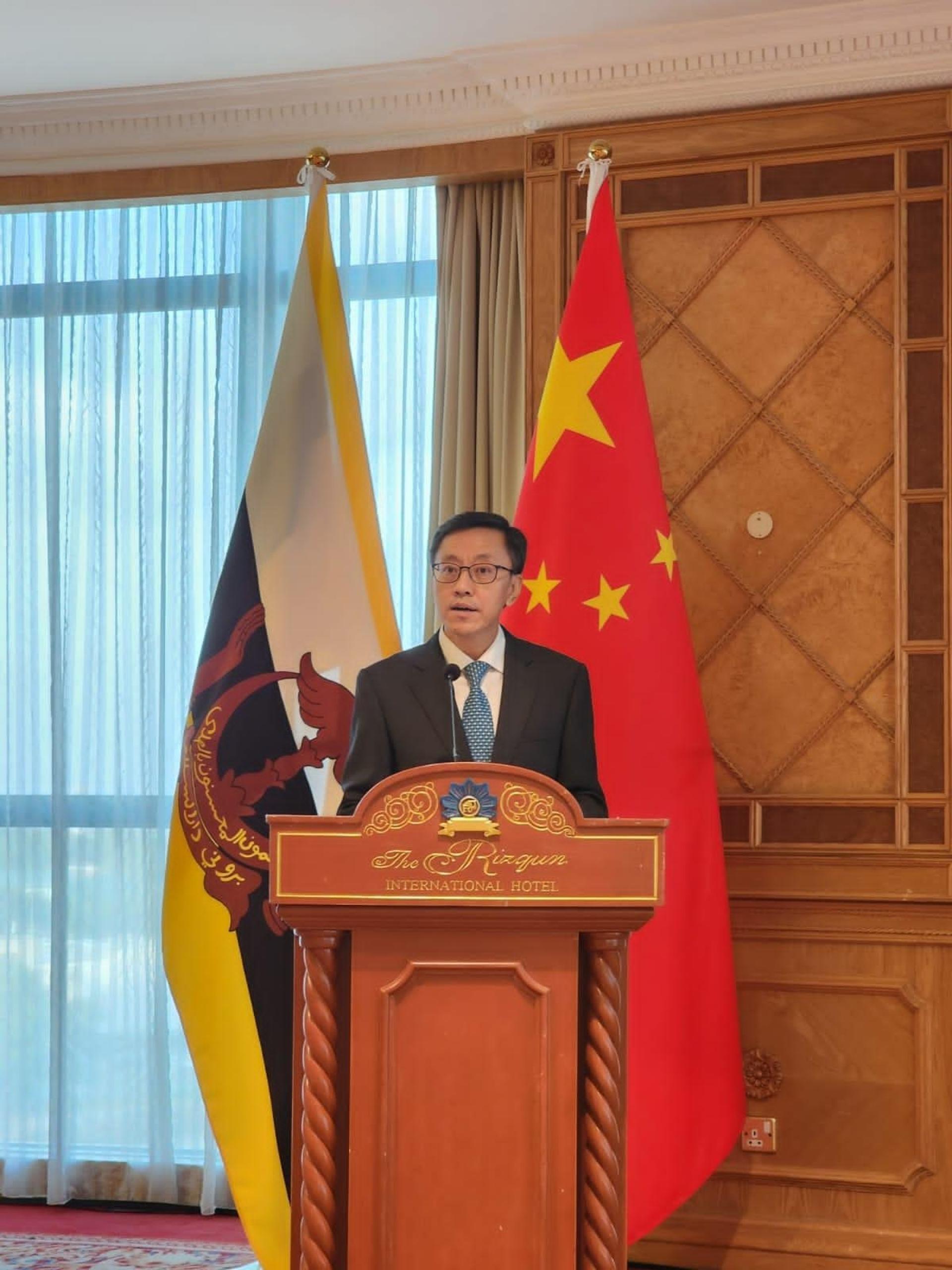
(Bandar Seri Begawan, 14th) Chinese Ambassador to Brunei, Chen Shaochun, delivered a speech at the 2026 Ramadan Media and Think Tank Briefing, stating that the 22nd Session of Brunei's Legislative Council has officially opened. His Majesty the Sultan attended the event and delivered a royal address, marking his first public appearance after undergoing right knee replacement surgery. The Chinese side extends sincere congratulations on His Majesty’s rapid recovery and the opening of the Legislative Council session, and believes that under his leadership, Brunei will continue to advance towards its ‘Vision 2035’ and achieve greater accomplishments.
Chen Shaochun pointed out that as Brunei’s Legislative Council session opens, China’s annual ‘Two Sessions’ have recently concluded in Beijing. The ‘Two Sessions’—the National People's Congress (NPC) and the Chinese People's Political Consultative Conference (CPPCC)—are important events on China’s annual political agenda. Deputies and members gather in Beijing to discuss national affairs and development. Through this window, one can observe China’s top current concerns and the practice of whole-process people's democracy.
The Ambassador introduced that this year’s Two Sessions produced fruitful outcomes, including deliberation of the government work report at the fourth session of the 14th NPC, approval of the ‘15th Five-Year’ plan outline and annual budget, and passage of the ‘Ecological and Environmental Code’ and other laws; the fourth session of the 14th CPPCC earnestly discussed the government work report and the draft plan outline, and reviewed work reports of the Standing Committee of the CPPCC, among other documents.
He noted that in his government work report, Premier Li Qiang summarized work over the past year and five years, and set out the goals and tasks for this year and the next five years. The report proposed a 2026 GDP growth target of 4.5% to 5%, an urban surveyed unemployment rate of around 5.5%, more than 12 million new urban jobs, a consumer price increase of around 2%, and identified ten key tasks, including building a strong domestic market, fostering new growth drivers, achieving scientific and technological self-reliance and strength, deepening reform, expanding openness, rural revitalization, new-type urbanization, improving people’s livelihood, green transition, and enhancing risk prevention and security capacity.
Ambassador Chen further explained that the ‘15th Five-Year’ plan outline turns the party’s blueprint into a concrete task list, highlighting four core themes: high-quality development, domestic circulation, common prosperity, and coordinated development and security, with 109 major projects proposed to support high-quality growth. The outline features three characteristics: foresight, people-oriented, and openness, balancing strategic planning and people’s concerns, while promoting the smooth flow of both domestic and international dual circulation.
Regarding foreign policy, Chen Shaochun stated that under the guidance of Xi Jinping’s Thought on Socialism with Chinese Characteristics for a New Era, China promotes the building of a community with a shared future for mankind, advancing four global initiatives: global development, global security, global civilization, and global governance, to foster multilateralism, international cooperation, and peace and stability. He emphasized that China is willing to work with Middle Eastern countries to implement the Global Security Initiative and promote regional stability; at the same time, it attaches great importance to neighborhood diplomacy, with ASEAN as a key focus, striving to build a China-ASEAN community with a shared future, and to safeguard peace and cooperation in the South China Sea.
The Ambassador also discussed China-Brunei relations, recalling the achievements of His Majesty’s visit to China last year, and stressed that under the alignment of the ‘Belt and Road Initiative’ and ‘Vision 2035’, the two sides are promoting joint maritime development and the steady advancement of high-level strategic trust. This year marks the 35th anniversary of China-Brunei diplomatic relations. China welcomes His Majesty to attend the APEC Informal Leaders’ Meeting in China, and both sides will continue to strengthen strategic mutual trust, deepen high-quality cooperation, and jointly work towards building a China-Brunei community with a shared future.
Regarding Taiwan and Xinjiang-related issues, Chen Shaochun reiterated that China adheres to the one-China principle; Taiwan has been part of China's territory since ancient times, and China firmly opposes ‘Taiwan independence’ separatist forces. Xinjiang enjoys social stability, ethnic unity, and economic development. China sincerely welcomes Bruneian friends to visit Xinjiang and experience its cultural and developmental achievements.
In concluding remarks, Chen Shaochun thanked media and think tank friends for their longstanding attention to China-Brunei relations and China’s development, expressing hope for more opportunities for exchange in the future, and to jointly promote new progress and new chapters in China-Brunei relations.
The Ambassador introduced that this year’s Two Sessions produced fruitful outcomes, including deliberation of the government work report at the fourth session of the 14th NPC, approval of the ‘15th Five-Year’ plan outline and annual budget, and passage of the ‘Ecological and Environmental Code’ and other laws; the fourth session of the 14th CPPCC earnestly discussed the government work report and the draft plan outline, and reviewed work reports of the Standing Committee of the CPPCC, among other documents.
He noted that in his government work report, Premier Li Qiang summarized work over the past year and five years, and set out the goals and tasks for this year and the next five years. The report proposed a 2026 GDP growth target of 4.5% to 5%, an urban surveyed unemployment rate of around 5.5%, more than 12 million new urban jobs, a consumer price increase of around 2%, and identified ten key tasks, including building a strong domestic market, fostering new growth drivers, achieving scientific and technological self-reliance and strength, deepening reform, expanding openness, rural revitalization, new-type urbanization, improving people’s livelihood, green transition, and enhancing risk prevention and security capacity.
Ambassador Chen further explained that the ‘15th Five-Year’ plan outline turns the party’s blueprint into a concrete task list, highlighting four core themes: high-quality development, domestic circulation, common prosperity, and coordinated development and security, with 109 major projects proposed to support high-quality growth. The outline features three characteristics: foresight, people-oriented, and openness, balancing strategic planning and people’s concerns, while promoting the smooth flow of both domestic and international dual circulation.
Regarding foreign policy, Chen Shaochun stated that under the guidance of Xi Jinping’s Thought on Socialism with Chinese Characteristics for a New Era, China promotes the building of a community with a shared future for mankind, advancing four global initiatives: global development, global security, global civilization, and global governance, to foster multilateralism, international cooperation, and peace and stability. He emphasized that China is willing to work with Middle Eastern countries to implement the Global Security Initiative and promote regional stability; at the same time, it attaches great importance to neighborhood diplomacy, with ASEAN as a key focus, striving to build a China-ASEAN community with a shared future, and to safeguard peace and cooperation in the South China Sea.
The Ambassador also discussed China-Brunei relations, recalling the achievements of His Majesty’s visit to China last year, and stressed that under the alignment of the ‘Belt and Road Initiative’ and ‘Vision 2035’, the two sides are promoting joint maritime development and the steady advancement of high-level strategic trust. This year marks the 35th anniversary of China-Brunei diplomatic relations. China welcomes His Majesty to attend the APEC Informal Leaders’ Meeting in China, and both sides will continue to strengthen strategic mutual trust, deepen high-quality cooperation, and jointly work towards building a China-Brunei community with a shared future.
Regarding Taiwan and Xinjiang-related issues, Chen Shaochun reiterated that China adheres to the one-China principle; Taiwan has been part of China's territory since ancient times, and China firmly opposes ‘Taiwan independence’ separatist forces. Xinjiang enjoys social stability, ethnic unity, and economic development. China sincerely welcomes Bruneian friends to visit Xinjiang and experience its cultural and developmental achievements.
In concluding remarks, Chen Shaochun thanked media and think tank friends for their longstanding attention to China-Brunei relations and China’s development, expressing hope for more opportunities for exchange in the future, and to jointly promote new progress and new chapters in China-Brunei relations.