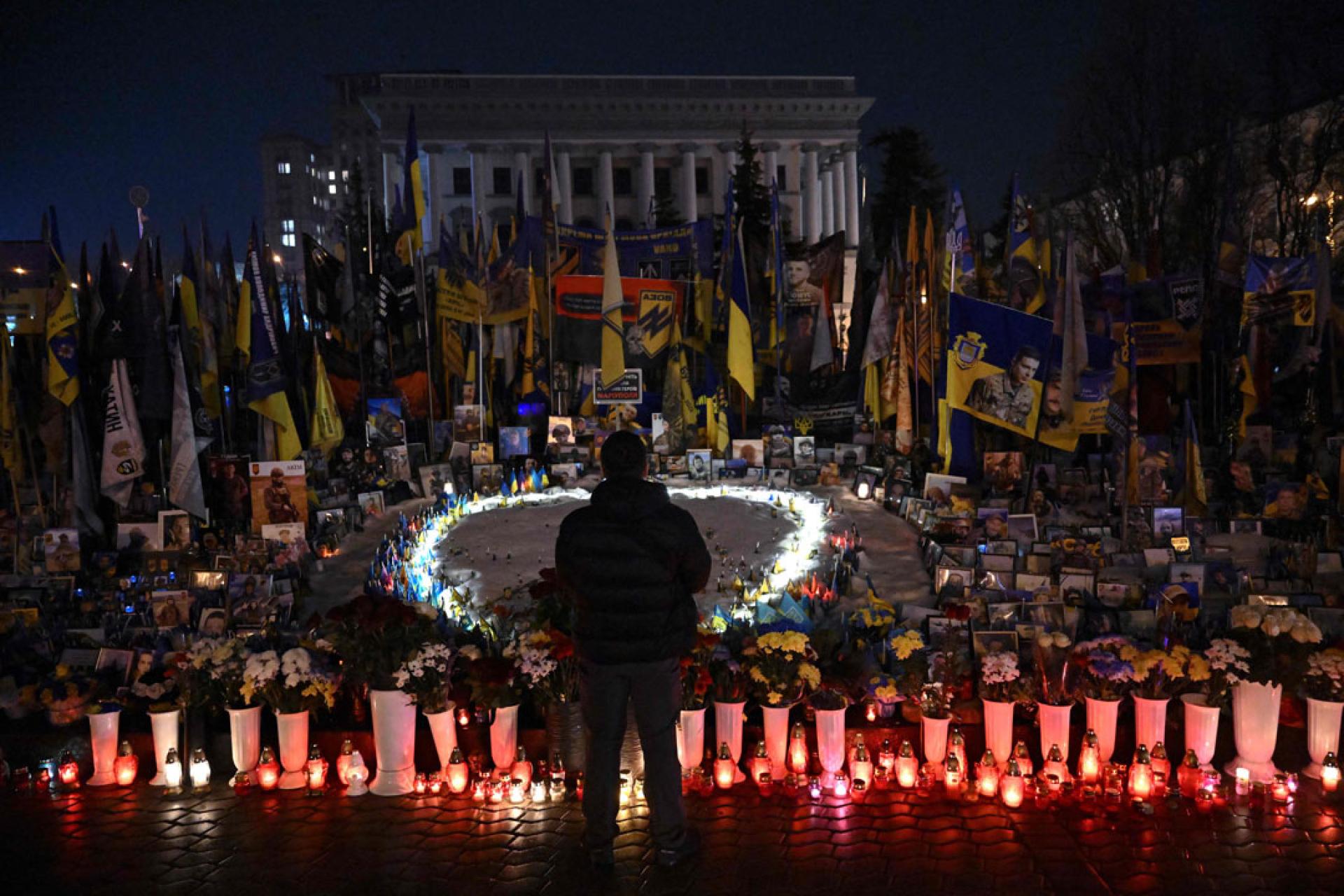
February 24, 2026 marks the 4th anniversary of the Russia-Ukraine war. At present, the battlefield between Russia and Ukraine shows a 'high consumption' tug-of-war stalemate; domestically, both economies and people's livelihoods have been affected; at the negotiation table, intensive talks among all parties are progressing, entering the 'deep water' zone where substantive issues are addressed. Both sides are growing weary, and the door to dialogue is opening. Will the four-year-long war reach a turning point?
What is the situation on the battlefield?
Military experts believe that the Russia-Ukraine battlefield is characterized by 'offensive-defensive tug-of-war' and 'high-consumption confrontation'; Russia overall has certain advantages but cannot break the deadlock. The Russian army is pursuing its strategic objectives with 'continuous, slow' advancement.
Russian military expert Nikita Yurchenko believes there were three 'campaign-level confrontations' between Russia and Ukraine last year, resulting in Russia 'recapturing' the entire Kursk region, 'taking' the key Ukrainian-held city of Kupiansk in Kharkiv region, and 'controlling' Krasnoarmeysk (called Pokrovsk by Ukraine), paving the way for complete control of the Donetsk region.
Ukraine, meanwhile, has stepped up its long-range strikes. According to Ukrainian military experts, Ukraine has conducted attacks on warplanes and ships, airports and ports, energy facilities and more through military operations such as the 'spider web' campaign, expanding the attack range deeper into Russian territory and achieving some results. Russian Defense Ministry reports show that the number of Ukrainian drones shot down by Russian forces each week has remained at 1,000 to 2,000; simultaneously, the Russian army is also carrying out long-range strikes against Ukraine's electricity and other logistical supply facilities.
According to Yurchenko and other Russian and Ukrainian experts, compared with previous years, one major characteristic of the 2025 conflict is that Ukraine did not launch any ground offensive on the same scale as the Russians, but managed to preserve viable forces in several critical moments while maintaining the integrity of its front lines; thus, the battlefield situation remains stalemated.
For Ukraine, the biggest variable on the battlefield may come from U.S. and European military aid. Western experts note that although Ukraine's defense production capacity is rapidly increasing, the Trump administration in the U.S. appears to be militarily disengaging and pressuring for negotiations, while European support for Ukraine is becoming uncertain due to 'purse-string tightness' and internal divisions, increasing the military pressure faced by Ukraine.
How heavy are the economic losses?
Some international media have pointed out that the Russia-Ukraine conflict has become a 'resource war' and an 'economic attrition war,' dealing a blow to the economies and the livelihoods of both Russia, Ukraine and the wider region.
The Russian economy is obviously under pressure from Western sanctions, but also shows resilience. According to Russia's "Kommersant" newspaper, Russia's foreign trade volume in 2025 was lower than in 2021, with a significant decline in exports to European countries. Against the background of slowing growth and contracting trade, Russia has stepped up efforts to open new markets and the role of the private sector has increased; the economy, in its turbulence, is showing a certain degree of adaptability. Russian economic analyst Nakhushev says that now most Russians' lives are not affected by front-line events.
The Ukrainian economy is deeply affected by the ongoing conflict. According to the World Bank, Ukraine's poverty rate reached 36.9% last year, far higher than pre-conflict levels. According to a report jointly published on the 23rd by the World Bank, the European Commission, the United Nations, and the Ukrainian government, as of late last year, Ukraine's direct losses from the conflict have reached $195 billion (about RM759 billion), while its reconstruction costs over the next 10 years will total $588 billion, roughly three times Ukraine's GDP last year.
Ukraine's major crisis is debt. The International Monetary Fund previously projected Ukraine's public debt at about 108.6% of GDP for 2025. The Ukrainian Finance Ministry and experts estimate that Ukraine is likely to maintain this debt ratio over the next two years, meaning that even all Ukrainians' earnings are not enough to pay off the debt. The 2026 Ukrainian state budget deficit is 1.9 trillion hryvnias (about $45 billion), meaning Ukraine needs to rely on borrowing and aid—especially from the European Union—to keep its economy and society running.
The European economy is also shrouded in the shadow of the conflict. On one hand, aid to Ukraine is putting long-term pressure on the EU's finances and further aggravating internal EU divisions. On the other hand, 'decoupling' from Russian energy has driven up European energy prices. Security concerns, economic sluggishness, and social divisions are dragging Europe into deeper trouble.\=
Where does the road to peace talks lead?\=
Since 2026, Russia, the U.S., and Ukraine have held three rounds of talks, with another round expected around the 27th of this month. These talks have begun to focus on substantive issues in the Ukrainian crisis, and finally, the door to dialogue is opening.\=
Russian and Ukrainian experts interpret the prospects for Russia-Ukraine negotiations as being affected by three major factors.\=
First, there are 'irreconcilable core bottom lines.' Territory and security guarantees are the two 'core sticking points.' Russia insists the entire Donbas region belong to Russia, while Ukraine says it will not unilaterally withdraw from Donbas; Ukraine has made Western-provided security guarantees a condition for cessation of fighting, but Russia cannot accept the deployment of Western military personnel and facilities in Ukraine.\=
Second, the U.S. mediation is seen as 'insincere.' Some Russian and Ukrainian experts analyze that the U.S. push for negotiations looks more like a 'gesture,' designed to keep the conflict relatively controllable by maintaining talks—on one hand, retaining strategic leverage over Russia, Ukraine, and Europe with sanctions and military aid, and on the other, bringing huge profits to its own military-industrial complex.\=
Third, Russian and Ukrainian public opinion is 'too complicated.' Ukrainians display an attitude of exhaustion with the conflict but pessimism about negotiations. A poll by a Ukrainian polling agency at the end of last year showed that over 52% of Ukrainians believed the overall situation would not improve in 2026. Many Ukrainians don't believe in a lasting ceasefire, don't trust the U.S. to provide guarantees, don't trust Russia to honor agreements, and thus conclude that only continued resistance can ensure a once-and-for-all solution; meanwhile, a poll released in February by Russia’s All-Russian Center for the Study of Public Opinion showed Russian public support for the war at 65%. These opposing public opinions increase government pressure at the negotiating table.