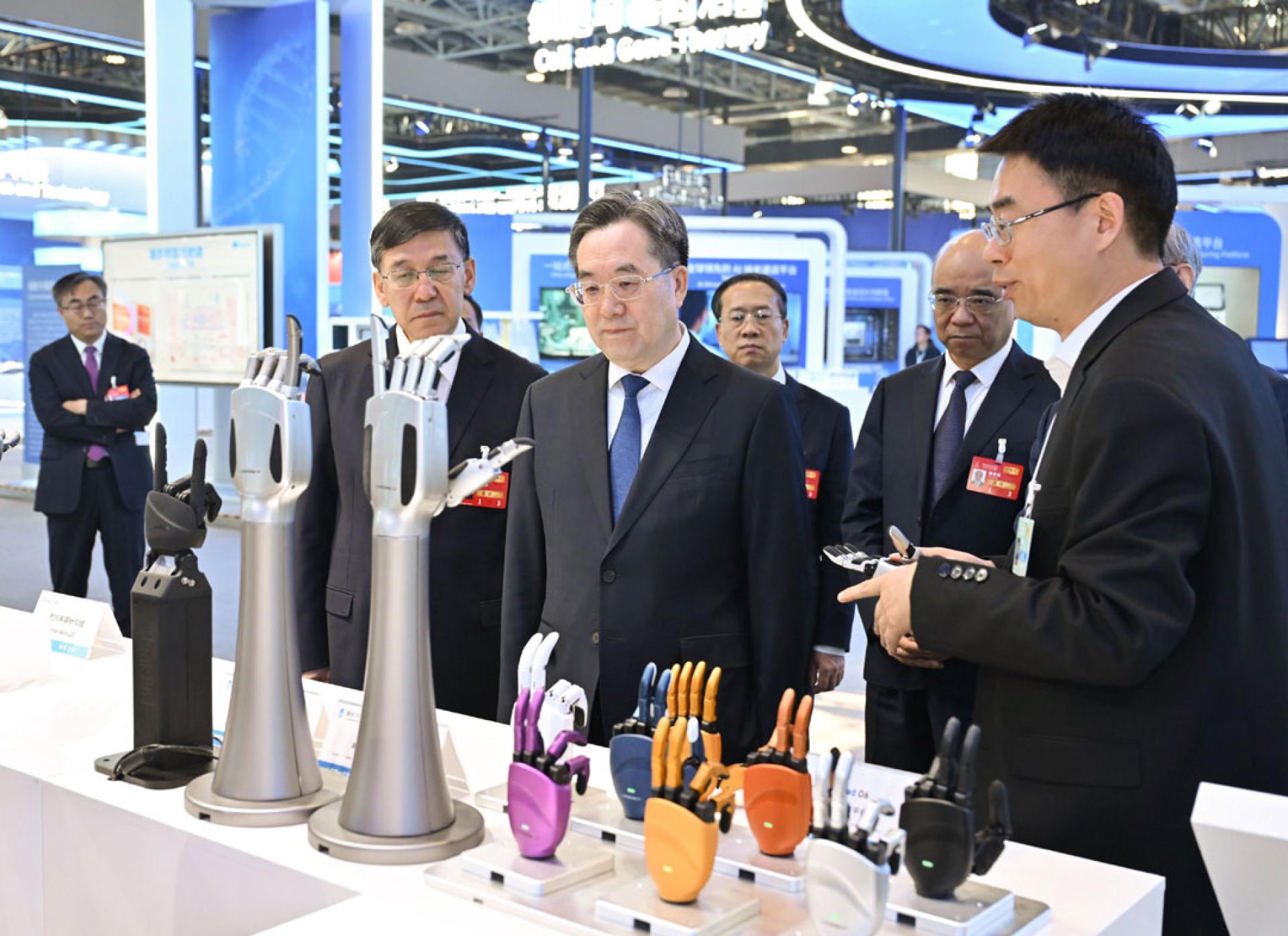
Chinese Vice Premier Ding Xuexiang said that China is willing to work together with all parties to jointly build a global science and technology community, and put forward three suggestions, including promoting more equitable and benevolent technology governance and properly addressing rule conflicts that may arise from technological development.
According to China News Service, the 2026 Zhongguancun Forum Annual Conference opened in Beijing on the 25th, with Ding Xuexiang attending the opening ceremony and delivering a speech. Ding Xuexiang said that during the just-concluded 14th Five-Year Plan period, China's science and technology sector made new significant achievements, the country's technological strength was greatly enhanced, and its influence as an important pole of global innovation was significantly increased.
Ding Xuexiang said that in the 15th Five-Year Plan period, China will accelerate the achievement of high-level scientific and technological self-reliance and self-strengthening, focus on building an international science and technology innovation center, and create an important strategic pillar for building a strong science and technology nation. He said that Chinese President Xi Jinping, at last year's Central Economic Work Conference, announced the expansion of the Beijing International Science and Technology Innovation Center to cover the Beijing-Tianjin-Hebei region, and the Shanghai International Science and Technology Innovation Center to cover the Yangtze River Delta. Major deployments have been made regarding the construction of the three major international sci-tech innovation centers.
Ding Xuexiang stated that the Beijing-Tianjin-Hebei region, the Yangtze River Delta, and the Guangdong-Hong Kong-Macao Greater Bay Area are the three main engines driving China’s high-quality development. Concentrated efforts in these three regions to promote the construction of international science and technology innovation centers, shifting from city-wide breakthroughs to integrated regional development, is beneficial for achieving coordinated resources, layered policies, collaborative strengths, and complementary advantages—forming excellent sources of scientific and technological innovation, high-end industry leadership, and the aggregation of scientific and technological resources and talent, and playing a better leading, exemplary, and radiating role in the process of Chinese-style modernization.
He said support will be given to building the Beijing (Beijing-Tianjin-Hebei) International Science and Technology Innovation Center into a globally significant scientific and talent hub and a highland for innovation.
Ding Xuexiang also stated that China is willing to work together with all parties to jointly build a global science and technology community. He put forward three suggestions: First, to build a more open and inclusive innovation network and tighten the cooperative ties among various innovation entities; second, to carry out broader and more diverse scientific and technological cooperation, strengthen collaborative basic research in frontier science and the application of emerging technologies, and empower the economic and social development of all countries; third, to promote more equitable and benevolent technology governance, and properly address rule conflicts, social risks, and ethical challenges that may arise from technological development.