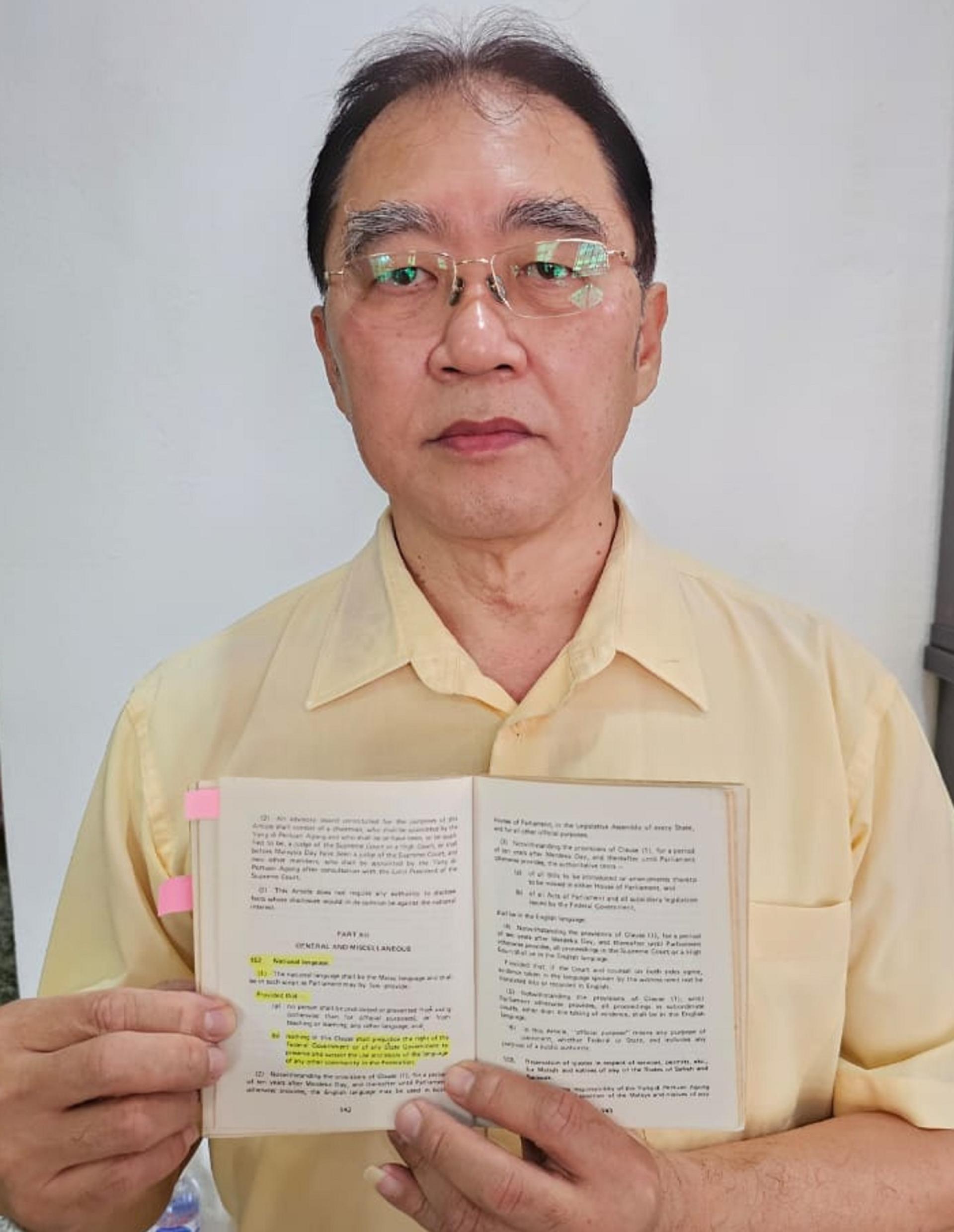
(Kuching, 14th) People's Justice Party Kuching Division Chairman, lawyer Wong Kim Hwa, today urged Prime Minister Dato’ Seri Anwar to follow the example of the two East Malaysian states, Sarawak and Sabah, in recognizing the Unified Examination Certificate (UEC) from Chinese independent schools, in order to realize the unity and integrity of Malaysia’s diverse education and to demonstrate the Madani government's practice of its progressive education policy.
He pointed out that the recognition of the UEC by Sarawak and Sabah has already proven the resilience of the East Malaysian people in valuing and recognizing the importance and necessity of the UEC.
He said supporting the development of mother tongue education allows it to reach the world, and is true practice of Malaysia’s reality as a multiracial, multi-education country.
Wong Kim Hwa today expressed his full support for the Democratic Action Party's call for the government to fulfill its election promise to recognize the Unified Examination Certificate (UEC) of Chinese independent high schools and made the above appeal.
He said Malaysia is a multi-ethnic country, and the mother tongue development of different ethnic groups is in line with our Constitution, which under its protection, Malaysian children have the freedom and right to learn and develop education in their mother tongue.
Wong Kim Hwa pointed out that Article 152(1) of the Malaysian Constitution states that the national language is Malay, but as provided by law enacted by Parliament:
a. No person shall be prohibited or prevented from using (other than for official purposes), teaching, or learning any other language;
b. Nothing in this Clause shall preclude the Federal Government or any State Government from preserving and sustaining the use and study of the language of any other community.
Moreover, in Pakatan Harapan's 2022 election manifesto, it was stated that the UEC would be recognized, with the condition that candidates must achieve at least a credit in Bahasa Malaysia in the SPM examination as a qualification to apply for local universities or institutions of higher learning.
Clearly, Pakatan Harapan’s election manifesto already stipulated that recognition of the UEC must be based on at least a credit in Bahasa Malaysia, which demonstrates it will not affect the status of the national language.
Therefore, recognizing the UEC respects the Constitution while upholding the position of the national language, and fully aligns with the circumstances of Malaysia’s multiracial society.
Wong Kim Hwa said the United Chinese School Committees' Association of Malaysia (Dong Zong) has also published an updated list of global universities accepting the UEC as of July this year, including universities in China, Hong Kong and Macau, Taiwan, Singapore, the UK, Australia, Ireland, New Zealand, Canada, the US, the Netherlands, Japan, etc., which have successively recognized the UEC from Malaysia’s Chinese Independent High Schools (MICSS), with many taking the UEC as a university admission requirement.
In addition, some universities have signed cooperation agreements with Dong Zong or independent schools in Malaysia, offering generous scholarships to outstanding independent secondary school students; to date, many Malaysian independent high school graduates have gone on to further their studies in many countries around the world.
This shows that the Chinese independent school certificate has a certain status internationally.
Under such a unique multi-stream education policy, independent school students are able to simultaneously study Chinese, English, and Malay, thus broadening and deepening their knowledge fields.
For decades, Chinese independent high schools have cultivated tens of thousands of graduates with a foundation in three languages, making positive contributions to the country’s development.
Wong Kim Hwa stressed that comprehensive recognition of the UEC is the true practice of the ideals of Malaysia Madani politics, and further implements the principles of multiracialism and multistream education advocated by the nation, Pakatan Harapan, and the People’s Justice Party.
He pointed out that the recognition of the UEC by Sarawak and Sabah has already proven the resilience of the East Malaysian people in valuing and recognizing the importance and necessity of the UEC.
He said supporting the development of mother tongue education allows it to reach the world, and is true practice of Malaysia’s reality as a multiracial, multi-education country.
Wong Kim Hwa today expressed his full support for the Democratic Action Party's call for the government to fulfill its election promise to recognize the Unified Examination Certificate (UEC) of Chinese independent high schools and made the above appeal.
He said Malaysia is a multi-ethnic country, and the mother tongue development of different ethnic groups is in line with our Constitution, which under its protection, Malaysian children have the freedom and right to learn and develop education in their mother tongue.
a. No person shall be prohibited or prevented from using (other than for official purposes), teaching, or learning any other language;
b. Nothing in this Clause shall preclude the Federal Government or any State Government from preserving and sustaining the use and study of the language of any other community.
Moreover, in Pakatan Harapan's 2022 election manifesto, it was stated that the UEC would be recognized, with the condition that candidates must achieve at least a credit in Bahasa Malaysia in the SPM examination as a qualification to apply for local universities or institutions of higher learning.
Clearly, Pakatan Harapan’s election manifesto already stipulated that recognition of the UEC must be based on at least a credit in Bahasa Malaysia, which demonstrates it will not affect the status of the national language.
Therefore, recognizing the UEC respects the Constitution while upholding the position of the national language, and fully aligns with the circumstances of Malaysia’s multiracial society.
Wong Kim Hwa said the United Chinese School Committees' Association of Malaysia (Dong Zong) has also published an updated list of global universities accepting the UEC as of July this year, including universities in China, Hong Kong and Macau, Taiwan, Singapore, the UK, Australia, Ireland, New Zealand, Canada, the US, the Netherlands, Japan, etc., which have successively recognized the UEC from Malaysia’s Chinese Independent High Schools (MICSS), with many taking the UEC as a university admission requirement.
In addition, some universities have signed cooperation agreements with Dong Zong or independent schools in Malaysia, offering generous scholarships to outstanding independent secondary school students; to date, many Malaysian independent high school graduates have gone on to further their studies in many countries around the world.
This shows that the Chinese independent school certificate has a certain status internationally.
Under such a unique multi-stream education policy, independent school students are able to simultaneously study Chinese, English, and Malay, thus broadening and deepening their knowledge fields.
For decades, Chinese independent high schools have cultivated tens of thousands of graduates with a foundation in three languages, making positive contributions to the country’s development.
Wong Kim Hwa stressed that comprehensive recognition of the UEC is the true practice of the ideals of Malaysia Madani politics, and further implements the principles of multiracialism and multistream education advocated by the nation, Pakatan Harapan, and the People’s Justice Party.