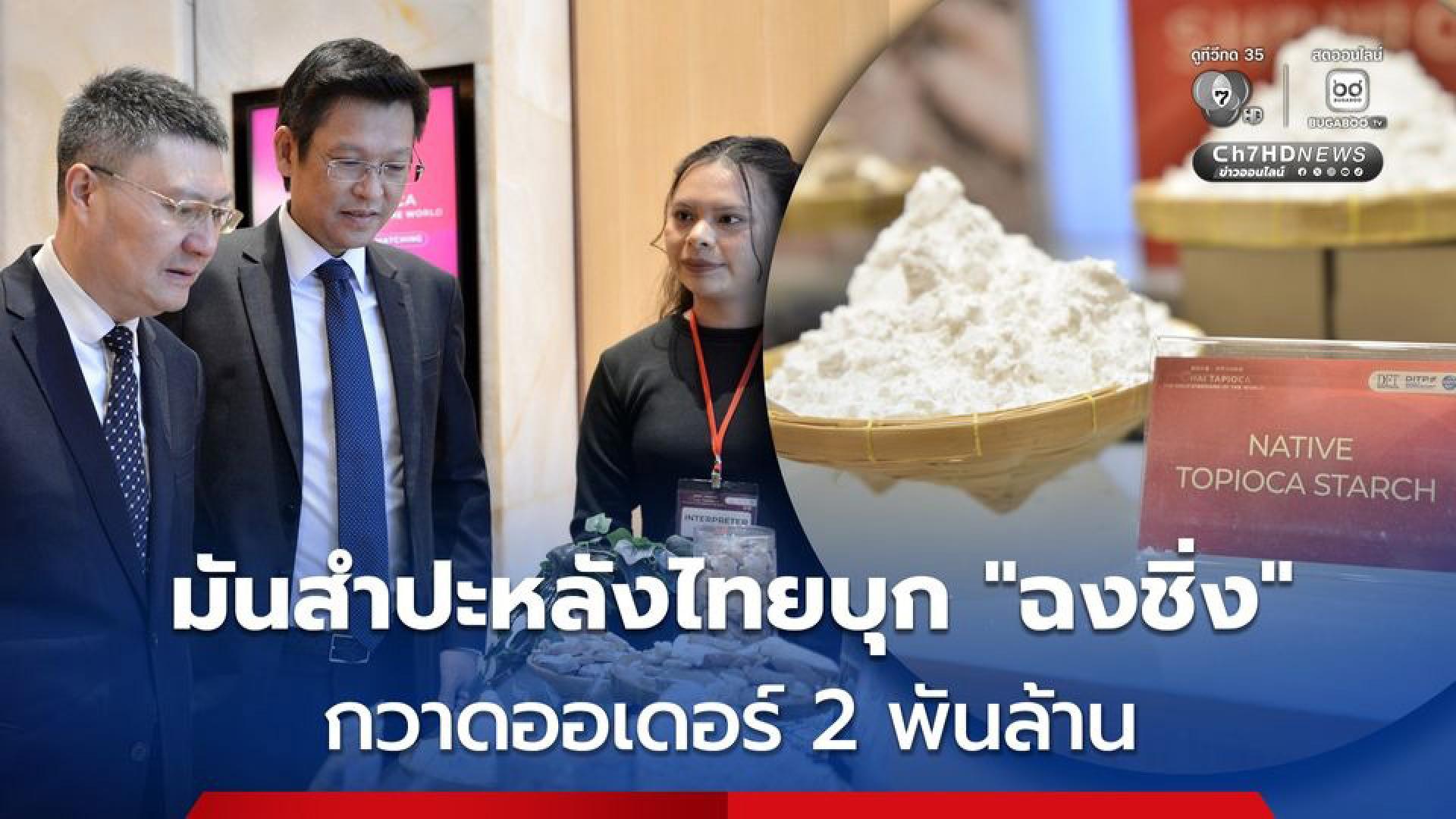
On April 20th, Arada, Director-General of Thailand's Department of Foreign Trade, revealed that Deputy Director-General Noppadon led a delegation of 22 cassava industry enterprises to Chongqing, China on April 8th. There, they held business matching talks with 34 Chinese importers, successfully expanding the export of Thai cassava to this new market in western China. Previously, Thailand had never engaged in trade negotiations with western China. As an important city in the region, Chongqing is regarded as having significant economic and industrial growth potential thanks to China’s Western Development Policy.
During this round of business matching talks, Thai participants conducted in-depth discussions with Chinese importers from the food, feed, logistics supply chain, and related downstream industries. The Thai delegation also emphasized the outstanding quality of Thai cassava by presenting product samples, which received high recognition from the Chinese side, who expressed a willingness to import Thai cassava as a raw material for various industries in China.
Arada pointed out that China is the largest export market for Thai cassava, currently concentrated mainly in the eastern regions. However, driven by population growth and urban development in western China, demand for consumer goods and industrial raw materials continues to rise. With ongoing improvements in infrastructure and logistics systems in China, shipping goods from Thailand has become more convenient than before. The results of this business matching event have been fruitful: the Chinese side affirmed the quality standards of Thai cassava and demonstrated strong willingness to import.
It is estimated that in the coming year, orders for Thai cassava starch will reach a value of US$32.442 million (about MYR 128.37 million), and orders for cassava chips and pellet products will amount to US$30.81 million (about MYR 121.91 million), for a total of US$63.252 million (about MYR 250.29 million). This marks an important step in successfully expanding Thailand's cassava market into western China. The Department of Foreign Trade will closely monitor this development and continue to promote steady growth in both the volume and value of Thai cassava exports.
Arada further added that the delegation visited the Chongqing International Land-Sea Supply Chain Exhibition Center on April 9 to inspect the logistics system. This center is a major logistics hub in western China, integrating cargo collection and distribution, transshipment, and multimodal transport, and is closely linked with China's Belt and Road Initiative. Its infrastructure is fully capable of supporting international trade and investment. Additionally, the delegation observed various modes of water, rail, and road transportation on site, which connect western China with other regions, ASEAN, Central Asia, and Europe. This can greatly shorten the time for Thai products to enter the western Chinese market and reduce costs, enhancing overall competitiveness. The fruitful outcome of this business matching event fully demonstrates that the policies of the Ministry of Commerce and the Department of Foreign Trade have been effective in promoting the sustainable and stable development of Thai agricultural products in international markets.