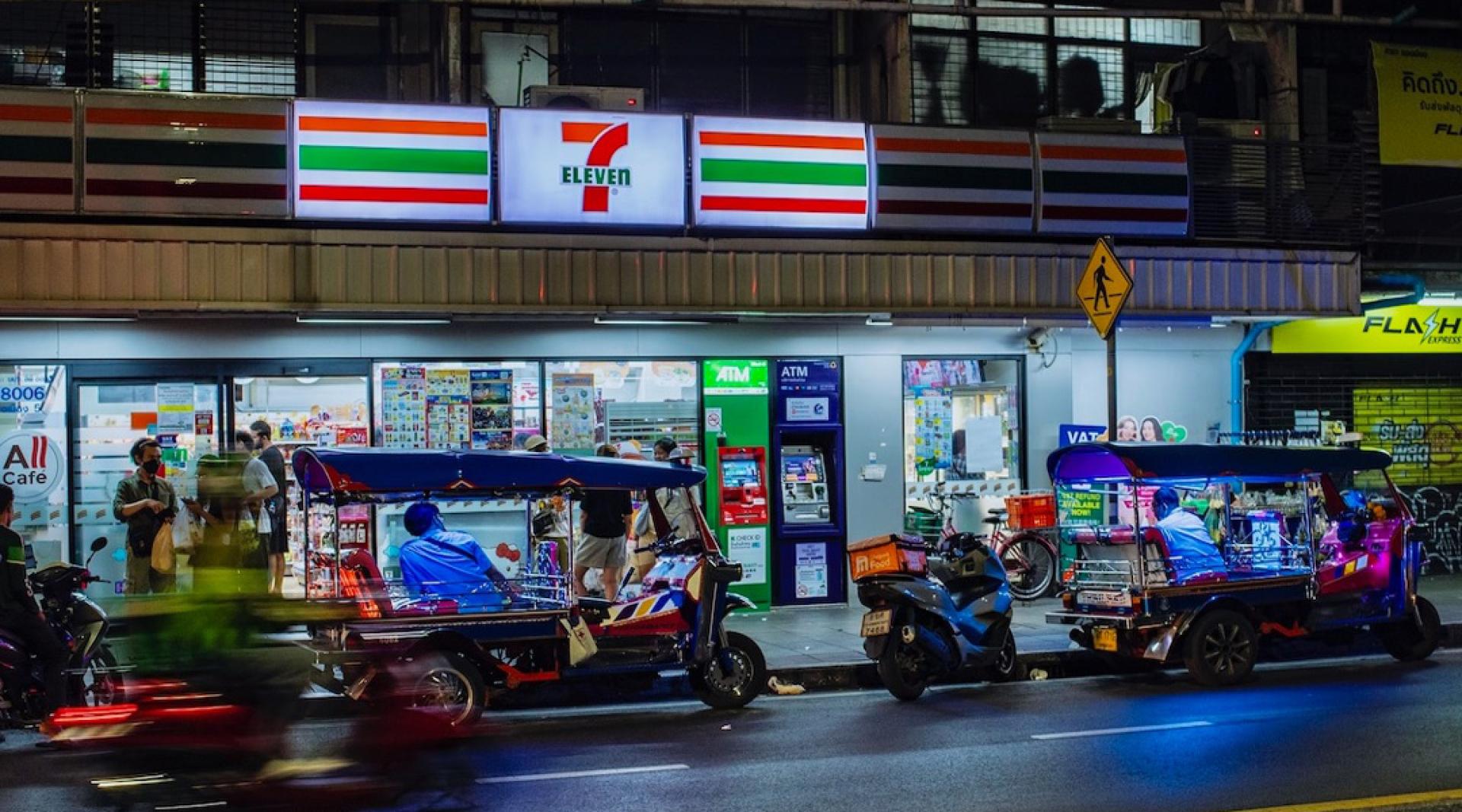
The world's largest convenience store chain brand, 7-Eleven, recently released its global store data for 2026. As of 2026, the total number of 7-Eleven stores in more than 20 countries worldwide has exceeded 85,000, with Thailand ranking second in terms of store count.
According to Thai Headline News, statistics show that the top five countries in terms of the number of 7-Eleven stores globally in 2026 are as follows: Japan firmly holds the top spot with over 21,600 stores; Thailand ranks second with more than 14,800 stores; the United States comes in third with more than 12,300 stores; South Korea is fourth with 11,000 stores; and the Philippines is fifth with more than 5,000 stores.
In Thailand, 7-Eleven stores are operated by CP ALL, which belongs to the Charoen Pokphand (CP) Group. After years of expansion, stores have now covered all 77 provinces nationwide, penetrating not only core urban business districts but also being widely distributed across communities, near schools, office buildings, and gas station networks, forming a "high-density, strong-penetration" network structure.
Convenience stores have become an indispensable part of daily life for the people, maintaining rapid expansion in both tourism cities and second-tier provinces. Analysts believe that the success of the Thai market lies in the combination of highly standardized management and a strong supply chain system with localized product innovation, achieving simultaneous growth in scale and efficiency.
In Thailand, 7-Eleven stores are operated by CP ALL, which belongs to the Charoen Pokphand (CP) Group. After years of expansion, stores have now covered all 77 provinces nationwide, penetrating not only core urban business districts but also being widely distributed across communities, near schools, office buildings, and gas station networks, forming a "high-density, strong-penetration" network structure.
Convenience stores have become an indispensable part of daily life for the people, maintaining rapid expansion in both tourism cities and second-tier provinces. Analysts believe that the success of the Thai market lies in the combination of highly standardized management and a strong supply chain system with localized product innovation, achieving simultaneous growth in scale and efficiency.