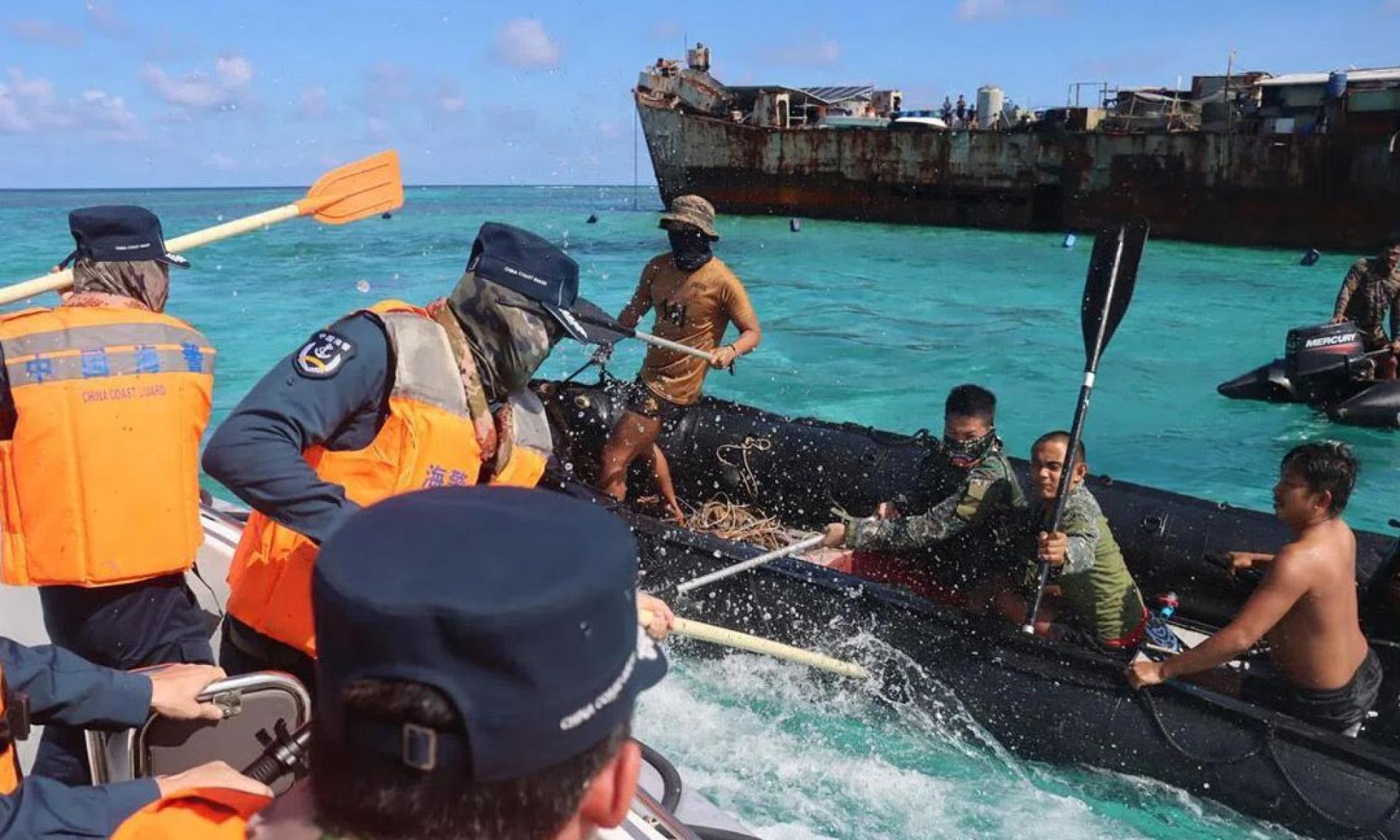
Chinese Foreign Minister Wang Yi will travel to Manila this week to attend the ASEAN Foreign Ministers’ Meeting, where he is expected to hold the first bilateral meeting in two years with Philippine Foreign Secretary Lazaro. However, the two countries faced off on Monday near the disputed Ren’ai Reef in the South China Sea (referred to as Ayungin Shoal by the Philippines), each accusing the other of provocation; the Philippines alleges Chinese coast guard personnel assaulted Philippine personnel, while China counters that the Philippine side is “distorting facts and making false accusations against China.”
Experts interviewed believe that the latest maritime conflict will further heighten tensions between China and the Philippines, but it is not expected to affect the foreign ministers’ meeting. Although a resolution to the South China Sea dispute is unlikely in the short term, both sides hope to manage their differences and prevent maritime friction from escalating into a more serious conflict.
The Philippines is hosting the ASEAN Foreign Ministers’ Meeting and related meetings this week. According to the website of the Philippine Presidential Communications Office and Bloomberg News, Philippine Foreign Ministry spokesperson Imperial stated that the Philippine foreign secretary would chair a series of meetings between ASEAN and its dialogue partners, including the United States, China, South Korea, the European Union, Japan, India, Australia, New Zealand, Canada, Russia, and the United Kingdom.
Imperial also stated that Wang Yi will attend the ASEAN–China Foreign Ministers’ Meeting, and the Chinese and Philippine foreign ministers are expected to meet during the conference. He said the Philippines considers this meeting “very important,” as it involves not only bilateral relations but also discussions of the regional situation and its impact on ASEAN. “Therefore, we are looking forward to this.” China’s Ministry of Foreign Affairs also announced on Monday that Wang Yi would be attending the China–ASEAN Foreign Ministers’ Meeting in Manila on Wednesday.
China and the Philippines have experienced frequent friction recently. In May, Japan and the Philippines announced the commencement of negotiations on the delimitation of their Exclusive Economic Zones (EEZ) and continental shelves, sparking dissatisfaction in Beijing. On July 12, the 10th anniversary of the South China Sea arbitration case, China’s Ministry of Foreign Affairs reiterated that the ruling is “illegal and null and void”; state-run Chinese media quoted several scholars as suggesting that Beijing should consider claiming sovereignty over the Batanes Islands in northern Philippines, asserting that these islands “legally belong to our Taiwan island.”
In recent days, the two sides have also been embroiled in a diplomatic dispute over an AI-generated video released by Chinese state media. On July 10, China Daily posted a video on social media that depicted a monkey dressed in traditional Filipino attire, insinuating that the Philippines obeys the United States and Japan, with content covering the Japan-Philippines maritime boundary negotiations and the South China Sea arbitration. The Philippine foreign ministry criticized the video as “denigrating, dehumanizing, and racist,” lodged a protest with the Chinese ambassador in Manila, and requested the video’s removal; China’s foreign ministry responded that the online video was not an official act and declined to comment further.
The latest maritime incident occurred Monday morning in the waters near Ren’ai Reef.
Li Mingjiang, Senior Fellow affiliated with the S. Rajaratnam School of International Studies in Singapore, told Lianhe Zaobao that the latest maritime clash is not expected to impact the foreign ministers’ meeting, as both parties’ willingness to meet suggests a desire to limit losses in bilateral relations. He believes Beijing will use the meeting to express its concerns over the Philippines’ increasing cooperation with the US and Japan, while as ASEAN’s rotating chair this year, the Philippines will also need to maintain communication with Beijing if it wishes to promote progress in ASEAN–China cooperation.
However, Li believes that as the Philippines continues to deepen its security cooperation with the US and Japan, China is unlikely to make significant progress on a “South China Sea Code of Conduct” agreement this year; the more realistic short-term goal for China and the Philippines is to manage differences and prevent maritime friction from escalating, though tensions in the South China Sea will likely continue.
Zhu Feng, Dean of the School of International Relations at Nanjing University, also believes that the willingness of Chinese and Philippine foreign ministers to meet is in itself a positive sign, showing both sides hope to reduce the risk of conflict through diplomatic channels.
He anticipates that Wang Yi is also very likely to meet with US Secretary of State Rubio in Manila. Given the current regional situation, both China and the US want to prevent further deterioration in the Western Pacific, and strengthening diplomatic communication and managing potential conflicts is in the interests of both sides.