Thailand's General Election Voting on the 8th: Orange, Blue, Red Tripartite Competition
Published atFeb 07, 2026 11:51 am
The election for Thailand's House of Representatives will be held on February 8, with a new prime minister soon to emerge. This election has distinctive features and many points of interest. According to current poll analyses, it is unlikely that any single party will win enough seats to form a government alone, so the formation of the new cabinet will likely require ‘combinations and permutations’.
Xinhua News Agency comprehensive report: According to statistics from Thailand's Election Commission, a total of 57 parties are competing for 500 seats in the lower house (House of Representatives), and more than 90 prime ministerial candidates have been nominated. The official vote-counting results must be announced by April 9 at the latest. The new parliament must convene within 15 days to elect a Speaker, after which the lower house will vote to select a new Prime Minister. 为泰党首相候选人约查南。● Bhumjaithai Party Focuses on National Security and Economic Stimulus Policies
Since the announcement in December last year of an early House of Representatives election, Thailand’s major parties have been actively campaigning nationwide. On the evening of February 6, the main parties held large rallies at different locations in central Bangkok to play their final cards in a bid to win as many votes as possible.
The general public opinion holds that the main contenders remain Bhumjaithai Party, Move Forward Party, and Pheu Thai Party. Bhumjaithai, as the conservative party, emphasizes national security and economic stimulus; the Move Forward Party, as the radical reformist, advocates structural reforms and curbing the influence of the military and monarchy; while Pheu Thai Party, still branded by its connection to Thaksin, primarily advocates economic recovery.
A recent poll by the National Institute of Development Administration shows that the Move Forward Party is temporarily leading with 33.56% support, followed by Bhumjaithai Party and Pheu Thai Party with 22.76% and 16.92% respectively. These three parties are represented by orange, blue, and red respectively, and some experts have called this electoral landscape a ‘tripartite stand-off of orange, blue, and red’. 人民党党首相候选人那他蓬。● Move Forward Party's Reform Position Seen as Radical
Phichai Phongsawad, associate professor at Chulalongkorn University's Faculty of Political Science, believes that Move Forward Party is likely to again become the largest party in the lower house, but its overly radical reform stance might lead to a repeat of its predecessor Future Forward Party’s fate—winning but still unable to form a government.
Jingsa Charoenwongsa, director of Thailand’s Institute of International Development, predicts that Bhumjaithai Party could possibly rise as the largest party in this election. He believes the party is highly likely to form a cross-camp coalition government with Pheu Thai and other smaller parties, while the Move Forward Party may again become the opposition.
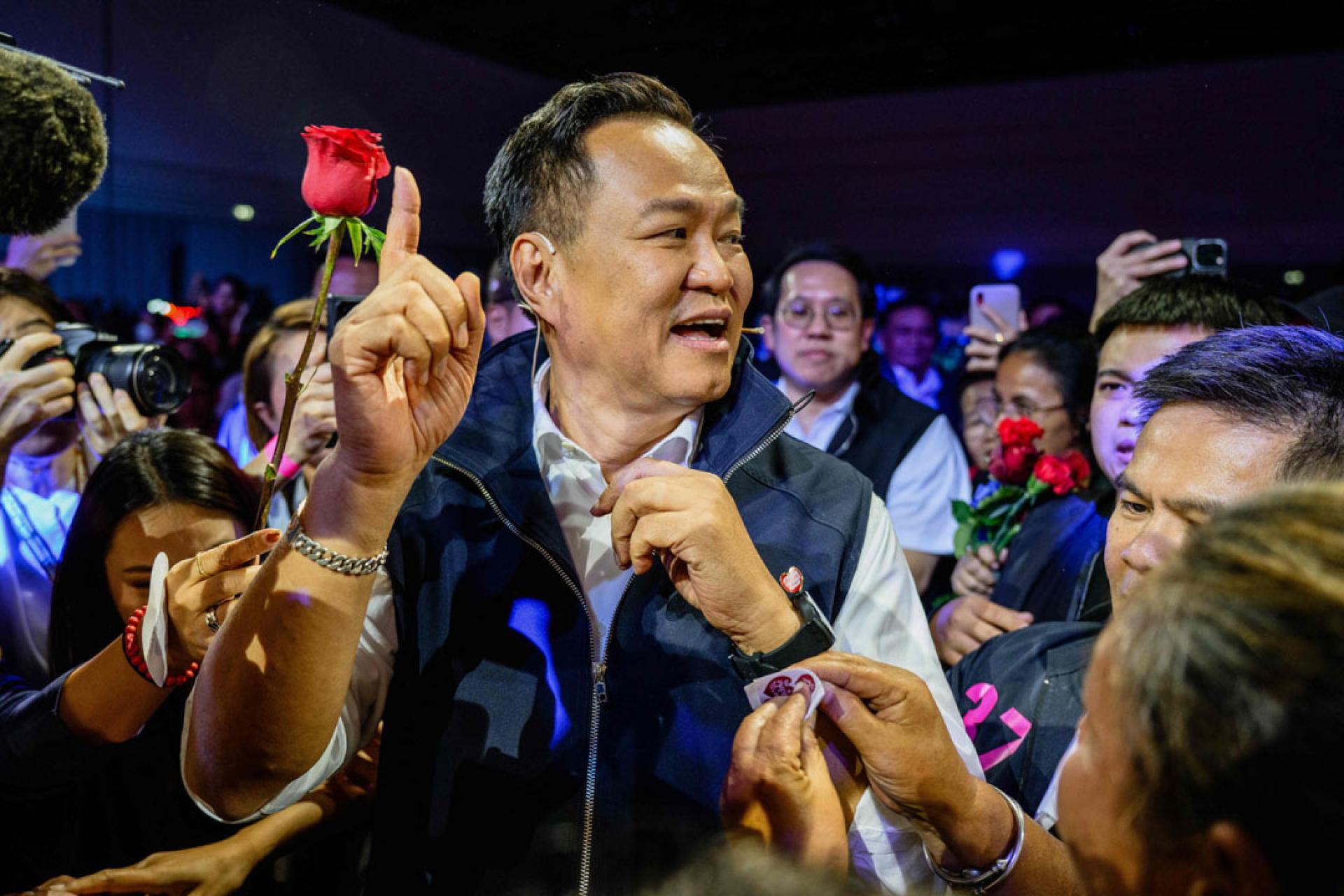
Other experts point out that as Bhumjaithai Party’s Prime Ministerial candidate, Anutin has significant advantages in consolidating local forces, controlling political resources, and coordinating across camps. Even if Bhumjaithai does not become the largest party in the lower house, he is still a most competitive candidate for Prime Minister.
In contrast to the high-profile campaigning by major parties, Thai voters are generally becoming more rational. Analysts believe the public is more concerned with whether the parties and their PM candidates can put forward pragmatic policies to improve livelihoods. They generally expect the new government to introduce concrete measures to reduce living burdens and focus on fostering new engines of economic growth.
● Youth Voters’ Movements Worth Watching
Recent polls show that nearly a quarter of voters have yet to decide on a candidate, reflecting public hesitation and dissatisfaction with current political options. According to a pre-election poll by Thailand’s The Nation, increasing employment and income, and lowering living costs are voters’ top two priorities for the new government’s first 100 days, followed by fighting corruption and easing household debt.
Among different voter groups, the movements of youth voters are particularly worth watching. The Bangkok Post noted that this year around 2.3 million young voters are expected to participate in an election for the first time. They are more concerned with educational equity, job opportunities, environmental protection, and basic welfare.
Public opinion holds that this election is likely to bring forth a coalition government marked by compromise. Whether the new government can effectively address core concerns like job creation, lowering prices, and debt reduction—and whether campaign promises can be turned into sustainable public policy—will largely determine its prospects for governance and political stability.
This article has been translated using our AI technology. While we strive for accuracy,
AI translations
may contain errors. For the most precise information, please refer to the original article.