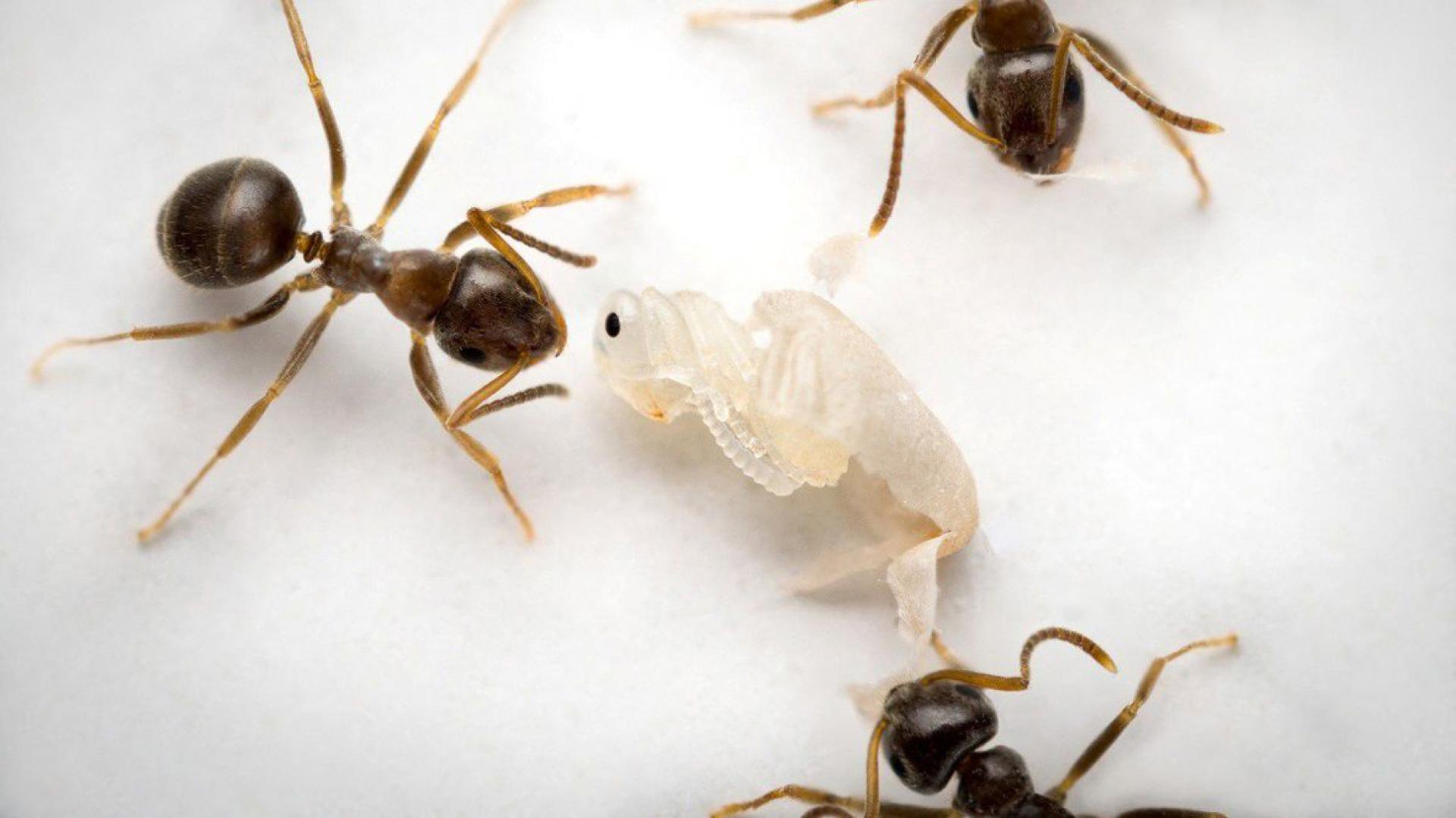
Ants are highly organized social insects, and according to an Austrian study, even young ants possess the spirit of self-sacrifice. When infected with deadly diseases, they actively release a scent 'requesting death' to prevent the spread of the disease and protect the survival of the entire colony. However, there is an exception in the colony: pupae destined to become queen ants do not exhibit this self-sacrifice.
AFP reported on the 2nd that ant colonies are like "superorganisms," with the survival of the group outweighing the individual, and they work together for the survival and reproduction of the whole. Dawson, a behavioral ecologist at Austria's Institute of Science and Technology (ISTA), explained that within an ant nest, thousands of ants crawl around and come into contact with one another, making it an ideal breeding ground for disease. When adult worker ants fall ill and risk spreading disease within the nest, the sick worker ant will leave the colony and die alone to prevent the whole group from being infected.
Dawson pointed out that ants in the pupal stage are still inside their cocoon and cannot actively maintain social distance like adults. Previous research has found that when these pupae are infected and facing death, their chemical composition changes, releasing a specific scent that attracts worker ants to remove the pupa. The worker ants will first tear open the infected pupa's cocoon and create holes in it to inject venom. This venom acts as a disinfectant, killing pathogens that threaten the entire nest, but at the same time, it also causes the host larva to die.
Dawson led this new study to explore whether this "kill me" signal is intentionally released by the pupae. Researchers experimented with the small black garden ant Lasius niger, sampling scents from infected pupae and applying them to healthy ones. As a result, worker ants would also destroy the healthy pupae covered in the scent. The research team continued experimenting and found that infected pupae only release the chemical scent signal when worker ants are nearby, indicating it is a deliberate "request for death" signal.
Dawson said: "It's a form of sacrifice, an altruistic behavior, but it's also in their own interest, since it preserves their genes for the next generation."
However, the study also found that there is one category of member in the nest that does not exhibit this self-sacrificing behavior: pupae that will become future queens. When these queen-destined pupae are infected, they do not release the same scent signals. Dawson noted that the research team originally suspected these future queens might be "cheating," but further experiments showed that "queen pupae have much stronger immune systems than worker pupae and can fend off infections." The research thus concludes that this is why queen pupae do not need to send out a 'request for death' signal.
This research report was published in the journal Nature Communications. Dawson hopes that future research will further explore whether queen pupae will resort to self-sacrifice when faced with infections they cannot overcome.